Saturday, June 24, 2006

Good Analysis of the Coalition Deal

RFE's Jan Maksymiuk did a helpful piece explaining the basics of the coalition agreement here.

In the second, more analytical part of the piece, he sounded one warning I completely agree with:
Our Ukraine's proposal that Petro Poroshenko, Tymoshenko's fiercest enemy in the 2005 feud within the then-Orange coalition, take the post of parliamentary speaker seems to be an ill-advised "parliamentary check" on Tymoshenko as the head of the cabinet. There is a great likelihood that the former rivalry between these two might start anew, plunging the new coalition once again into recriminations and quarreling.
. . .Have not had time to do any blogging or vlogging this week after getting back from my trip, as Latvia "goes nuts" celebrating the Summer Solstice this week every year, and I have been very busy either performing myself this week with the folk group Skandinieki or looking after Julija while her mama performs . . .am recovering today from an all-night celebration of Solstice with the Skandinieki and their friends. . .Latvians often refer to Summer Solstice as Ligo or Jaņi (as Ukrainians call it Ivana Kupala, the first name coming from the Xtian calender/attempt to co-opt the pre-Xtian holiday). . .Ligo is one of the best times of the year to visit Latvia, especially if you can celebrate it with pagany, spiritual, folkloristic, nationally-oriented Latvians, rather than with those just looking for an excuse to party. . .but party and drink we did, along with the deep spirituality of the event!

Tuesday, June 20, 2006

2 Articles

I am back from my little Central to Eastern Europe adventure--Riga to Vienna to Budapest to Kyiv to Riga--and will have something to write about it, maybe, in the future.

For now, two good Kyiv Post op-eds worth reading if you have not:

How to understand Ukrainian President Viktor Yushchenko

by Taras Kuzio, rather (correctly) scazing about the man once thought to be contemporary Ukraine's savior

Ukrainians are not that easily fooled
(good analysis of Tymoshenko's past and personality that clarifies why she should be given another chance)

I read somewhere the other day that Our Ukraine had proposed Poroshenko as speaker;if true, that is f**in' ridiculous. Zvarych, Bezsmertnyj and Poroshenko. . .blah

Wednesday, May 31, 2006

Excellent Commentary: Lessons of Germany's Grand Coalition for Ukrainian Process

If you get it, the most recent e-poshta (for May 31, 2006; you can join by writing to myroslava_e-poshta-canadaus@yahoogroups.com)

this week has an excellent commentary on the lessons that the recent Grand Coalition building process in Germany has for Ukraine. Many commentators, including from Our Ukraine and Yushchenko, have been making this comparison.

The major points of the commentary were thus (which are points I and others have been making in the Ukrainain blogosphere, in our various ways):

On the German model, Our Ukraine must accept that they lost the right to name the PM within a reform-oriented, pro-democracy coalition and must accept Tymoshenko's demand for the PM post. Merkel demanded the SPD's acceptance of her as PM before beginning talks on a guiding government program/policy, and the SPD, which like Our Ukraine was stunned by its defeat, initially resisted but eventually gave in. Our Ukraine should accept Tymoshenko's premiership, THEN talk about a specific program.

Second, Tymoshenko and her cadre then must proceed to divide posts reflecting relative states of electoral preference, agree to respect the president and his party, and work hard to compromise on a specific program and, once that program is in place, they MUST stick to it.

Now the following is my point, though it was hinted at in the piece: Though I share some doubt over whether Tymoshenko is a principled politician and populist or people's politician--i.e., whether she is not just an overly ambitious and glamorous loudmouth and de facto crony capitalist--she must be given a chance to demonstrate her sincerity once again. She will, as I have said in many other places, have to check her ambition and her stubbornness and will have to give-in on a variety of matters. And there are those who would argue that she has indeed attempted to strike a much more conciliatory tone toward Ukraine's free-market liberals and even, to some extent, the oligarchs.

The final issue hinted at in the piece: what was not done in the German case and what can not be repeated in the Ukrainian one is creation of a government with more than one center of power. I still blame Yushchenko squarely for the failure of his first government because of this, and his pal Poroshenko next.

I could not cut and paste the e-poshta article, as I am writing from an internet club in Vienna and the computer here, for some reason, is not letting me cut and paste.

My cousin, born and raised in Germany and grandson of Lev Rebet, the social-democratic oriented ideologue of the OUN, is getting married here in a famous Uniate Cathedral that is symbolic, for Ukrainian Uniates, of Maria Theresa's patronage of things Ruthenian.

Tuesday, May 30, 2006

Video: The Mill and the Peasants


Watch the video

This is more footage from the town of Pidhajtsi in Western Ukraine, shot in August, 2005.

If a peasantry is a population bound to and dependent for survival upon the land through various means that grossly benefit local or not-so-local lords while keeping the individual farmer more or less locked in his/her place--such as via outright serfdom or through credit arrangements and dependency on local "lords" to pay out some cash—then the cash-crop and subsistence farmers of Western Ukraine qualify as a contemporary, postmodern peasantry of the latter sort.
In the previous two posts I have briefly discussed the plight of the people/farmers of the Western Ukrainian countryside. Here I continue: This is footage of men loading sacks of processed wheat flour into their wagons and tractors (see previous post for a comment about the persistence of wagons in the Ukrainian countryside).

There are three main cash-crops that people sell in Pidhajtsi and throughout the Western Ukrainian countryside; in order of economic relevance (i.e., in order of what is most lucrative for the peasant household), they are: sugar beet, wheat, and cow's milk. Each of these crops are harvested by the peasant household and brought elsewhere to be processed. Cow’s milk and wheat are brought to local processing plants where they are made, in the case of milk, into cheese, creams, pasteurized milk, etc., and into processed flour in case of the wheat. Sugar beets are brought to a burjakpunkt or drop-off point from whence they are hauled elsewhere to be processed into sugar. All of the sugar in Ukraine comes from sugar beets.

Each family has roughly 1.5 hectare of land in the fields. Nearly all of the work is done by hand using rudimentary, though time-honored, implements and little or no modern machinary. In addition to the aforementioned cash-crops (there are sometimes others, but those are the main ones) a typical household raises foodstuffs for home consumption: red beets, yellow beets (for feed), corn (for feed), potatoes and a variety of other vegetables and herbs. There is a common plumb-and-apple orchard and most homesteads have apple trees, while some have plumb and cherry trees and berry bushes. Plumbs, though certainly good for eating and commonly used in pastries, is also necessary for making the local samohonka or moonshine, which usually is not a vodka or horylka (the Ukrainian word for vodka), but a plumb-brandy called, in this part of Ukraine, slivjanka. (Note: plumb-brandy is called slivovitsa by other peoples of Eastern Europe, and sometimes rakija in the Balkans; to Hungarians, it is palinka). It is also important to note that just about every household has either one cow or a goat for milk from which creams and cheeses are made, and plenty of fowl (as shown in a previous post).

Just a few American families employing American agribusiness technology could farm the land around Pidhajtsi; instead, the land supports about 7-8,000 people, if you include the nearby villages as "suburbs” of Pidhajtsi (Ukrainians live clustered into towns and villages with the fields surrounding the settlements). Many analysts complain that Ukraine’s agricultural potential is massively underdeveloped.

When farmers take their foodstuffs to be processed, they are repaid by the factories not in cash but in barter: they receive a cut of the final processed goods made from their beets/wheat/milk. A portion of the processed goods go for home consumption; the rest is sold whenever the need for cash arises at a local, weekly market (every Thursday in Pidhajtsi). In this footage, the men are loading their share of the processed flour made from their wheat.

Sugar beets yield sacks of sugar, and milk yields pasteurized milk or other processed dairy products. With the wheat, people will bake their own bread at home and will use the sugar that was the fruit of their own labor. The processed, pasteurized dairy products often go to market, as most villagers use milk straight from the cow in their own diets.

I was universally told by people in Pidhajtsi that it is not worth it for anyone to bring milk to the dairy factory unless one has at least three or more cows. Thus, in the afternoon you can see Babas carrying bucket after bucket to and from home and factory a number of times.

Whether it is the dairy, beet, or wheat factory, everyone will tell you that the exchange rate is unfair and to the advantage of the processors.

Who owns and runs these factories?

I tried to get an answer to this question in the following ways:

1) I tried to get some interviews and to film inside some of the factories, but neither the mill nor the dairy plant was willing to oblige. At the dairy factory, I was told by the plant’s manager that the owner was not present, that he does not live in Pidhajtsi and that he is probably at another one of his plants. The manager also said that she already knew the owner would not be willing to be interviewed, and when I asked if I could interview her, she said she had no right to speak about the company and told the security guards present to escort me and my second-cousin off the factory grounds. And oh, one of the guards had already made sure that my videocamera was turned off.

It was more of the same at the mill; thus the footage here is shot not just across the street from the plant but from across the street and down the road a bit, as security had told me to move on.

At the burjakpunkt or beet pick-up site, I was allowed to film, though the people rather nervously allowed me to do so. I was hollered at anytime I turned my camera on any worker. The most violent response to my camera came from the man in the room where the local peasants came to collect their sacks of processed sugar. Some of that footage will appear later.

2) I tried to get some answers from local officials, but most of them were reticent, even after the Orange Revolution, to answer my questions about who owns what and how they came to own it.

However, I do know the following from the tales of locals: The mill and the dairy factory both were part of a Soviet-era conservatives factory that produced a range of foodstuffs (bread, pastries, jams, jarred salads, pickles, dairy products, etc.). It collapsed in the early 1990s, and most people say that the managers of the factory ran their business into the ground and sold off factory equipment for their own, short-term gain (others defend them saying that they could not adjust to market conditions so quickly after the end of the command economy). The mill and dairy factory were reopened years later as private businesses, but on much smaller scales.

Corruption and and lack of transparency in the agricultural sector and especially in the Ukrainian countryside are truly large-scale problems. Many in Pidhajtsi have come to feel that Yushchenko has neither the intention nor the will to truly take on rural problems, and sometimes complain that like all previous administrations, his is focused all-too-exclusively on industry (which also means on Eastern Ukraine). One major sign to many locals that Yushchenko is not concerned with their plight in the countryside was his memorandum with Yanukovych in which Yushchenko agreed to extend parlaimentary immunity from prosecution to local government officials. Another symptom of this lack of will for many is his close relationship with Petro Poroshenko, Ukraine’s so-called Chocolate King. Poroshenko owns a large chocolates-and-sweets factory in addition to other businesses, and is definitely a New Eastern European worth an estimated $350 million, according to Warsaw-based Gazeta Wyborcza. He is widely perceived by many as profiting from the unfair barter practices in the countryside—a cheap supply of sugar for his factory contributing to is considerable wealth.

However, Ukrainians at the local level do have this problem: they barely self-organize to take on the power of rural agricultural corporations and officials. Western Ukraine is not Latin America and certainly not Chiapas, where there are local movements developing at the most grassroots of levels to take on or refuse the power of middlemen (coyotes) and corrupt politicians in the agricultural sector. Though the Orange Revolution showed an unprecedented level of civic activism and self-organization in Ukraine, and though such activism remains higher than it was in pre-OR times, people in general seem to have once again put all of their hope in the state and in politicians to make a difference. This is too bad. One recent speaker ruminated on whether Ukrainians have truly broken from what he called the following, centuries-old and unhappy tradition in Ukraine: apathy and disillusionment with political and civil-society processes creating a cycle of inaction only occasionally interupted by periods of revolutionary upheaval. He was not sure that Ukrainians are now solidly discovering the middlepath in which everyday actions by an active citizenry truly makes a difference, though many have proclaimed such is the result of the Orange Revolution.

This is what makes the apparent disappearance of the NGOs of the election campaign and Orange Revolution period so sad, and why it was so lamentable that the main (largest and best organized) activist group Pora! was more or less hijacked by those who wanted to make of it a political party. What Ukraine badly needs today is not more political parties but ongoing grassroots organizing efforts; and what Ukrainians should take as a contemporary model are the collectivist, self-organizing efforts of people on the ground in various parts of Latin America--or examples from their own history. A Zapatista, or even better yet, a Makhnovist (but without the guns) or OUN inspired model for regional self-organization could work well in agricultural Western Ukraine. This time, the fight would not be with foreign invaders but with locals, and the goal an effort to ensure a better rate of exchange. A Ukrainian Cesar Chavez?

Wednesday, May 24, 2006

Officially-Unofficial Talks Soon to End and Officially-Official Talks Soon to Begin

The officially-unofficial talks on a parliamentary coalition will officially end with the start of the next parliament, after which officially-official talks will begin with a presumably unofficially-official clean slate; or that is so according to this blurb from RFE newsline:

UKRAINIAN PREMIER SAYS 'OFFICIAL' COALITION TALKS TO START AFTER PARLIAMENT'S INAUGURATION.

Prime Minister Yuriy Yekhanurov said in an interview with the May 24 issue of the Kyiv-based daily "Ekonomicheskie izvestia" that an "official negotiation process" regarding the creation of a new ruling coalition will begin only after the inauguration of the newly elected Verkhovna Rada. "For the time being, it's just a warming-up, a preparatory work -- there is an exchange of opinions [and] ascertaining of positions of the sides under way," Yekhanurov added. The Ukrainian parliament elected on March 26 gathers for its inaugural session on May 25. President Viktor Yushchenko is expected to attend the session and make a speech. Under the amended Ukrainian Constitution that took effect on January 1, 2006, the president has the right to dissolve parliament if it fails to form a majority within 30 days after its first sitting or to form a new cabinet within 60 days after the dismissal or resignation of the previous one. JM

Monday, May 22, 2006

Video: Fall Harvest in Western Ukraine I


Watch the video

This is footage taken in late September, 2005 in the town of Pidhajtsi (pop approx. 4,000) in the state of Ternopil in western Ukraine.

These people are gathering the remaining corn stalks in their fields after having had completed the fall harvest. They will use the stalks as windbreaks, i.e., as protection against the strong, bitterly cold winds of the Pre-Carpathian winters (Pidhajtsi is in the foothills that climb up to the Carpathians of southwestern Ukraine). They will place the stalks either directly alongside the outside face of the walls of their home, or will line the fences around their home with them.

Note that they are using a horse and wagon; for the most part, those who use a horse and wagon for fieldwork and hauling can not afford a small tractor, though there are those who still prefer the old way to the modern. The modern and premodern live side-by-side much more in Ukraine than in the West, which means that the line between culture and nature, city and countryside is nowhere near as distinct in Ukraine as it is in the West.

Others who choose not to use the stalks for wind-breaks merely burn the stalks in the fields. Throughout the harvest season, the hillsides are dotted with small fires burning--quite a sight at night.

Heating and insulation are a major issue in Ukraine today; the traditonal, mud-and-clay walled homes of the East Slavs were much better insulated than the more modern homes built in the region since the turn of the 20th century or just before. Ukrainians have among the highest per capita consumption of natural gas in the world. Their winters are bitterly cold, but their more moderny homes are very poorly insulated. The Soviet government found it easier to build cheap homes and to burn lots of energy to heat them; this is the legacy still badly effecting all of Ukraine today.

Notice the little girl in the footage. She was fabulous!

For more info about the people of Western Ukraine, especially vis-a-vis poverty, subsistence farming, low wages and unemployment, see comments to last post.

Video: A Baba Feeds the Fowl in Western Ukraine

I now have a vlog (video blog) site through which I can cross-post footage to this, my Ukraineblog. This is the first entry on that site; the text and foto below appear here according to vlogger's cross-posting format that uses a still-foto I selected from and text I wrote about the footage.

Many more entries are soon to come to that site, which you can go to
here; here on DYKUN, I will cross-post only Ukraine-related stuff. Enjoy.

Watch the video
This is footage that was shot in the town of Pidhajtsi (pop approx. 4,000), state of Ternopil, in western Ukraine in September, 2005. The people of the small towns and villages in this region--the Pidhajetskyj rajon (county of Pidhajtsi), which is among the poorest regions in Ukraine--survive as subsistence farmers with some degree of waged labor. The official unemployment figure for the county, according to pre-Orange Revolution stats, is 10-15%; a number of county officials told me that the actual figure is between 35-45%. Average wages/pensions are about $60/month. Nearly every household in the town of Pidhajtsi (Ukrainian counties are named for their seat of government) has three generations present whose members usually survive $2/day or less ($2/day being the true poverty line for people of the northern hemisphere, due to heating cost). The people of this region in general can not survive without raising and growing their own food. The scene in this clip: Nearly every household keeps chickens, geese, and ducks, while some also have turkeys. Baba Feeds the Fowl.

Wednesday, May 17, 2006

Tired of Our Ukraine Shenanigans

Why is this putz still in a position to make any such
comments at all? From RFE newsline:


OUR UKRAINE REPORTEDLY SUSPENDS COALITION TALKS WITH
ORANGE-REVOLUTION ALLIES. Roman Zvarych of Our Ukraine
told
journalists in Kyiv on May 16 that his bloc has
suspended talks on
the creation of a ruling coalition
with the Yuliya Tymoshenko Bloc
and the Socialist Party,
Ukrainian media reported. Zvarych explained
that the
move was taken in response to Yuliya Tymoshenko's
earlier
public statements that her bloc will get the
post of prime minister
and the Socialists that of
parliamentary speaker. He stressed that
Our Ukraine
will not accept an "ultimatum." Zvarych also said
that
Our Ukraine wants the three 2004 Orange
Revolution allies to request
that President Viktor
Yushchenko hold a meeting with them. "[We want
to
request that] the president receive leaders of these
political
forces in order to find a joint way out of
this situation," Zvarych
added. Yushchenko is Our
Ukraine's founder and honorary chairman.
Meanwhile,
Oleksandr Turchynov of the Tymoshenko Bloc told

journalists on May 17 that the talks between the
three forces were to
be restarted later the same day,
UNIAN reported. JM


Translation: Our Ukraine is still dragging its feet, pissing people
off, and this time engaging in some BS about gentlemanliness:
"We want to talk to you, but only if you are nice."

And only if you don't make demands that reflect how
Orange voters
voted!

Kuzio got it right here (Kyiv Post editorial).

[Update: I forgot that the Post has started making its older op-eds
available only for money, true to their mission of making Ukraine
over in the image of Western-capitalist paradiso. In short, Kuzio said that
the West should change its image of Tymoshenko, as she appears as
the only political leader left in Ukraine--beside Moroz?--serious
about taking on corruption.

Though I am not 100% confident of her sincerity, I want t
to see have another go at it: see what I wrote here.]

And Bob has been right all along about
Yushchenko.

Tuesday, May 16, 2006

I've Reappeared In. . .

Riga Train Station

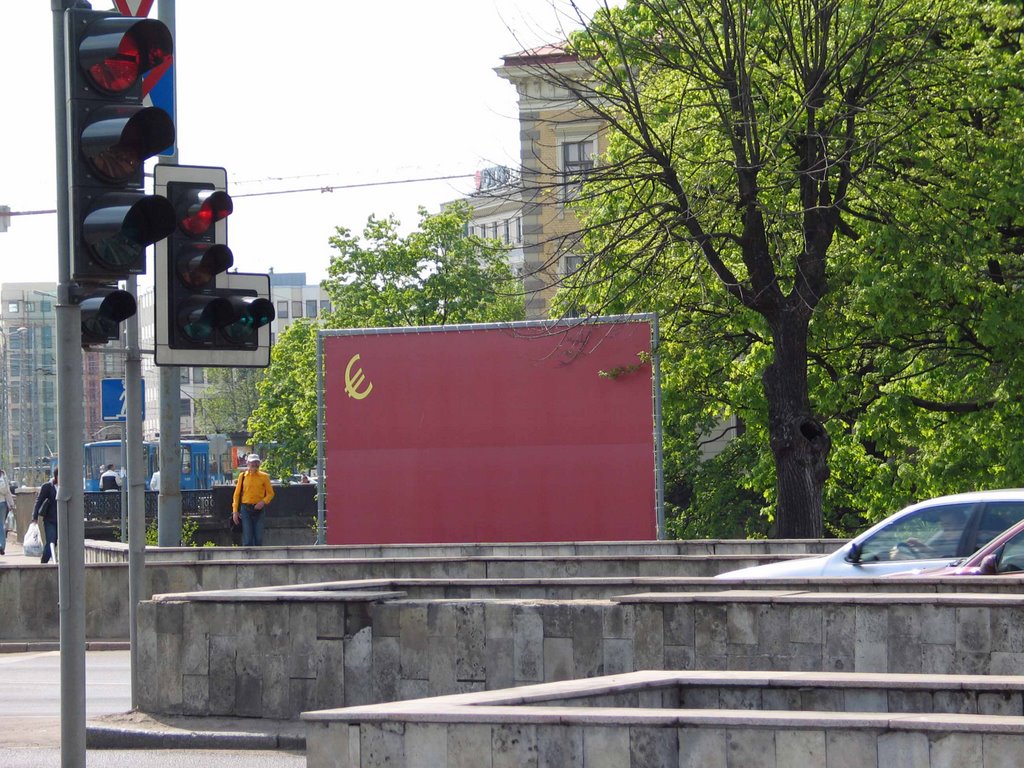
Propaganda
(More on the way. . .)

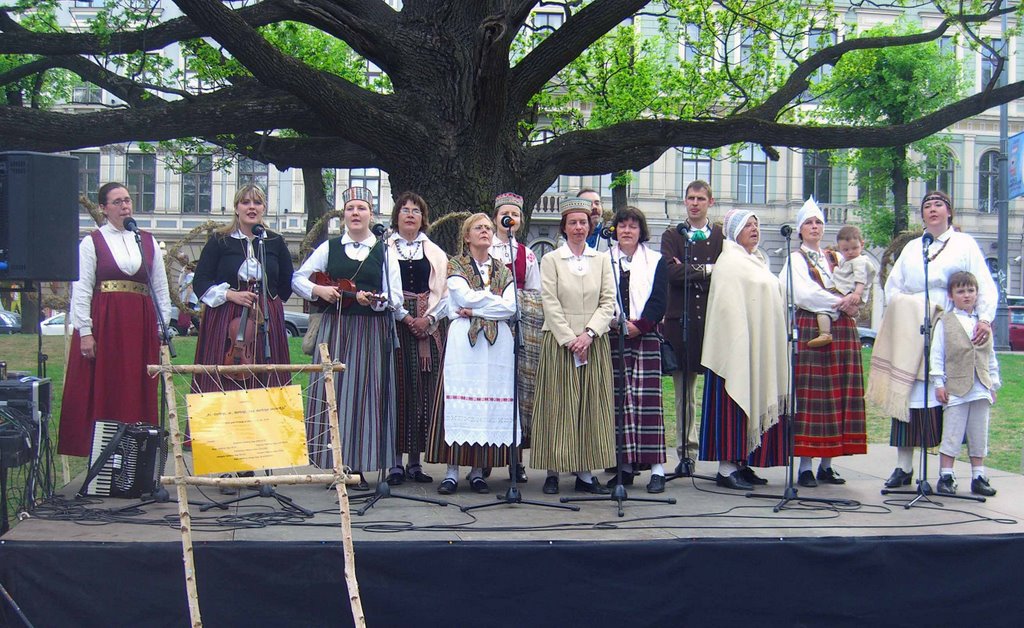
Skandinieki-Mother of Latvian Folk Choirs
(Zinta, Julija's mama, is the one on the far left)

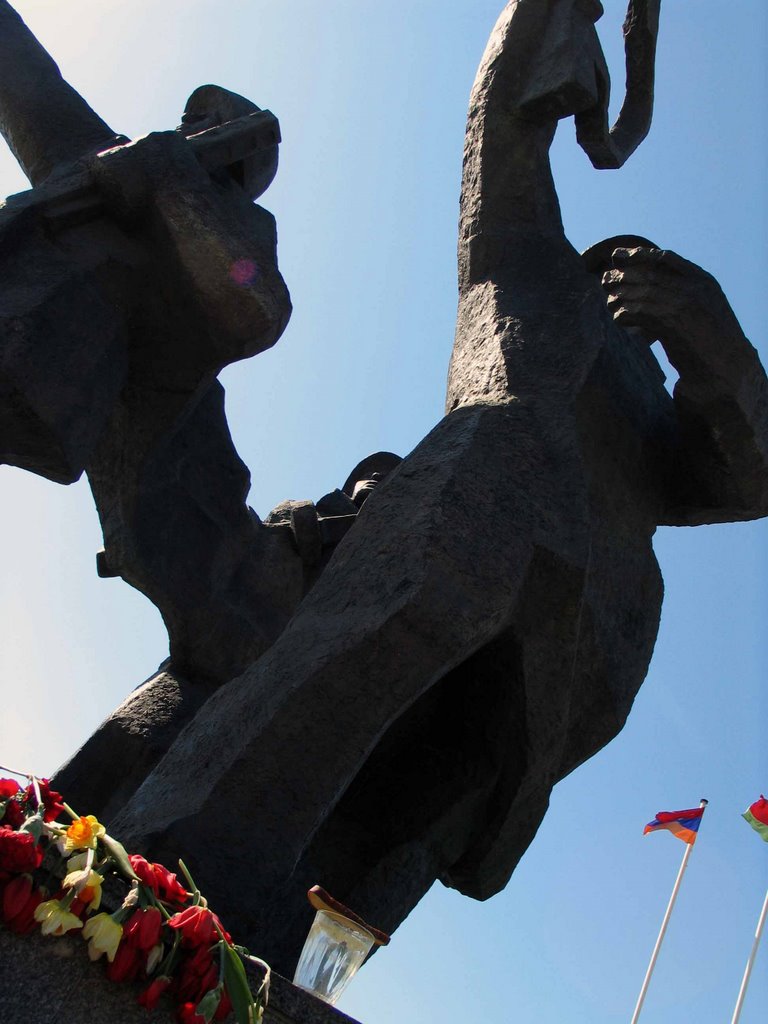
At the WWII Memorial a couple of days ago

VE Day in Latvia is celebrated primarily by ethnic Russians. Most Latvians look at May 9 as commemorating those inglorious days in which one dictator was defeated and another took over, bringing more mass deportations, executions/purges, and an attempt at cultural genocide. They are not being bad sports for not celebrating this day as Western Europeans and many Russians do, or as folks nostalgic for the Soviet past do; those who think so minimize their suffering and the importance of their collective memory/experience of the history of the WWII period.

To my mind, it is important to commemorate Hitler's end; but in those countries where it matters, the day should indded also be a commemoration of what happened in the wake of that defeat--another devastating defeat.

Daughter Julija

Julija's First Teeth

Saturday, April 22, 2006

Mykhailo Chovhan--Rendered Victim of Chornobyl by Soviet System

Mykhajlo Chovhan was a truck driver in the county of Pidhajtsi in 1986. He was back in his home village, having had completed military service--I do not remember where he was stationed, though I vaguely recall him saying something about Afghanistan. But my memory fails me on this point; I might be just making this detail up. Sometime in May he was called up and told that he would be sent to work elsewhere for a couple of weeks. Mykhajlo said that it was only en route that he and his fellows were told that they were on their way to Chornobyl.

Mykhajlo wears what must count as the thickest glasses ever worn by a human being--they should definitely find a place in a Museum of Strange and Unusual Medical Devices, such as we have here in Minneapolis. He told me that his eyes are slowly "melting." He said that he feels like his internal organs are slowly decaying, changing form, and becoming something like a moosh of organic flesh without distinctions. He is becoming a body without organs (but not in the liberating sort of way that certain poststructuralists have celebrated). He says that at some point his body will prematurely just stop working and become a body without organs and without a soul, without a life. It could be soon, or it could be in a while.

Mykhajlo says that he spent weeks driving materials out of the Chornobyl site on a flatbed truck. He gets a medical pension, which he receives though no doctor has ever told him for sure what his problem really is. He complains that the pension, of course, is meager and that in the early 1990s, it wasn't even paid.

He did not become sick right away, he says. It wasn't until years after the disaster that he started to feel ill. He says the effects have started to accelerate. He is a 40 something man who walks with a cane. He is tired all the time. He is a warm enough fellow, quite willing if not quite eager to talk about the issue. Though I have not spent much time talking with him--he is yet another of my father's cousins from the village of Sil'tse not far from the town of Pidhajtsi--he has never asked me for money, just for my understanding. Do I understand how many others like him there must be in Ukraine? He hoped that Yushchenko would make a difference in his situation. I wonder what Mykhajlo thinks now (I don't mean that as a cheapshot at Yushchenko, but rather, I really do wonder what he thinks now. . .).

He is angry about what happened to him, but not in an unhealthy kind of way, or, that is how it seemed to me. He has a very justifiable anger, but he doesn't hold it in that way that easts away at a person from the inside out, making worse an already-bad condition.

He says that they--the drivers--were told at the time that their job wasn't dangerous. They weren't hauling (radioactive) materials from the immediate site of the plant, afterall, but from one area to another within vicinity of the plant.

This is written for him, and for the many invisible victims of that disaster.

I hope I will be able to spend more time talking with him next time in Sil'tse.

***********
UPDATE: Some Chornobyl articles:

RFE piece on other victims whose stories are similar to Mykhajlo's here.

RFE piece on reactions to a recent UN (IAEA) report on Chornobyl here.

About the Greenpeace report that claims that the UN (IAEA) report grossly underestimates the number of those effected here.

Ukraineblogger "Leopolis" has posted a bunch of interesting documents and pieces dealing with the disaster here.

Saturday, April 15, 2006

Our Ukraine: Aloof and Stalling

I wrote to Oksana Kolodnytska, who's been featured a number of times on this blog, just after the elections to ask why she thought her home state carried Tymoshenko and why she thought that Ty did so well in the elections in general. She wrote (in English. . .these are her words):
"So, I think she had the image of a victim who was fighting against oligarchs, was betrayed, and as my dad said, many felt deceived by Yushchenko and so she seemed to be their last hope. One more reason why people voted for her, is that they didn't hear any firm promise from OUR Ukraine not to form a coalition with the Regions after the election. In fact, three days before the elections Yushchenko in an interview on 1 plus 1 was very evasive about the question of possible coalition withthe Regions. Tymoshenko's team did a good job of getting their message out about no compromise with Regions.

There were practically no ads for Tymoshenko on TV while we watched tons of shitty advertisements for Our Ukraine, Regions, Lytvyn, Vitrenko and others. Tymoshenko went to different cities and towns, gathered crowds of people, inspired them. Her voice became hoarse because of the constant shouting, talking. She's an energizer. She spent a lot of money on this campaign. . ."
End of quote.

This makes me recall that Yushchenko's star
didn't begin to fall just last
January
with the Gas Deal; no, it was the
Memorandum
with
Yanukovych that caused it to start falling from the sky.
Ever
since, people have been waiting
to see how far he was willing to
compromise on their ideals.
They saw no sign that gave them any
hope. Hence the vote.
Now all the stalling makes him appear as aloof as ever. . .

Which makes me recall somethin' else, the
following front page that
appeared just after
the memorandum last fall (on a pro-Tymoshenko paper whose
title I unfortunately clipped when scanning and
have now forgotten. . .)

(freakin' blogger absolutely sucks when you try to
cut and paste. . .fonts
and alignrment always get messed up. . .
no time to correct and deal with
html right now. . .)

Chauvinists

From RFE newsline:

AMBASSADOR SAYS RUSSIA WILL 'NEVER GIVE UP' INTERESTS INTRANSDNIESTER. Russian Ambassador to Moldova Nikolai Ryabov said onApril 12 that Moscow "will never give up its interests" in thebreakaway Transdniester region, "where it has been present for morethan a century," Interfax reported the same day. Ryabov said inTransdniester's capital Tiraspol that Russians "rest in thecemeteries there. A huge part of our history belongs to this region."Ryabov also said that Moscow plans to push for an end to new customsregulations on the Transdniester section of the Moldovan-Ukrainianborder. Moldova and Ukraine implemented the new rules in March aspart of an effort to combat smuggling (see "RFE/RL Newsline," March6, 7, and 8, 2006). "We will certainly be able to find a way out ofthe crisis through joint efforts. Moscow will push for the end of theeconomic blockade of [Transdniester]," he said. "Russia will notallow anybody to dictate terms in the [Transdniester] settlementprocess. Moscow will demand that those standing behind this economicblockade abandon their policies." BW

Friday, April 14, 2006

Photos of Immigrant Rights Rally; Another Blog

Nothing about Ukraine in this post:

I have posted photos of last Sunday's Immigrant Rights Rally in St. Paul (capital of MN) at my foto pages here.

I have been writing another blog on culture and society from an anti-war and left perspective you can check out here.

Monday, April 03, 2006

Whose Revolution Was It?

I am not given permission to name names, so I will not. Nor can I give the background information on either of these fellows, so you will just have to take my word for it that these are the words of credible characters that had something to do with the pre-OR, OR and post-OR politics. They are words that came up in the course of conversations last fall in Ukraine about the role of people's power and foreign governments in the making of the OR:

To paraphrase one guy:

“It is ridiculous, these people who think that the OR was orchestrated by US money. Some US NGOs are. . .terribly inefficient and ineffective. Do you know where a lot of that money (State Department money that was supposed to be channeled to election efforst in Ukraine) went that was supposed to help Ukrainians? To the salaries and lifestyles of the Americans working in the NGOs and living there in Kyiv! They were also disorganized. These guys could never have been responsible for pulling off a revolution. . .”

Translation: If there was a Western conspiracy behind the OR, it was carried out in a haphazard and disorganized manner in which a lot of the money for revolution was lost on bureaucracy and spent on lifestyles, and which succeeded in spite of itself. At least, that's the story according to this one fellow.

I can’t believe I never posted about this. It just came up in a conversation that I was having tonight with one of my favorite debaters, my Tato. I brought it up as a point of agreement between us, the right wing father and left wing son.

Something someone else had to say also came up tonight:

“You know the American movie the Matrix? Ok, we can say this: the OR did not escape the matrix (of global capitalism) but extended it. There is no doubt about that and I am critical of it because of this, too (like the Western Left wing critics). However, I must also say that I demonstrated and that the joy I felt there, in the streets with the masses of Ukrainians, is inexplicable. It is important that the OR happened for Ukrainians, for our culture and heritage, even if there are the negative aspects (that are formidable).”

If Ukrainians with progressive Left sympathies can have a nuanced and sophisticated analysis of what happened in their country, why can’t the Left in the West as well?

Then to conclude with a quote from Petro Hrytsak, son of one of Ukraine's more prominent historians, Yaroslav Hrytsak:

"It (the OR) was, in addition to the coming of age of a Ukrainian civil society, also the true coming of age of a Ukrainian youth culture."

Ukraine Appears in NPR Program Speaking of Faith

This week on NPR's Speaking of Faith program is a conversation with Adrian Ivakhiv, a professor of environmental studies who is Ukrainian-Canadian that you can listen to here. Though the program is focused on a discussion about the persistence and spread of paganism and neopaganism in the world today in general, he talks a bit about Ukraine and its pagan heritage.

From the site's description:
An environmentalist who pursued the ecological impulse of Paganism, from its ancient roots to its modern revival in Europe and North America, discusses his observations about the spirit of Paganism and its influence on everyday Western culture — and even on old-time religion.

Ivakhiv is assistant professor of Environmental Studies at the University of Vermont and author of Claiming Sacred Ground: Pilgrims and Politics at Glastonbury and Sedona.
This is great to my mind for two reasons:

1) Ukraine gets mentioned in mainstream media in a positive light (insofar as you find a revival of paganism positive, I suppose);

2) My daughter Julija was given a Latvian pagan "baptism." Zinta, her mama, was never baptized Xtian and comes from a family that has been extremely active in the neopagan movement in the Latvian world. Hence, there was no talk of original sin nor of a vengeful God that one must fear at Julija's baptism; rather, there was talk of a beautiful, creative new life entering the world and of a benevolent, universal energy or God. Thus, it was not really a "baptism" (no washing away of sin) but a presentation to Julija of the community that will nourish and nurture her, and a presentation to the community of the new life--Julija--within it.

All of which are elements, no doubt, of Xtian baptism as well, which I mention in all fairness. . .


(I myself am not a complete adherent of Zinta's neopagan beliefs, as I have for over ten years been an avowed Zen Buddhist; however, insofar as one's neopaganism leads one to believe in a benevolent life force and the notion that all things are connected so that it is necessary to seek harmony and peace with all human
(not just fellow co-religionists and co-nationals) as well as nonhuman Others, I am quite sympathetic. And the distinction between a presentation (of an already beautiful baby) and a baptism (washing of sin) is to me very important. . .)

It is great that NPR did a program that treats modern neopaganism as serious and real thing; there is a great deal of creativity and fulfillment for many in the rebirth of paganism, though there are problems within the movement itself. . . For example, the RUNVira of Ukraine promote an ideology of xenophobic nationalism and hatred mixed in with their paganism (for them, Xtianity came as an imposition of northern, proto-Russian East Slavs upon southern, proto-Ukrainian East Slavs, and Jews are a foreign scourge from which Ukraine must be purified in order that Ukrainians can reclaim their ancient faith in full, blah, blah, blah).

Such are not the beliefs of every, contemporary neopagan. Though in the mid-XXth century much neopaganism was caught up with fascism, xenophobic nationalism, and anti-Semtitism, most of the neopaganism practiced in Europe and America today is caught up with countercultural currents that emphasize harmony with nature, human and nonhuman alike--and hopefully, this spirit will influence the all-too-prevalent xenophobia of far too many neopagans in Eastern European countries as well. But the point is , xenophobia and anti-Semitism are not products of the faith in itself.

And one further point: In countries like Latvia, which were among the last nations to be Xtianized in Europe, there is something of an unbroken stream between past and present in terms of its paganism. That is, there are families and individuals who never were baptized and who never ceased to practice and follow some of their people's pre-Xtian ways--and this is added on top of the fact that so many elements of pagan belief and practice already penetrated the later Christian and then modern cultures of most European countries, including the ones that were more thoroughly Christianized or that were less conducive to the incorporation of pagan elements into Xtianity than those countries whose form of Christianity was Eastern Rite. Thus, the "neo" side of their paganism is not all that new or reinvented (though in many respects, it most certainly is).

Update: After listening to the show again, here are 4 things I found important about what Ivakhiv said:

1) Though in the show he did not delve into this matter more than just asserting that a distinction exists, Ivakhiv did say that one should not conflate New Age with sincere neopaganism (perhaps he talked more about this distinction in segments of his interview with the show's producer that did not make it into the show; I certainly would like to hear more on this issue!).

2) He addressed what to his mind (and I agree with him) draws many people to this form of spiritual practice; here's the gist of what he said
as filtered though my way of putting it:

a) A desire to erase the modern seperation between a religion and a way of life, or to put it positively, a desire for an integrated way of life and religion that is more consciously founded upon harmonious relations with nature and society (which is also the reason, btw, that many people, including myself, find Buddhism appealing);

b) A desire for a religious practice that is more firmly rooted in performance and participation (i.e., egalitarianism, though he did not say it), symoblism and music, rather than guided contemplation and prayer alone.


3) He mentioned the sediment of paganism buried within Christian practices and briefly mentioned how a dual kind of faith has evolved in many Eastern European countries such as Ukraine, whereby paganism has remained a vital force even within Christianity (though, I would add and doubt he would disagree, often not recognized thusly).

4) He criticizes RUNVira and other neopagan organizations in Ukraine, and by extension elsewhere, for their xenophobic nationalism, while mentioning what he finds positive about their beliefs.

Final Update:

In all fairness, I feel I should mention here that all I said above about what can be found redeeming in some people’s approaches to paganism can also be found redeeming about some people’s approach to Xtianity.

I have met numerous folks and have friends for whom Xtianity is a message of universal love (not merely of co-religionists and co-nationals) and of real care and stewardship of the Earth. For a great example of an American Xtian of this variety, one should look to the prose and poetry of Wendell Berry, one of contemporary America’s best critics, essayists and poets.

That is, the ideology of original sin and all the hellfire and damnation of a supposedly vengeful God is either a minor element of their beliefs, or even more adamantly for some friends, all that stuff is merely the ideology of the Old Testament that was Negated by the Teaching of Jesus, whose emphasis was love, harmony, forgiveness, and turning the other cheek. These are Christians whose beliefs I deeply respect.

My own adherence to Buddhism is rooted in my belief that Zen (of all the varieties of Buddhism) presents the universal message of all religion in its purest or most abstract form: the fact of our deep, mutual interdependence and the need to cultivate a peaceful and harmonious way of life within one’s self, and to cultivate this way among others. In Buddhism, there is no God in the sense of a creator God that carries out its Vengeance on feeble, sinning people; Buddha is not a God but the image of a perfected and happy one that we all should strive to become. And the most powerful thing about Zen among all religions is, to my mind, its prescription of a method and its traditions for reaching that harmonious place in thought and practice, body and mind.

After Buddhism would porbably come, for me, neopaganism of Zinta's or of others like her's sort.

Friday, March 31, 2006

More Promotion: Mila Vocal Ensemble CD Release Party

The Mila Vocal Ensemble will celebrate the release of their most recent CD, V Gradinata, a recording of all Bulgarian songs, tomorrow evening, April, 1 at the Cowles Conservatory/Walker Art Center Sculpture Garden in Minneapolis, from 5-9 pm.

Come and soak up the arrival of Spring with music from the CD and Mila's extensive, 30-nation repertoire.

Mila Vocal Ensemble strives for a delicate balance between the raw sounds of the village and the requirements of staged performance/recording in their presentation of traditional, folk music.

(Their sound is as arranged for the stage/recording as I, the village-style fanatic, can tolerate, and they do beautiful things while not crossing the line of too much arranging and too much alteration. The show will be worth attending!)


Listen here for samples of their work on previous CDs (including one CD recorded when many of the current members of Mila were members of the Ethnic Dance Theater Vocal Ensemble), and check out this link to video of their live performance (2 songs) in the studios of Minnesota Public Radio recorded earlier this week.

See you tomorrow at the party/show!

To purchase tickets in advance on line, go here and scroll to the bottom.

A Do-able Plan?

From Ukrajinska Pravda (English translation by Nikolai Bilaniuk for UkraineList, original article here in Ukrainian):
The leader of the Socialist Party of Ukraine, Oleksandr Moroz, has come out in favour of a coalition including the Tymoshenko Bloc, "Our Ukraine" and the SPU.
He spoke about this to journalists next to the Presidential Secretariat, after a meeting with President Victor Yushchenko.
"We are ready to support a memorandum on the principles of forming a coalition of three parties - the Tymoshenko Bloc, Our Ukraine, and SPU," said Moroz.

It should be a coalition of those people, for whom the majority of the electorate voted. That's because the election campaign was based on the alternative "either the people of the Maidan, or the Party of Regions." explained Moroz.

To summarize, in his words, about 70% of the electorate is not in favour of the Party of Regions.

According to him, the memorandum is to be signed "in the nearest days."

To this Moroz added, that he agrees with Yushchenko's thought that "we don't need to deepen the east-west fissure."

"We have to search for understanding. I would advocate a solution, in which the Party of Regions would nonetheless be represented in the power structures. In four or five oblasts they have a majority on the oblast councils. So it would only be natural that they hold the governorships too," added Moroz.

In his words, the possibility of achieving this solution will depend on Viktor Yanukovych.

Moroz said that in the formation of the government they will apply the principle that every party will take turns claiming a portfolio, and the remaining portfolios will be handed out on the basis of who has more votes in Parliament.

Moroz also said that other forces that are party to the coalition will not have veto power over ministerial candidacies.

In response to the question, will the Tymoshenko Bloc have the right to nominate the prime minister given that they earned the greatest number of votes in the coalition, Moroz answered "Yes, of course."

To this, the leader of the SPU added that a second option is being considered, in which the candidates for the posts of prime minister and speaker will have to be decided by consensus among the three parties.

On the question of Tymoshenko, Moroz said that he had met with her, and "she did not use the language of ultimatums."

Concerning his meeting with Yushchenko, Moroz explained: "We did not agree to anything, but the above mentioned negotiations are taking place."
This plan seems to fit all the pieces of the election puzzle together the best, given that it now seems that the Socialists have agreed to work with BjuT to form the majority only with Our Ukraine; i.e., that they agree with BjuT that the government should be based on "the people of the Maidan," not of the Regions. . .

If all this really is the case, then it seems that Our Ukraine are now, for the moment, the King-makers.

Our Ukraine can still decide to take its 1/3 of the Maidan votes (as the Socialists and BjuT together have more or less 2/3 of pro-Orange votes) and form a coalition with the Regions on the basis of what could be summarized as the stance that what is needed is post-OR reconciliation. . .

Also, Tymoshenko is allegedly pledging to be more business-friendly (i.e., no more reprivatizations, presumably. . .)

Another oped article by RFE's Roman Kupchinsky here; not quite sure what he means by the last line. . .

Thursday, March 30, 2006

Gas Deal and Tieing Up Some Loose Ends

Via abdymok I got this excellent piece from the NYTimes on the January gas deal (NYTimes version here):
The official residence of the managing director of a company now set to control Ukraine's supply of natural gas is a one-story, clapboard house in a tumbledown village bordering a defunct collective farm outside Moscow. A dirty rug covers the floor, a bare light bulb hangs from the ceiling and scraps of plywood plug gaps in the wall.

Olga P. Sakharova, 49, lives there with her mother and a German fox terrier called Lyusa and has never heard of the director, Oleg A. Palchikov, who operates a business worth $7 billion a year.

"What boss would want to live here?" Ms. Sakharova asked, surprised to learn that she occupied one of the few known addresses of any of the executives of the shadowy gas trading company involved in a deal between Ukraine and Russia that continues to roil politics here in Kiev, nearly 400 miles away.

Read on at either link above. . .
***************
For those who have asked me in person (and why not in the comments section? if you read, then comment or ask there, please!) about when one can expect news of the formation of the new coalition and appointment of PM in Ukraine's parliament:

Our Ukraine has declared that it will not go public with any decision before April 7. Lots of negotiating is going on with those parties likely to form some part of the majority, thus Party of Regions, BjuT, and the Socialists.

The sites most frequently updating about developments in Ukraine vis-a-vis the elections are foreign notes and neeka's backlog. Both sites have factual information and other stuff, opinion and other non-election related stuff.

Also, adbymok and leopolis and orange ukraine are writing about the election, just not as frequently as the other two. All worth checking into.
***************
THERE IS THIS GREAT animation of Tymoshenko and Yanukovych (in Russian) that I got via Petro's Jotter
***************
For Michael, w/whom I chatted today (you should pose your questions to me on my blog!), check the above sites for more info on Belarus', especially Neeka's site and here, at Neeka's round ups of Belarusblogs on Global Voices site.

Here's what happened:


The first photo is from this set; the last two photos are from here.

Read this here ("A Rebith of Opposition, or A Rebirth of Fear?") for a summary and some thoughts and read this NYTimes piece ("Belarus To Charge Defeated Candidate Who Led Protest").

And look at the pics here of a demo at the Belarusian State TV that happened just the other day W, March 29, after the crackdown.

Shchyro djakuju, Neeka, for all the links on your site and at your global voices site. . .

And wait, Stephan at Everybody I Love You did an interesting piece comparing Lukashenka and the Bush administration's record on free and fair elections; he also has some other posts about the situation in Belarus' and a few pieces about the Ukrainian elections.

Tuesday, March 28, 2006

Why Yulia Tymoshenko Deserves a Second Chance as PM

[Update: "Deserves" is not the right word in the title above: "Should Get" should have been the phrase in the title. I don't think many of the current political big-wigs in Ukraine "deserve" the post . .]

Just quick a note run off the top of my head (I'm workin' on a web design that I can't concentrate on until I get these thoughts out from jiggling 'round my head):

Tymoshenko deserves should get another chance, if for just one reason:

The Orange Revolution was not singularly about market values (which the recent vote to my mind confirms; see my post below). It may have been that for Yushchenko (though he used more and more populist rhetoric, starting in the middle of the summer of 2004, as the elections approached) and for the West, but as far as I experienced it, most Ukrainians were motivated to join the protest for a variety of, albeit often conflicting, goals that were rooted as much in non-market values (social justice, social programs) as pro-market ones.

Who will strike the best balance between these two sides of the OR coin? I am not exactly sure anymore that Tymoshenko is the ideal leader in this regard, but I want to see her try again. However, along with all of those who voted a pro-Orange protest vote (either for BjuT or the Socialists or Pora-PRP), I certainly don’t think that Yushchenko’s government was heading in the right direction of a proper balance. . .

In short, populism is a stance and not just a bunch of rhetoric and a set of slogans, though Tymoshenko was not at all explicit about specifics on policy during the campaign--except for stating unequivocally that she was against the gas deal and against forming a partnership with the Regions--which does worry me (but her positions on the gas deal and the Regions do not worry me!). However, neither has anyone else been specific in this campaign. As other Ukrainebloggers have noted, this was yet another election campaign season based on personality rather than substance and specific proposals.

If she is PM this time, both she and Yushchenko must agree on a program, and once that is agreed upon there can be no deviation from either side. Yushchenko really messed things up last time around by endowing Poroshenko with such powers to conflict with Tymoshenko. He messed things up last time around by being equivocal. This time, he must commit. So must she, if it turns out that she must commit to fewer reprivatizations and make other concessions to the Our Ukraine, free market liberalism approach (she should not get involved with price-setting again, for example). And as PM, she must prove that she is not herself a crony capitalist, as she was accused in relation to Nikopol.

But she should be given another chance. She is smart enough to handle doing some things in ways that are not to her liking for the sake of a stable Orange-coalition government. I personally do not have such a character; I find it very hard to back or enforce decisions or approaches that I do not like or approve of, but I think she is, well, cunning enough of a character to do so. She will have to check her ambition, but it will be much easier for her if, this time, Yushchenko doesn’t burry a knife in her back from the get to. To my mind, she was showing the signs of someone coming undone because of all the things going on behind her back; which is quite reasonable. I think she would have been much more willing to cooperate with the president if she had not constantly had the gnat Poroshenko buzzing around and biting her where it counts.

But to prevent Yushchenko from doing so again or for going for a Regions coalition, she is going to have to agree to drift closer to some of his positions.

Perhaps I am not entitled to my opinion as I am not a Ukrainian citizen and am writing from the US of A. But then again, lots of very poor people in Ukraine also voted for (what I am interpreting here as) a better balance between the market and nonmarket values raised by the Orange Revolution. This includes members of my own family in both Central and Western Ukraine; some voted for Yushchenko, some for Moroz, and quite a few for Tymoshenko. (Though I have not found out for sure yet, I pretty certain that some of my Poltava family voted for Regions.)


Monday, March 27, 2006

Media Inaccuracies about the Elections

Thankfully, not all of the media are saying such things, but I heard on the BBC yesterday a report saying that Ukraine was heading back into Russia's orbit and that Yanukovych has made a big comeback. Um, excuse me, but the man (Yanukovych or Ya for short) has not yet become PM again and it is no surprise to anyone who knows anything about Ukraine and these elections that he performed as he did. Those reporters hollerin' today about Ya's performance are a bit like that person in the car ride who wakes up and starts excitedly pointing out the approaching mountain range that everyone else in the car already spotted 45 minutes ago. . .

Then there was the Washington Post article that was reprinted in our local Minneapolis paper with the headline, "Voters turn away from Orange Revolution."

What?

The article as printed in the Post was a slight bit more accurately entitled, "Ruling Party Suffers Rout in Ukraine" by Peter Finn, who nonetheless did talk about the election as Yanukovych's big comeback. . .

Because of all this, I had the following chat tonight with some Latvian friends (of varying ages, from 30 somethings on up to 50 somethings) about the elections. "My god, what's happening in Ukraine?" one fellow asked. "We [Latvians] all know that the long-term Russian plan is to swallow Latvia whole again, but my god, we thought you Ukrainians would slow the Russian machinary down a bit!"

I told him to hold his horses, that there would be no need anytime soon (hopefully never) to send his sons, with their Latvian scouting skills, to the motherland to defend against an eminent Russian invasion. For as we all know: Nothing is said and done until we see who emerges as PM. I am loath to make any prediction.

Thus there is no comeback as of yet for Yanukovych and Ukraine's voters have not turned their backs on the OR. Neither Ya nor the Regions party disappeared after the OR, and in fact, Ya has recieved fewer votes (vis-a-vis his party) in this parliamentary election than he did in the presidential election. So this is all premature talk. There is the chance that he may return as PM, but that will in very large part depend on Yushchenko's response to the bigger news story of this election (see next paragraph). Furthermore, there are those pundits out there who argue that it is inaccurate to assert that, without a doubt, Ukraine will necessarily race back into the Russian orbit and redevelop a pre-OR political culture in the event that Ya becomes PM again. . .I am not entirely convinced of this, but anyway. . .

So the big story here (since it's not news that Ukraine has an East-West divide and that Ya performed as everyone expected him to) is the protest vote against Yushchenko's handling of reforms embodied by Tymoshenko's and the Socialist's performance.

In other words, the story is not that Ya has made a comeback (yet), nor that Ukrainians have turned their backs on the OR; the story is that the majority of pro-Orange Ukrainians have told Yushchenko that they don't want further compromise with the Party of Regions and that they want a harder pro-reform line.

The next big story will be all about coalition building, of course. I don't pretend to be saying anything original here.

[Update: just noticed that bob at abdymok and One Eyed Cat at OrangeRevolution have made similar points here and here.]

Btw, there is some good journalism out there on the elections. Via Dominique Arel's Ukraine List, I spotted a good article in the Guardian entitled "The Future's Still Orange" (WOW! In the Guardian! A good article on Ukraine!), and in the Warsaw-based Gazeta Wyborcza there's "The Revolution is not Lost."

For those of you who don't get the Ukraine List:

a) You can write to Mr. Arel at darel@uottawa.ca to request a free subscription;

b) A thought-piece on the elections via the Ukraine List from Taras Kuzio:

Ukraine's 2006 Elections (Taras Kuzio):

1. The elections will be declared to have been held in a free and fair manner, the first in Ukraine since 1994. This will be contrasted to elections in Belarus and the generally poor democratic situation in the CIS. The OSCE/Council of Europe/EU have given high remarks to the elections.

2. Yushchenko can take great credit for this progress.

3. The holding of free and fair elections will put pressure on the EU to change its passivity which is in place since Yushchenko's election.

4. Voting patterns resemble 2004, except Yanukovych will not obtain 44% as he did then. But, it's still early as only 20% of the votes have been counted.

5. Yushchenko (and thereby Our Ukraine) is a "kamikaze" president. He made countless mistakes in 2005, including sacking the Tymoshenko government and dividing the Orange camp, signing a Memo with Yanukovych and keeping Prosecutor Piskun until October, thereby not following through on instituting charges against high level officials, and he mishandled the gas contract. Yushchenko also wasted a year when he had Kuchma's powers and failed to use them to stamp his authority on the country.

6. Tymoshenko came second because of Yushchenko's "kamikaze" mistakes that led to a Orange protest vote going to her, rather than to Pora. Our Ukraine proved to be arrogant, both vis-a-vis Orange voters and vis-a-vis Yushchenko himself. Senior Orange businessmen accused of corruption in September refused to back down from standing in Our Ukraine, ignoring Yushchenko's advice. Political parties in Our Ukraine refused to merge into a single pro-presidential party.

7. Economics never did, and did not in these elections, drive Ukrainian voters. Whether Ukraine has 2% or 12% GDP is not something that guides Ukrainian voters. Negative voting s always a major factor in Ukraine's elections.

8. An Orange coalition was always the most realistic choice for Ukraine for two reasons:

a) to send a signal to the West and Russia about the sustainability of the Orange Revolution and democratic change

b) any deal with Yanukovych/Regions would have been the political death for Yushchenko. This is what I have been saying for weeks and it is echoed by comments from Lytvyn, Tymoshenko, Ryabchuk and others. Our Ukraine coming in third have no political strength to do a deal with Regions which have a lot more votes.

9. Yushchenko failed to understand an important, perhaps most important, factor driving the Orange Revolution - the sense of feelings of injustice against abuse of office, corruption and "Bandits" running Ukraine. Prime Minister Yuriy Yekhanurov totally misunderstood this feeling, as seen by his invitation to Ukraine's oligarchs to a meeting in October where he described them as "Ukraine's national bourgoiese." The Rule Of Law cannot move ahead without dealing with these issues from the past - election fraud in 2004, high level corruption, who ordered the Gongadze murder and Yushchenko's assasination.

10. Yanukovych is not a reformed leader:

a) he sent greetings to Lukashenko on his "victory." Yushchenko and the Ministry of Foreign Affairs followed the Western position on the Belarus elections.

b) he has never acknowledged his defeat in 2004. The top five in Regions included Yanukovych, the crazy Taras Chornovil, separatist Yevhen Kushnariov, and others who were a poor choice if Yanukovych wanted to show a conciliatory position. Throughout the elections they have continued to denounce the legitimacy of the Orange Revolution as a "illegal coup," "Orange rats," etc, etc.

c) US comment on Regions is confusing: should we take their program for its face value (Anders Aslund) or should we ignore the program as there are pro-European businessmen ready to change the face of Regions (Adrian Karatnycky). If it is the former then Regions is (in addition to economic reform) against NATO membership, for full membership in the CIS Single Economic Space, and Russian as a state language. Regions voted against WTO legislation.

d) Regions will vote with the government on certain issues dealing with economics.

11. Tymoshenko might become Prime Minister or Rada speaker. Her record in office is mixed, not purely black. Much of what Yushchenko/Our Ukraine have taken credit for economically was initiated under her government.

12. These elections show Ukraine's democratic progress has consolidated after the Orange Revolution. The choice of an Orange coalition makes it more likely Ukraine will obtain a MAP in Riga in November. Judgements about Ukraine's democratic progress should not be influenced negatively by dislike of the ensuing parliamentary coalition.

13. I doubt parliament will last its full term of five years. The contradictions inherent in particular insides the Party of Regions will lead it to implode.