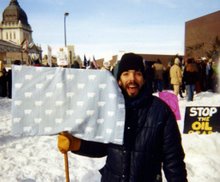
This is a belated announcement; our Hutsul Project site has been up and running for sometime. Please visit: www.hutsul-project.com


Jonah Gindin: Is the promotion of democracy inherently imperialist?
William I Robinson: The promotion of democracy is inherently not imperialist; on the contrary, it is inherently revolutionary, progressive and wonderful! But the people who are promoting democracy are social movements in the global north and global south, solidarity movements in the north, mass movements in the south. What the United States is promoting, in Venezuela or elsewhere, is not democracy. United States foreign policy has absolutely nothing to do with promoting democracy; what it is doing is inherently imperialist.
But my argument in no way suggests that democratisation movements around the world are creatures of foreign policy; rather, it says that changes in US foreign policy and new modalities in US intervention are meant specifically to challenge, undermine, limit, and control the extent of social and political change in countries where masses of people – including the elite – are struggling for democracy.
In this perspective, US political intervention under the banner of “democracy promotion” is aimed at undermining authentic democracy, gaining control over popular movements for democratisation, keeping a lid on popular democracy movements, and limiting any change that may be brought about by mass democratisation movements so that the outcomes of democracy struggles do not threaten the elite order and integration into global capitalism.
If democracy means the power of the people, mass participation in the vital decisions of society, and democratic distribution of material and cultural resources, then democracy is a profound threat to global capitalist interests and must be mercilessly opposed and suppressed by US and transnational elites.
What is new about the strategy of “democracy promotion” is that this opposition and suppression is now conducted under the rhetorical banner of promoting democracy and through sophisticated new instruments and modalities of political intervention.
Jonah Gindin: How can one tell apart NGOs and human-rights groups genuinely dedicated to promoting social, economic, and human rights from the NED-fed variety?
William I Robinson: I think what’s going on is that as every country and community in the world is turned upside down by the penetration of capitalist globalisation, older forms of rule – authoritarianism, dictatorship – are delegitimated and challenged from below. At that point, the United States attempts to establish control of the type of political change that’s going to take place, and to make sure that certain groups get into power and others are marginalised.
Thus, if the US moves into a country like Kyrgyzstan or Ukraine, all the different groups involved in the democratisation struggle are going to come under US purview; some will be favoured by being brought into US programmes through funding, technical liaisons and advisors, while others will be excluded.
In no way are all these different groups stooges of US foreign policy; but those struggling for a completely different vision, one contrary to US and global capital’s interests are going to be marginalised if they can’t be bought (e.g, the more radical--and original Pora!--Chorna Pora, marginalized by Kaskiv's copy-cat and US-funded Pora!). US operatives, and their local allies and agents, will set up alternative or parallel organizations that are more powerful, more moderate, more centrist, more elite-oriented. These organisations and NGOs are going to receive international media attention and funding, and will be able to liaise with other forces abroad.
There are broadly three categories of groups. First, those that are clearly instruments of US foreign-policy objectives, groups trying to limit democratisation and control change; second, those pushed to the margins; third, those the US cannot or has no interest in marginalising or challenging, but which it attempts to co-opt and moderate.
Often there are well-intentioned people with a legitimate political agenda of democratisation, who – because structural or on-the-ground circumstances don’t allow anything else – become sucked into US and transnational elite foreign-policy operations (People such as the masses of Ukrainians who were duped into supporting one side of an intra-elite struggle that had little to do with improving non-elite lives in Ukraine).
By PAUL CRAIG ROBERTS
As articles by John Pilger, Alexander Cockburn, and Uri Avnery make clear, by groveling before the Israel Lobby Obama has dispelled any hope that his presidency would make a difference.
Obama told the Lobby that in order to protect Israel he would use all the powers of the presidency to prevent Iran from having a nuclear weapon. As in the case of Saddam Hussein’s “weapons of mass destruction,” the conclusion whether or not Iran is making a nuclear weapon will be determined by propaganda and not by fact. Therefore, there is no difference between Bush, McCain, Obama, and the Lobby with regard to the Middle East.
As Israel has several hundred nuclear weapons, and a modern air force and missiles supplied by the US, the idea that Israel needs American protection from Iran is a fantasy. All Israel needs to do in order to be safe and to live in peace is to stop stealing the West Bank and to drop its designs on southern Lebanon. Obama is too smart not to know that US foreign policy has been Shanghaied by the Lobby not in order to protect innocent Israel but to enable Israel’s territorial expansion.
Obama has dispelled hope on the economic front as well. Obama has  appointed two leading apologists for jobs offshoring as his economic advisors--Bill Clinton’s Treasury Robert Rubin and Rubin associate Jason Furman. These two are notorious for their justifications of policies that benefit Wall Street, CEOs, and large retailers at the expense of the economic well being and careers of millions of Americans.
As a result of offshoring, good jobs in America are disappearing. The Bureau of Labor Statistics job figures make it totally clear that the US economy has ceased creating net new middle class jobs in the private economy in the 21st century.
Stressing higher returns to shareholders, Wall Street pressures corporations to move their operations abroad. Wal-Mart tells its American suppliers to “meet the Chinese price” or else, a price that US firms can meet only by offshoring their operations to China.
Every job and product that is offshored increases the US trade deficit and lowers US GDP. It is a losing game for America that rewards the overpaid elite of Wall Street and corporate America, while dismantling the ladders of upward mobility.
By enlarging the trade deficit, offshoring erodes the reserve currency role of the dollar, the real basis of US power. Now that US imports exceed US industrial production, it is unlikely that the US trade deficit can be closed except by a sharp reduction in US consumption, which implies a drop in US living standards. If the dollar loses its reserve currency status, the US government will not be able to finance its budget and trade deficits.
Where is the hope when Obama endorses a foreign policy that benefits only Israeli territorial expansion and an economic policy that benefits only multimillionaires and billionaires?
The answer is that Obama’s election would signify the electorate’s rejection of Bush and the Republicans. Considering the cowardice of the Democratic Congress and its reluctance to hold a criminal regime accountable, electoral defeat is the only accountability that the Bush Republicans are likely to experience.
It is not sufficient accountability, but at least it is some accountability.
If the Republicans win the election and escape accountability, the damage Republicans have done to the US Constitution, civil liberty, and a free society will be irreversible. The Bush Regime and its totalitarians have openly violated US law against spying on Americans without warrants and US and international laws against torture. The regime and its totalitarians have violated the Constitution that they are sworn to uphold. Bush’s attorney general Gonzales even asserted to the Senate Judiciary Committee that the US Constitution does not provide habeas corpus protection to American citizens.
When federal courts acted to stop the regime’s unconstitutional practices and abuse of prisoners, the Republicans passed legislation to overturn the court rulings. The Republican Party has shown beyond all doubt that it holds the US Constitution in total contempt.
Today the Republican Party stands for unaccountable executive power.
To reelect such a party is to murder liberty in America.
The June 12 Supreme Court decision pulled America back from the abyss of tyranny. For years hundreds of innocent people have been held by the Bush regime without charges, a handful of which were set to be tried in a kangaroo military tribunal in which they could be convicted on the basis of secret evidence and confession extracted by torture.
The Court ruled 5-4 that detainees have the right to appeal to civilian courts for habeas corpus protection. The Bush Republicans claiming “extraordinary times” had created a gestapo system in which the government could accuse, without presenting any evidence, a person of being a threat and on that basis alone imprison him indefinitely. Justice Anthony Kennedy reminded the Republican Brownshirts that “The laws and Constitution are designed to survive, and remain in force, in extraordinary times.”
Bush’s current attorney general, Michael Mukassey, said he would proceed with his kangaroo trials.
President Bush indicated that he was inclined to again seek to overturn the Court with a law.
Brownshirt Republican Senator Lindsey Graham said he would draft a constitutional amendment to restore the executive branch’s tyrannical power.
Republican presidential nominee John McCain said that the Supreme Court decision protecting habeas corpus “is one of the worst decisions in the history of this country.”
The four Supreme Court justices (Alito, Roberts, Scalia, and Thomas) who voted for tyranny in America are all Republicans. They all came out of the Federalist Society, a highly subversive group of right-wing lawyers who are determined to elevate the powers of the executive branch above Congress and the Supreme Court.
The Republican Party has morphed into a Brownshirt Party. The party worships “energy in the executive.” If the Brownshirt Republicans are reelected, they only need one more Supreme Court appointment in order to destroy American liberty.
That is what is at stake in the November election. As bad as Obama is on important issues, his election will signal rejection of the tyranny to which the Republicans are committed.
Paul Craig Roberts was Assistant Secretary of the Treasury in the Reagan administration. He was Associate Editor of the Wall Street Journal editorial page and Contributing Editor of National Review. He is coauthor of The Tyranny of Good Intentions.He can be reached at: PaulCraigRoberts@yahoo.com
Iwaskewycz, Maria (maiden name Chovhana), age 87, passed away 2/7/08. She is preceded in her death by her husband Mykhajlo (“Mike”), daughter Katya, and in Ukraine by her parents and 4 siblings. She is survived by her children Ivanna Rebet (husband Andrij), Robert (wife Lydia) and Leo (wife Chris), her grandchildren (Taras, Stefan, Mark, Michael, Lana and Katya), her great-granddaughter (Julija), her brother Evhen (wife Zhdana) and his family, and in Ukraine by her sister Slavka (husband Ivan) and other family. Maria was, and her family will be, ever grateful for the opportunities provided by life in America after WWII. In the U.S., Maria and her husband were able to continue in the struggle for a free and independent Ukraine while free to live, make a good living, and raise a family without the political persecution they had known in their homeland. With her husband Mykhajlo and other community members Maria was co-founder of the Ukrainian American Community Center of Minneapolis and was a lifelong member of St. Constantine’s Ukrainian Catholic Church, where she was active in parish life. Also with her husband, Maria funded a variety of Ukrainian organizations--including the Ukrainian Free University in Munich--and after Ukrainian independence, funded construction of three churches in Ukraine. MARIA HAD A PASSION FOR FLOWER GARDENING and in her final days rediscovered a youthful love for singing Ukrainian folk songs. The family wishes to thank all of our mother’s friends who visited and helped during her illness, with special thanks to Mrs. Olha Lytvyn and to her nurse, Lucille. Memorials preferred to St. Constantine’s Church.There is so much that I really want to say, but little I feel able to, for now. For now. More later.
The December 11 "events in the Verkhovna Rada revealed the obvious lack of viability of a [BYUT/NUNS] coalition of 227 lawmakers," Yanukovych said. "Society should receive an answer to the question of whether a coalition of 227 is capable of taking responsibility for the country," he continued. "Either they take responsibility and realize their promises to voters...or they must admit that a coalition of 227 cannot work," he added.Yanukovych shouldn't even be in politics in Ukraine anymore; he should have been permanently lustrated from politics by presidential decree on Jan. 24, 2005, the day after Yushchenko's inauguration.
the post-1989 disillusionment, cynicism, and an embittered view of the past affected every continent without exception. and those who now adopted the victors' view of history came from all social classes and political backgrounds: left social-democrats, eurocommunists, ex-trotskyists, pristine pure sectarians in their prime and now transferring the same vice to serve older causes, maoists once prone to street-violence, marxist theorists, staunch anti-imperialists who in their zeal had defended the ethiopian dergue and the disasterous soviet intervention in afghanistan, former anarchists--representatives of all these people could be found serving virtually every neoliberal government--in europe and north america, south africa and brazil, china and australia and the muslim world--or, where this was not possible, applauding wildly from the sidelines. they still believed in the class struggle, but had changed sides. they had not understood that the historical graph never rises consistently. it is a broken and contradictory line that can fall to zero and then rise again, suddenly and without warning.
politicians and academics, novelists and playwrights, filmmakers and journalists united to celebrate each new triumph of the wc [washington consensus]. nor should it be forgotten that in those heady post-1991 days news of victories came thick and fast. the more recent the convert, the stronger the ardour with which the new world order was defended. there was an intense longing to break decisively with the past and to demonstrate this as publicly as possible in self-righteous tones, without a blush of shame. what better way but to denounce the opponents of 'humanitarian wars' (the colonial whip that is one of the more savage and hypocritical heirlooms from previous centuries) as reactionary enemies of civilization and all anti-capitalist alternatives as paving the way to totalitarianism? having convinced themselves that no other roads were possible or desirable, they remodelled their lives and work to meet the requirements of the new order. a few even found themselves unable to condemn torture as long as it was being carried out in the interests of humanity and civilization. others discovered that old-fashioned colonialism was not such a bad things after all and defended imperial occupations of sovereign states and the creation of new western protectorates in the balkans or the hindu kush. and all the while they insisteted that they were the true voices of reason. yes, they had joined the ranks of the imperial armies as propagandists; yes, they had supported wars and occupations, but no other choice was on offer. were there other choices, then, when montaigne derided european racism, toussaint led a successful revolt against slavery, mark twain denounced the imperial occupation of the philippines, or marcel proust mocked the bibilical pretensions of zionism?
the left, the antiwar movement, the handful of tough-minded journalists still permitted a voice in the mainstream media, the 'idiots' who attended the festivals of the world social forum, the 'islamo-fascists' all derided the coarse cynicism of the neo-imperialist folk and their role as treacherous turncoats. thus described, rage injected venom into their opportunism. not a few soft-spoken, snivelling journalists and academics were transformed overnight ino warriors for the imperialist cause, desperate to please their new master and, as a result, often more boorish and belligerent than those they served. a similar constellation of characters had emerged after epochal defeats in previous centuries. . .in many cases, these by no means unintelligent people expended much of their energy in the primitive and petty task of self-justification, which meant that their most recent productions displayed no signs of intellectual hunger. in the new milieu in which they found themselves there were always more experienced and more consistent defenders of the status-quo. to make themselves heard they had to work harder than more traditional conformists: they had a past to expunge. some succeeded. were they all devious and insincere? i don't think so. the conversions, in most cases, were genuine enough, albeit a few continued to convince themselves that they remained 'on the democratic left' or were the 'only real left'. why this insistence? perhaps to admit a total break would mean placing their life's work on a funeral pyre. vanity forbade such excesses.
the bandwagon careerists who clambered aboard the 1990s war chariot had been hasty in assuming that because they were finished, everything else was too. the earth had been stolen, surveillance satellites littered the sky, but free thought and dissidence had not completely disappeared. illusions about the civilizing function of a bloody empire and the rancid rhetoric of wc [washington consensus] politicians were being destroyed on the battlefields of iraq and in the mountains of afghanistan and subsequently in lebanon. nowhere was this more the case than in the late president monroe's imperial backyard. the glimmer of an actual political alternative, however, was visible only in latin america [decidedly and unfortunately not in post-soviet eastern europe]. there, new social movements had thrown up new political leaders. they were insisting that, despite the fall of the soviet union, the world was still confronted with old choices. either a revamped global capitalism with new wars and new impoverishment, chaos, anarchy, or a rethought and revived socialism, democratic in character and capable of serving the needs of the poor. these leaders were determined to rescue the stranded ship 'utopia', to initiate more egalitarian, redistributive policies and to involve the poor in the political life of their countires. for proclaiming these modest goals they were traduced and vilified. their real crime is to challenge the certainties of the new order, to disregard the forbidden signs of the wc. an ally of that consensus can crush its opponents, torture or kill political prisoners, ban all rival parties, sell half a country's assets for private gain and still obtain the 'international community's' seal of approval. but if a government challenges the priorities of the global system in the name of an invigorated democracy and an ultra-democratic constitution and, worst of all, continues to be re-elected by its stubborn citizenry it will be vilified and attacked. for refusing to concur with the wc it is accused of 'totalitarianism' and the order goes out that it must be crushed politically, ideologically, and if necessary, by force of arms. this is the world in which we live today, a world described with telling scorn by harold pinter.
--pp. 23-25 from pirates of the carribean: axis of hope.
 Spirit and the Struggle:
 happening that some thing we might call "spirit" is constituted and that some process we might call "progress" happens (though there always also is regression). Since Marx stood Hegel on his head, progressives have been aware of this: the world is constituted in praxis, i.e., struggle. "Before Being, there is politics" (cf. deleuze/guattari). It is through struggles (becomings) of all sorts that our Being-in-the-world is produced and
 reproduced. The human world is produced in the multitude of class or economic struggles, political struggles, cultural struggles, reproductive struggles (the struggle for liberal reproductive rights, or control over one's own body, especially by women), sexuality struggles, academic and intellectual struggles, etc.
 The key word in all of this is not spirit, but struggle. Better than the birth of spirit, the Orange Revolution is thought of as a significant moment in Ukrainians' post-Soviet struggle to change their country, a struggle that is far from accomplished and that still requires grassroots action and organization--which was, at the time of the Orange Revolution, still only at a rudimentary level, appearances to the contrary aside.
  (An active NGO sector is neither a replacement for nor a necessary indication of a nation-wide, consolidated and deeply-rooted grassroots movement for change.) The Orange Revolution was still just a beginning, not a culmination. Yushchenko's inauguration day proclamation of the end of Ukraine' s post-Soviet history was premature (unless the nature of elections and relative freedom of press are the sole issues defining the boundary between post-Soviet and post-post-Soviet), and what is more, was an indication of the degree to which Yushchenko and gang considered the need for real struggle already over. This in turn indicated that Yushchenko and gang
  would soon capitulate to Ukraine's oligarchic or elite-driven political system and capitalism instead of leading a genuine, progressive struggle against oligrachic control. (Their capitulation to their oligarchic adversaries and betrayal of their Orange Revolution promises is an event that is marked on the pages of the ill-considered, so-called "Memorandum of Understanding," signed by Yushchenko and Yanukovych in the autumn of 2005.)
 against Ukraine's billionaires and their cronies), instead of using the full strength of the will they had backing them after the Orange Revolution. In so doing, and though they promised to struggle for deKuchmization, they have betrayed those who really made the Orange Revolution happen, and are complicit in the (re-) creation of a Kuchma-lite system that is now taking hold in Ukraine, one in which only some (perhaps none!) of the extremes of Kuchmism
  are eliminated. They have shown that they are preoccupied with inter-elite struggles for their own sake and that they are nearly as removed from everyday people as are those they once called bandits and criminals. As Kuzio put it (here), Yushchenko has failed, as much as his predecessors, to be a listening president. In Yushchenko's case--in an effort to bring about the important
 disenchantment of the Yushchenko myth so widely spun in the heady OR days--it is important to recognize that one does not become a politician of the multitude of Ukrainians simply by virtue of having roots in a village one left behind long ago and by having a (bourgeois) passion for (collecting) folk art and (the leisurely study and promotion of) Ukrainian history. Yushchenko was only but ever a reluctant revolutionary (here),
  and has with almost total consistency refused any warrior path. The Orange Revolution was a remarkable exception in his technocrat's life. He prefers what he frequently called "clean politics," or to be what he fancies a proper, European gentleman-politician, indeed, an elite--real struggle is too messy, especially for the investors and governments
 abroad and for the interests of captial at home whose desires the president sought to fulfill more than those of the people whose struggle he claimed to champion. In this context, the manner in which the president chose to mark the second anniversary of the Orange Revolution, with an elite gathering far removed from "the maidan" and its people, is no surprise (here).
 Spirit can always be lost. If the world is not the product of a spirit that is inevitably heading toward a telos (goal)--i.e., Freedom--but is created as the result of a wide variety of everyday becomings or struggles, then gains can be lost. "Freedom" is potentially gained (and lost) in struggle. If one doesn't like Marxist talk, perhaps one can appreciate terms borrowed from Zen Buddism: The Buddha was never content to relax. The Buddha had to renew his efforts everyday, lest he fall from his Enlightenment.
  If the Buddha can slip from Enlightenment without daily struggle and effort, Ukraine can loose the spirit of the Orange Revolution that hasn't yet been fully realized. Like any person after a flash of realization, Ukraine as a nation can become stuck in a semi-realized state and can succumb to old and new illusions, despite the Orange Revolution.
 This is not to say that there is no positive or progressive accumulation of successes from previous struggles--that is, gains of the oppressed vis-a-vis the powers-that-be are in a certain sense permanent (cf. the life work of Antonio Negri, in particular this, this, this and this). There is a positive/progressive accumulation of the gains made in struggle that parallels the (negative, repressive) accumulations of capital and power. This is not a contradiction of the principle that there can always be a reversal to oppression and a loss of spirit after a progressive victory. Because of the positive accumulation of struggles, the political and capitalist powers-that-be are forced to innovate in their techniques of control
  and exploitation. This very thing is happening in Ukraine right now, and most of Yushchenko's oranges are reduced today to a scramble, not to stop this innovation, but to hold on to a meager share of the power they so quickly and unwittingly ceded to their oligarchic adversaries out of the blindness of their beliefs/interests and/or the hubris of their personalities.
 Thus, after a victory of the oppressed, the powers-that-be can no longer rely solely on previous techniques, but there always-already are new techniques of control and exploitation to be invented and combined with older ones. Many critics have pointed out that two central limitations of Marx's thought were a) his failure to foresee the flexibility of capital and capitalist forms of rule in
 overcoming economic and political crises and, relatedly, b) his conviction that crises would necessarily lead to capitalism's collapse. For all their talk about needing stability in the market, capitalist powers have over and again demonstrated they can strive in times of crises, for it is in the resolution of crises that they can reassert their power and control, often with greater
  depth than before (cf. Negri, again). This process of reassertion is taking place in Ukraine right now, and Yushchenko and gang have enfeebled themselves to such an extent that they are not able to stop it (and it is likely that some among them benefit from and support the Kuchmism-lite system). Thus two similar criticisms of Yushchenko and gang
  and their apologists can be made:
 cooperation with an orange power, and become a kind of consolidated-on-orange-terms "national bourgeoisie." This latter bit was more an element of faith--not of some kind of level-headed pragmatism--that entered into their beliefs, willy-nilly. And so once again, religious leaders have failed to deliver to Ukrainians that for which they so long have prayed.
 Thus, though positive change has happened in Ukraine--the minimum that was possible after the Orange Revolution--one should not prematurely think the struggle is over, nor that the Spirit of the Orange Revolution will live on without ongoing efforts. Ukraine after the Orange Revolution is stuck in a semi-realized state and is stuck with a
  plethora of top-level politicians who leave much to be desired (including Tymoshenko). This situation requires that the people who dreamed of much more and who felt the spirit two years ago renew their efforts in building a real movement for change in their country. I fear that no political force in Ukraine today is capable of delivering what the multitude of Ukrainians dreamed of or glimpsed in Nov-Dec. 2004. That force is still waiting to be made.
  Thus the most basic but important work of organizing and solidifying a real grassroots movement against corruption and elite intrigue is still of the upmost importance in Ukraine--and this is the reason why the ruination of Pora! as the embryo of a real, all-Ukrainian grassroots movement by the hubris of one man and the pretension of becoming a political party was one of the greatest tragedies of the post-OR days. But it is not a tragedy that can not be overcome.
 Spirit is nothing without struggle; spirit will perish if concrete struggle does not continue.
 For this reason, those who continue to occupy tent camps and to protest in Kyiv and across Ukraine, and who picketed outside of Yushchenko's elite gathering for the OR's anniversary, and who otherwise refuse to make any apologies for the way in which Yushchenko and team have betrayed "the people of the maidan," are in my opinion doing the right thing.
 *All but the last five fotos, which were taken in Kyiv, are still-fotos captured from digital video that I took in various locations in Western Ukraine during the OR.
This is footage of members of the folk choir Skandinieki singing this past weekend at a rock that marks one of the spots in Riga where 5 people were killed during a Soviet crackdown on January 20, 1991.
In the course of its terminal year segments within the Soviet government made two bungled attempts to keep things from falling apart. The second of these is better known--i.e., the August Coup. However, that long and tense year began right away with a display of the Soviet authority's anxiety--a crackdown was launched in the breakaway Baltic States. In the Spring of 1990 each of the Baltic States had made moves toward independence from the USSR. On January 13, 1991 in Vilnius and on January 20, 1991 in Riga, blood was spilled as the Soviet government tried, unsuccessfully, to reassert control after months of failed negotiations by which the Soviet government had hoped to persuade the Baltic States to sign Gorbachev's new Union Treaty. To read more about what happened in Riga, you can go to this post on my blog. Scroll down to the middle of the post where the red letters read "About the Massacre."
5 people were killed and hundreds were injured in a park in the center of Riga in 1991. On the places where the dead fell are large rocks bearing the victims' names. Throughout the year in Riga people place flowers and candles on or near these rocks, and they especially do so each year on January 20, which is an official day of commemoration. I went with some fellow members of the folklore ensemble Skandinieki to sing at each of the rocks in honor of the day.
January 20 was the culmination of a week long series of events during which, in 1991, people built and staffed, night and day, barricades throughout Riga in expectation of a Soviet crackdown. Thus each year on January 20 folks come out to rebuild a small portion of the barricades, light campfires, eat soup and sing, much as they did in 1991.Â
The experience of people standing at the barricades, sharing food, singing, and risking their lives together was a foundational moment for the renewal of Latvian statehood and of Latvian society in general, one that remains meaningful for many people in the country today. For others, in the context of Latvia's current woes (the lowest wages in the EU, high unemployment, labor leakage/brain drain to Western Europe and the US, continuing corruption, and heightened tensions between Latvia's largest ethnic communities), January 1991 is a fading memory or is viewed as a moment of an all-too-delusional hope. It is just as likely that one in either camp--the camp of those for whom January 1991 remains a vivid memory or of those for whom it is a fading experience--could bemoan the current situation in the country with statements like, "Remember what we stood for in '91?" or, "Too bad things couldn't be more like they were in '91." or, "When did things start to go so wrong?"
In either case, memory of the day is still conjured in a way that endows it with a powerful role in the making of this nation.
January 20 is an important part of the country's yearly cycle and a pillar in the formation of its post-Soviet national identity.
Note, however, that though the number of those who do come out on January 20 each year is often small--as it was this past Saturday--many people in this country will attest to the importance of the day. Thus it is important that a subcultural or small group actively makes the event that helps keep the memory alive; and it is no surprise that members of the folk choir Skandinieki--many of whom together as members of the group and seperately played important roles in the anti-Soviet resistance--would take an active role in commemorating events on January 20.Â
And perhaps one can comment here that if a critical enough mass of people could have--after the deluge that was the Soviet collapse--eventually become as active again in the political and cultural life of the country as they had been in the days of the barricades, and as member of the ensemble continued to be, many of the woes mentioned above might not have come to pass. Â
And this speaks volumes to Ukraine's ongoing experience of the Orange Revolution. Spirit will perish without struggle and the efforts of, at the very least, a very determined minority. Thankfully a sizable enough mass exists to keep the spirit of the OR quite alive in Ukraine; but how about the larger, political-economic picture? Much struggle is still needed. . .
Z NOVYM ROKOM!
this is a long, 20 minute clip from new year's eve 2005 in kyiv. the orange revolution demonstrations and the third round of elections (that yushchenko won) had just concluded. on this day, people were anxiously awaiting the inauguration of yushchenko and the start of a truly new year.
i post this as reminder of the optimism about the potential and, what is more, of the strong will for change that existed at the time in ukraine. my point is not to feel pessimistic about all that hasn't happened in ukraine since, but rather, to provide a reminder of what is yet to be done.
most of this was filmed on a tiny, hand-held jvc, dv-camera without the use of a monopod, tripod, or proper microphone, so the quality is pretty shabby. the quality greatly improves about half way into the clip, for the simple reasons that i was no longer standing smooshed between people and therefore had more control over my movements than in the huge mass, and i wasn't using digital zoom to film things too far off in the distance anymore.
i did not provide subtitles, so here are some notes:
the first speaker is mikheil saakashvili, the current president of georgia who rose to power via similar events as the orange revolution. saakashvili was once a university student in kyiv during soviet times, and brilliantly addressed the multitude of new year's revelers that night on independence square mostly in ukrainian.
the next person to appear is yushchenko--he made that night a claim that has become a rather famous for him; in sum, he says that for the last 14 years before the orange revolution, ukraine has been independent but not free, but after the orange revolution, ukraine has become not only independent but also free at last.
following yushchenko, julija tymoshenko then oleksandr moroz give some new year's greetings. moroz's comments were cut short by the arrival of the new year, something that today seems rather appropriate--i.e., that his comments would be cut short.
after the holiday greetings follows some music:
first, oleksandr ponomarov sings the national anthem of ukraine.
then the band Green Jolly makes an appearance. they first played their hit song that was an anthem of the orange revolution, razom nas bahato, nas ne podalaty (together we are many, we won't be overcome). their next song, dobryj vechir (good evening) is, to my mind, a beautiful one, and the moment at that time on independence square when they sang it was really great, filled as it was by a song that seemed so heartfelt. in the song, the narrator is singing good evening to his/her mother and friends, wishing them good fortune, good health, etc.
following next is footage of the super star group tartak. i included footage of them singing their two hits, veselo (happy)! and hoolihan (hooligan). i quite dig this group.
after them comes someone singing a more traditional ukrainian pop song--i forget the singer's name, ale, ras, dva, try, bud'mo--hej hej hej, anyway! there is nice footage of people dancing around and of a contemporary zaporozhets (not of a car, but of a fellow sporting a cossack hair-do).
this would not be a clip edited by yours truly without what comes next: folk musicians and people dancing on the street.
next is a bit of footage from january 1: the tent camp on khreshchatyk (the main boulevard through heart of kyiv that was the epicenter of the orange revolution), followed by one of my favorites of all my clips: a really great shot of a spetsnas (special forces) soldier guarding the presidential administration building and unwrapping some candy or gum. the shot is reminiscent of vladimir putin's refusal of the big baby viktor yanukovych's offer of candy during a parade that took place in kyiv, just before the start of the election debacle that led to the orange revolution.
after that come two more clips of dancing and of new year's reveling. these two clips--one of folks dancing on independence square to a guy playing accordion, and another of a baba busting some fantastic moves to the musicians playing in the entrance to the teatralna stanstija (theater metro station)--are the best bits of this entire little 20 minute film. (most especially the baba dancing!!)
enjoy!
us'oho najkrashchoho,
i veselykh svjat!
This was filmed on a relatively crappy digital camera at Dievseta, a retreat center run by Dievturi in Wisconsin, USA. Dievturi refers to an organization of people who follow pre-Christian Latvian customs in a contemporary context that is active both in Latvia and the Latvian diaspora.
The Dievturi have a kind of formalized path for following these traditions, while there are also those who consider themselves followers of the old ways who do not call themselves Dievturi.This is very authentic, i.e., an example of how Latvians in tune with their ancient traditions celebrate the Winter Solstice, in Latvia and in the diaspora.
These traditions are very similar to Ukrainian ones.
"Kalado" is the Latvian word for "Koljada."
Though there are differences, I am one to appreciate what is common!
Enjoy!
Priecigus Ziemas Svetkus!article from counterpunch.
By TARIQ ALI
In the Muslim world religious groups that are militarily effective, but politically limited dominate resistance to the American Empire. Asia is infatuated with capital. Europe lies buried deep in neo-liberal torpor, and the Left and social movements in the EU (Italy is the most recent example) are in an advanced state of decomposition. But in South America an axis of hope has emerged that challenges imperial domination on every level. Democracy, hollowed-out and offering no alternatives in the North, is being used to revive hope in the South.
The likely re-election of Hugo Chavez this weekend in Venezuela will mark a new stage in the process. His opponent, Manuel Rosales, described in the Financial Times (November 30) as a "centre-left" candidate was heavily implicated in the defeated coup attempt to topple Chavez in 2004. Rosales claims that "I will not sit on anyone's lap" but it is hardly a secret that he is firmly attached to the White House.
The wave of revolts and social movements spreading unevenly across the South American continent today are the inevitable result of the Washington Consensus, the economic enslavement of the world. Latin America was the first laboratory for the Hayekian experiments that finally produced the Consensus. The Chicago boys led by the late Milton Friedman, who pioneered neo-liberal economics, used Chile after the Pinochet coup of 1973 as a laboratory. It was a good situation for them. The Chilean working class and its two principal parties had been crushed, their leading cadres killed or "disappeared". Six years later, the Sandinista revolution in Nicaragua was crushed by a US-backed Contra counter-revolution.
Earlier this month, the Sandinista leader, Daniel Ortega won the Presidency in his country. Blessed by the church, flanked by a former Contra as his vice-president and still loathed by the US ambassador, Ortega may be a sickly shadow of his former self, but his victory undoubtedly reflects the desire of Nicaraguans for change. Will Managua follow the radically redistributive policies of anti-imperialist Caracas or confine itself to rhetoric and remain a client of the International Monetary Fund?
There was even better recent news from Quito. The substantial electoral triumph of Rafael Correa, a dynamic, young, US-educated economist and former finance minister, who pledged in his election campaign to reverse  Ecuador's participation in the US-backed free trade area for the Americas, to ask the US military to vacate its base at Manta, and to join Opec and the growing Bolivarian movement that seeks to unite South America against imperialism.
Correa's victory comes at a time when Latin America is on the march again. There have been some spectacular demonstrations of the popular will in Porto Alegre, Caracas, Buenos Aires, Cochabamba and Cuzco, to name but a few cities.
This has offered a new hope to a world either deep in neoliberal torpor (the EU, the US, the Far East) or suffering from the military and economic depredations of the new order (Iraq, Palestine, Lebanon, Afghanistan, south Asia).The struggle spearheaded by the Bolivarian Republic of Venezuela against the Washington consensus has attracted the fury of the White House. Three attempts (including a military coup backed by the US and the EU) were made to topple Hugo Chávez.
Chávez was first elected president of Venezuela in February 1999, 10 years after a popular insurrection against the IMF readjustment programme had been brutally crushed by Carlos Andrés Peréz, whose party was once the largest affiliate of the Socialist International. In his election campaign Peréz had denounced the economists on the World Bank's payroll as "genocide workers in the pay of economic totalitarianism" and the IMF as "a neutron bomb that killed people, but left buildings standing".
Afterwards he caved in to the demands of both institutions, suspended the constitution, declared a state of emergency and ordered the army to mow down the protesters. More than 2,000 poor people were shot dead by troops. This was the founding moment of the Bolivarian upheaval in Venezuela.
Chávez and other junior officers organized to protest against the misuse and corruption of the army. In 1992 the radical officers organised a rebellion against those who had authorized the butchery. It failed because it was soon after the traumas of 1989, but people did not forget. That is how the new Bolivarians came to power and began to slowly and cautiously implement social-democratic reforms, reminiscent of Roosevelt's New Deal and the policies of the 1945 Labour government. In a world dominated by the Washington consensus this was unacceptable. Hence the drive to topple him. Hence the demand by Pat Robertson, the leader of political Christianity in the US, that Washington should organise the immediate assassination of Chávez. Venezuela, till now an obscure country as far as the rest of the world was concerned, suddenly became a beacon.
The majority of the people who elected Chávez were angry and determined. They had felt unrepresented for 10 years; they had been betrayed by the traditional parties; they disapproved of the neoliberal policies then in force, which consisted of an assault on the poor in order to shore up a parasitical oligarchy and a corrupt civilian and trade-union bureaucracy. They disapproved of the use that was made of the country's oil reserves. They disapproved of the arrogance of the Venezuelan elite, which utilised wealth and a lighter skin colour to sustain itself at the expense of the dark-skinned and poor majority. Electing Chávez was their revenge.
When it became clear that Chávez was determined to make modest changes to the country's social structure, Washington sounded the tocsin. Nowhere has the embittered bigotry emanating from this quarter been more evident than in its actions and propaganda against Venezuela, with the Financial Times and the Economist in the forefront of a massive disinformation campaign.
They are united by their prejudices against Chávez, whose advent to power was viewed as an insane aberration because the social reforms funded by oil revenues - free health, education and housing for the poor - were regarded as a regression to the bad old days, a first step on the road to totalitarianism.
Chávez never concealed his politics. The two 18th-century Simóns - Bolívar and Rodríguez - had taught him a simple lesson: do not serve the interests of others; make your own political and economic revolution; and unite South America against all empires. This was the core of his program, which is unacceptable to the supporters of the Washington Consensus.
The key to a serious Latin American challenge to the US lies in regional cohesion. This is crucial. When the cable channel Telesur was launched in Caracas nearly two years ago, one of their first programs revealed a shocking level of ignorance amongst South Americans. In virtually every capital city vox pop interviews revealed that people knew the name of their own capital and that of the United States. Very few could name even two or three capital cities in their own continent!
So regional unity---the Bolivarian Federation of sovereign states of which Chavez speaks incessantly----is necessary to move forward. Washington will do everything to prevent this since its own interests dictate dealing with countries unilaterally rather than as regional entities (this is even true of the European Union). Regional unity in South America could have a surprising impact in el Norte as well where the Hispanic population of the United States is growing rapidly to the great consternation of state ideologues like Samuel Huntington.
Tariq Ali's new book, Pirates of the Caribbean: Axis of Hope, is published by Verso