I should have put up these links ealier, but anyway. . .I have added a new links section called "Folk Culture Corner." So far there are only three. . .I will add more later. These are links to groups of my own homeboys and gals in Minneapolis, where there is a very active community of people dedicated to folk culture performance. Ethnic Dance Theatre is a professional ensemble composed of a dance troupe and orchestra, and which collaborates closely with the Mila Vocal Ensemble. Mila used to be the Ethnic Dance Theater Choir before they became their own entity in order to pursue a very active perfomance schedule of their own.
I have performed as a dancer off and on with EDT for the better part of 6 years (for 4 years solidly, then off and on for the last 2 1/2), and if you are around the Minneapolis area this winter, you will be able to spot me in EDT's folk-dance version of The Nutcracker. By-the-way, I left Ukraine last Th for Riga, and fly tomorrow back to Minneapolis to jump into a month of rehearsals for the show (they have been rehearsing for some time now. . .).
Skeptical about such a thing? A folk-dance version of the Nutcracker? Well, I can tell you this: It is one of the best things this company has ever produced. Think about it: The whole second half after the intermission is nothing but folk dances, and how much more interesting when they are presented as real folk dances by professional dancers and musicians dedicated to authenticity, and not as character ballet (my biases being made obvious here, as usual. . .)?
Also, the setting for the whole story works well for a folk dance troupe: The first half in the EDT version is set in a Franconian (German) bourgeois's home, during which the guests perform a Franconian contra dance from the late 18th century (a dance which is from the EDT repetoire; all the dances in the show are from the company's repetoire). Drosselmeier is returning from Transylvania with a Hungarian Nutcracker doll, and the show ends with a big and rather stunning Hungarian, boot-slappin' and turning, dance (there is also a Hungarian solo thrown-in in the dream sequence as the Nutcracker comes to life . . .).
The fight scene is between Cossacks and Caucasians (North Ossetians, to be exact. . .), who during the fight, dance in the styllistically appropriate manner. Perhaps this all-too-much reproduces traditional antagonisms that should not be reproduced, but EDT's mission is:
"To foster understanding and awareness of world cultures through the re-creation and presentation of traditional ethnic dance and music. In a society where racial tensions are prevalent, we believe it is vital to promote and project the inherent beauty, dignity, and integrity of all peoples. We believe that ethnic music and dance are true affirmations of human artistic expression. Many of the cultures which are represented in our programs are currently in great conflict. Through our performances, we acknowledge the inherent beauty and dignity of all peoples."
EDT has long been very successful at working toward its mission or promoting cross-cultural understanding. For example, just after 911 the company produced a show called "The Silk Road," which was its way of combating the rising tide of anti-Muslim feeling in the US; it also has done an all-Balkan show in times during which the Balkans are looked upon as a savage, barely-European backwater. . .
Well, anyway, back to the Nutcracker, the Snow Queen sequence is set to a very enchanting Russian choral arrangment, after which EDT gets to perform in the second half one of its own Chinese pieces and an Arabic piece, etc.
EDT, as well as Mila, and also the folk orchestra OBI (Orkestar bez Ime, from the Bulgarian) linked in the section, are dedicated to making their performances as authentic as possible. The director of EDT for the last 31 or so years has spent the same amount of time traveling to and fro Eastern Europe to study, as have a number of the other dancers, musicians, and singers in each of these outfits, many of whom have also studied in other parts of the world, such as Central Asia and the Middle East. All three groups are linked to each other by way of sharing performers and ideas and interests. And OBI, as a folk orchestra, bucks the trend of so many folksy, eastern-Europeany groups in the US: that is, they aren't some kind of goofy, hip or hippy-ish, fusion of various Eastern European styles with American rock and rockabilly. They actually care to play in idiomatically correct ways, study with native players, and strive to be as much like the real wedding bands that play in Eastern Europe and elsewhere as possible. This is also true of EDT and Mila, whose members also train with native directors, and who over the years have had native performers join their ranks, either as guests at concerts or full fledged members of the company, and also have had trained members of various diasporas in Minneapolis joining their ranks (for example, from the Latvian and Ukrainian diaspora, hence my daughter!).
So check out the sites. See a show when you can: EDT mostly performs in Minneapolis and at festivals in Europe, while Mila and OBI can be found wandering about the US. Mila also is becoming a frequent guest on Garrison Keilor's Prairie Home Companion show.
You can find samples of the EDT orchestra's, Mila's, and OBI's music on the sites.
And one other thing: what a joy it was for me that this time in Ukraine, I finally began making some contacts with the community of people dedicated to authenticity. . .to village-based authenticity, that is. . .
Music and dance are my first, and perhaps only true, passions. . .
Sunday, November 06, 2005


Saturday, November 05, 2005
A Literary Note on Henry Miller from one Ukrainian's Perspective. . .
I brought with me a copy of Henry Miller's Tropic of Cancer on this trip, for two reasons: to reread and see what I liked about it oh so much so many (12? 15?) years ago when I first read it, and to share it--this "shocking," "dirty" little book--with Oksana (in the pictures below), who speaks and reads English nearly fluently.
I was reading along but this time I found the book, well, sometimes interesting, but mostly trite. It really once appealed to my adolescent mentality, inspite of the misogyny and anti-Semitism, which I remember bothering me then (but it bothered me much more now). This time reading it, I had to keep reminding myself that it was written in the 1930s, that few had ever written like this or of such things, that in its day it certainly was not trite as it was a modernist reaction to the stuffy artisty of people like Henry James, a rejection of the realist literature, that I, in fact actually like a great deal more than Miller's (or Kerouac's) prose, etc.
So this time, Miller seemed like a hack and James a real artist. I couldn't really get into it this time, and handed it off to Oksana long before finishing it. Am I getting old?
Well, Oksana read it, was intrigued by it (the language and scandalous themes weren't shocking for her, though; she is quite modern), and when she finished it, she summed up the book quite well by saying, "Here, it was interesting, but you can have that bastard back. . ."
Well said.
I was reading along but this time I found the book, well, sometimes interesting, but mostly trite. It really once appealed to my adolescent mentality, inspite of the misogyny and anti-Semitism, which I remember bothering me then (but it bothered me much more now). This time reading it, I had to keep reminding myself that it was written in the 1930s, that few had ever written like this or of such things, that in its day it certainly was not trite as it was a modernist reaction to the stuffy artisty of people like Henry James, a rejection of the realist literature, that I, in fact actually like a great deal more than Miller's (or Kerouac's) prose, etc.
So this time, Miller seemed like a hack and James a real artist. I couldn't really get into it this time, and handed it off to Oksana long before finishing it. Am I getting old?
Well, Oksana read it, was intrigued by it (the language and scandalous themes weren't shocking for her, though; she is quite modern), and when she finished it, she summed up the book quite well by saying, "Here, it was interesting, but you can have that bastard back. . ."
Well said.
Friday, November 04, 2005
Yekhanurov and Lukashenka
Just some thoughts that I am wondering about these days, as I catch up on internet reading and the news about Ukraine (funny that while in Ukraine working on the doc just now, I was too busy to pay much attention to details about current events):
Is the new but hitherto rather weak-on-OR-promises Yushchenko-Yekhanurov team taking up the old hard line on a couple of things?
1) They said no more reprivatizations, but there are murmurings of that list of 70 once again after the success of the Kryvorizhstal process. . .
2) Tough talk on Russia from Yekhanurov: i. e., his suggestion that Russia would, if it entered the WTO first, have greater power to force Ukraine into an even greater neocolonial situation vis-a-vis Russia through economic means; see RFE (Radio Free Europe) articles here and here . . .
(But by-the-way, don't think I am a huge fan of Ukraine joining the WTO. The WTO is a deeply flawed institution in need of reform, away from a neoliberal, free-trade institution to a neo-social democratic, fair-trade one. It is the target of a serious challenge by a large and effective global movement struggling for just such a transformation; i.e., the WTO is the target of a struggle against how it is a mechanism for rigging the world economy for the benefit of mostly the elites of the northern and western hemispheres and for the southern and eastern elites that are their stooges. What this means is that I do support the idea of Ukraine joining it, and as a member, I hope that it will join the bloc of southern hemisphere countries that are struggling for more equitable trade between the south and north and east and west, and that walked out of the Cancun ministerial meeting in protest of northern and western hemisphere machinations. . .)
3) The post-OR hardline on Lukashenka is back, kind of, via Yekhanurov's comment on Nov. 1. . .see RFE here
I am happy about these harder line stances in general, but then unhappy that also, the post-OR tradition of one minister saying one thing and then another taking it back seems to have also returned, with Tarasyuk insisting that Yekhanurov meant no criticism of Lukashenka. . .RFE here
Of course I am frustrated with someone weakly saying to Lukashenka, "No, we didn't really mean it. . ."
Is the new but hitherto rather weak-on-OR-promises Yushchenko-Yekhanurov team taking up the old hard line on a couple of things?
1) They said no more reprivatizations, but there are murmurings of that list of 70 once again after the success of the Kryvorizhstal process. . .
2) Tough talk on Russia from Yekhanurov: i. e., his suggestion that Russia would, if it entered the WTO first, have greater power to force Ukraine into an even greater neocolonial situation vis-a-vis Russia through economic means; see RFE (Radio Free Europe) articles here and here . . .
(But by-the-way, don't think I am a huge fan of Ukraine joining the WTO. The WTO is a deeply flawed institution in need of reform, away from a neoliberal, free-trade institution to a neo-social democratic, fair-trade one. It is the target of a serious challenge by a large and effective global movement struggling for just such a transformation; i.e., the WTO is the target of a struggle against how it is a mechanism for rigging the world economy for the benefit of mostly the elites of the northern and western hemispheres and for the southern and eastern elites that are their stooges. What this means is that I do support the idea of Ukraine joining it, and as a member, I hope that it will join the bloc of southern hemisphere countries that are struggling for more equitable trade between the south and north and east and west, and that walked out of the Cancun ministerial meeting in protest of northern and western hemisphere machinations. . .)
3) The post-OR hardline on Lukashenka is back, kind of, via Yekhanurov's comment on Nov. 1. . .see RFE here
I am happy about these harder line stances in general, but then unhappy that also, the post-OR tradition of one minister saying one thing and then another taking it back seems to have also returned, with Tarasyuk insisting that Yekhanurov meant no criticism of Lukashenka. . .RFE here
Of course I am frustrated with someone weakly saying to Lukashenka, "No, we didn't really mean it. . ."
My Own OR Retrospectives at Orange Dykun
From now until mid-January of next year, I will be playing around at my other blogger site (Orange Dykun) as well, posting the pieces that I sent to an email list-serve that I established in the course of my first ever stay in Ukraine (from June 2004 to February 2005) and in the course of the OR. The list grew from maybe 100 addresses of family, friends, and acquaitances to some 600 addresses, and judging from the comments from people that they were forwarding the pieces to others, I guess that well over 1,000 people at least recieved, if not read, them.
The pieces were loaded with typos and run-on sentences, etc., as my pieces here often are. I do little editing for my blog, and I am definitely the kind of writer that blathers away and then needs to go back and fix things up. But also, last year, I was writing so fast from internet clubs in various parts of Ukraine, as I wandered around the country to see with my own eyes what was going on in different parts of the country in the course of the OR. I often had to get on a bus somewhere soon, so I wrote what and how I could in short time periods. Oh well. Those uptight about spelling and grammar will be annoyed. So be it. But I think I will do some fixing-up of those pieces as I post them at Orange Dykun, and will sometimes add some more reflections, I guess. . .
As I catch up, I will post each piece one year from the original date that it was sent. I hope some of you will read over there, and comment. . .
Enjoy.
Stefan
The pieces were loaded with typos and run-on sentences, etc., as my pieces here often are. I do little editing for my blog, and I am definitely the kind of writer that blathers away and then needs to go back and fix things up. But also, last year, I was writing so fast from internet clubs in various parts of Ukraine, as I wandered around the country to see with my own eyes what was going on in different parts of the country in the course of the OR. I often had to get on a bus somewhere soon, so I wrote what and how I could in short time periods. Oh well. Those uptight about spelling and grammar will be annoyed. So be it. But I think I will do some fixing-up of those pieces as I post them at Orange Dykun, and will sometimes add some more reflections, I guess. . .
As I catch up, I will post each piece one year from the original date that it was sent. I hope some of you will read over there, and comment. . .
Enjoy.
Stefan
Sunday, October 23, 2005
Check Out Orange Dykun
I have finally started posting things over at my other blog, called Orange Dykun.
Posted there will be more of my communiques from the OR, and stuff I wrote about my impressions of life in Ukraine during my first stay in the country, from June 2004 to March 2005. I wrote these pieces to a list-serve that I established then, not knowing at the time how easy it is to get your own blog going.
What I posted over there today is something that I think sheds light on the current anxiety over Yushchenko's willingness to compromise with the oligarchs.
I will be posting more things over there as the 1st anniversary of the OR approaches. . .
Posted there will be more of my communiques from the OR, and stuff I wrote about my impressions of life in Ukraine during my first stay in the country, from June 2004 to March 2005. I wrote these pieces to a list-serve that I established then, not knowing at the time how easy it is to get your own blog going.
What I posted over there today is something that I think sheds light on the current anxiety over Yushchenko's willingness to compromise with the oligarchs.
I will be posting more things over there as the 1st anniversary of the OR approaches. . .
Saturday, October 22, 2005
On the Road to a Documentary
READ AGAIN the comments to the fist photo below, if you already have read this post: I added more text about corruption, nepotism, and meritocracy today, Oct. 23, 2005:
These are all stills taken from some of my video footage. If they turn out well here, I am going to have a new obsession. These are stills on the road to becoming part of a documentary. .
.
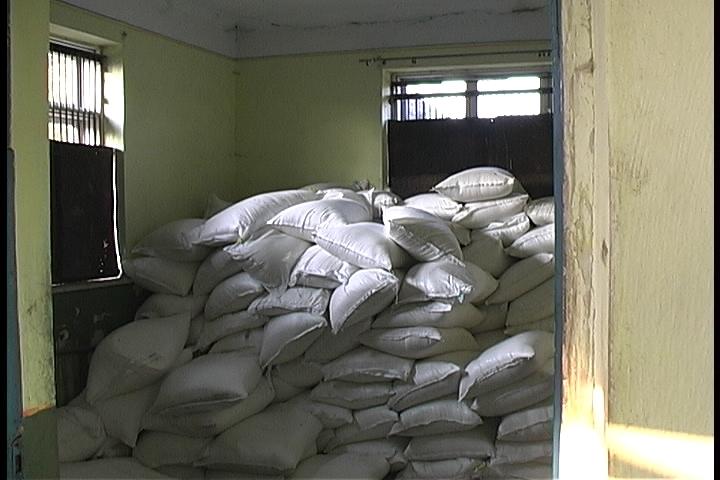
 Men Loading Sacks of Flour
 This photo is from the local mill in Pidhajtsi. The mill was part of a factory complex in Soviet times that also included a preservatives section and bakery. In the early 90s, the managers ran the preservatives and bakery sections into the ground while enriching themselves, and when it they closed, the managers sold most of the equipment. More than a 100 people were put out of work. Lesja Kolodnytska, wife of my father's fist cousin Hryts, worked there and has not held a job since then.
There is an overabundance of such stories in rural Ukraine. The mill survived the closure, and the bakery has been re-opened, but the preservatives section never re-opened. The mill and bakery are privately run and the management would not let me in to film.
There also is a dairy factory in Pidhajtsi that was also run into the ground, after which it was bought by a private interest that would NOT let me film. I had an argument with the plant manager, a woman who I asked if she was not ashamed to be defending the plant's secrecy after the Orange Revolution was a push for transparency in government and business practices. . .Of course, the woman has a boss, too, but she would not even try asking her boss to let me in and do an interview. . .
I told one fellow I know in Pidhajtsi about this, and he said to me, "Hey, no worries, I have got a contact there. . ." Such statements are of huge significance in Ukraine (as it is in all poor countries with hugely corrupt governments and business practices): "I have a contact, a friend, a colleague. . .
MUCH MORE than they are in the West, contacts are very important here. Far more people get positions in business or government based on contacts here rather than their competence or meritbthan in the so-called West. The OR in part was the expression of a desire to change this system of nepotism into a system that is more soundly based on principles of a meritocracy.
IF YOU ARE NOT A FAN OF POLEMICIZING (i.e., of ranting about politics), SKIP AHEAD FROM HERE TO THE NEXT PHOTO.
. .
Imagine a continuum of how one gets jobs or positions of power or influence, with contacts on the one side and merit on the other. The people of every country in the world, whether the West or otherwise, rely upon a combination of contact and merit. The question is which takes precedence. In the West, one can say in general that merit has an advantage over connections/contacts, especially ideologically if not in actual practice. However, there are those places in the West that the need for contacts is especially strong, such as in the journalists' and academics' world.
In Ukraine, the obvious emphasis is on connections/contacts. You often can't even get an interview without a contact, and people in the past (i.e., pre-OR), and I am sure that they still do, often pay just to get an interview. Sometimes there is no interview. You will get a job somewhere just because some family member or colleague works where you want to and has influence. I have family who have jobs purely through these means, through connections. They did not have any experience with their profession before they took their specialized jobs. But they were family and they needed work. Unemployment, scarcity, poverty all lead precisely to nepotistic and kleptocratic systems, no matter how democratic they appear in form. (And unemployment, poverty and scarcity are the creations or symptoms of a political-economic system sick with corruption and abuse of power, since scarcity and poverty are human-made problems, human-made constructs, especially in a country as rich in labor and natural resources and tourist/historical destinations as Ukraine).
The OR is making a difference in all this, however, in the following way: People can invoke it (depending on region, I am sure) in tough situations when dealing with police, or secutiry, or officials, or in seeking an interview, or getting medical care, or in just correcting people's brutish and annoying public behavior, etc. If you run into a problem, you can say, "What was the OR about?" etc. I was waiting in line to buy a train ticket in Kyiv when someone cut into the front of the line and someone confronted her by saying, "Do you remember how we all behaved during the revolution?" I had a problem getting into the Ivan Franko University in Lviv to do an interview (with the renowned Prof. Yaroslav Hrytsak). They have security guards who check IDs as you enter the school. This is a good thing in general, but I told the guard that I needed to get in to do an interview with Prof. Hrytsak, and that I didn't know that I would need a pass, and that I could not call him as I only had his home number, so could you please either escort me to his office or just let me? The guard sent me to the security desk where the other guards sat on their asses and told me, "We don't know him, we won't let you in, we can't help." I was so mad. I said, "What, is Ukraine still a wild country or did it become a more friendly place after the Revolution? Either let me in to go find his office, or walk with me, and if you don't want to do any of the asking to find, I'll hold your hand through the building and do the asking myself. . ." To which the captain stood up startled and told the guard at the gate to let me in!
There are more of such stories from others, but anyway, this would make the subject of a great anthropological study: How mere invocation of the memory of the OR is making a difference, however small.
Of course, one encounters plenty of such unhelpfulness in the US as well, but there is much more of it here. And once again, in connection to all of this I can talk about why I am so against the Bush administration. In addition to systematically eliminating hard won guarantees for transparency in government and in business through the Patriot Acts and the phony excuse of terrorism, it is one hell of a nepotistic and clannish (business clannish, mind you) administration. For example, was it mere coincidence that during the first Bush administration that the son of Collin Powel was made Chair of the FCC, at the very moment that Clear Channel, a Texas-based multimedia GIANT and Bush campaign supporter was pushing for further media deregulation along with Rupert Murdoch, the arch conservative media mogul, all against a massive grassroots campaign against further deregulation? Or how about Halliburton, whose CEO was VP Dick Cheney, being one of a number of Bush-friendly companies and campaign supporters to get no-bid contracts to rebuild Iraq, and which is a company that has overcharged the federal government, i.e., which has overcharged US taxpayers.
Didn't Ukrainians just begin a fight against politician-tycoons getting rich on public revenues? Didn't they just begin a fight for more transparency? Did they not just begin a fight against nepotism? And the US is going in the opposite direction. . .
And oh, once again, a message to all those activists in the West who think the OR (and the rebellions in Georgia and Yugoslavia) was a slick, postmodern coup led by the US: Perhaps activists should either pay more attention to what is going on in the US, or if they want to talk about Eastern Europe or the post Soviet world, they should get out of their armchairs and come here and talk to people on the ground, as they do in relation to people's struggles in Latin America!
I would be very happy to be any fellow progressive activist's guide if one should decide to come here and become more personally familiar with people's struggles on the ground in Eurasia!
Now, here's a thought: Observation or study of the countries of the post Soviet world, whose peoples are in the main nowhere near to as immiserated or impoverished as are the masses in countries such a India or those of subsaharan Africa, may just suggest what the critical mass of poverty and scarcity is for nepotism to take the advantage over merit. No doubt, there is a huge social sciences dealing with such questions in the abstract if not dealing specifically with the post-Soviet world, actually. . .surrounding such terms as collective action, game-theory, tragedy of the commons, etc.
As for Ukraine, after the OR and after expression of a great will to creat a more meritocratous system, we still wait to see how competent the people who have made into government after the OR will be. This comment includes Yushchenko, who still has yet to prove himself as a competent politician, to my mind and that of many others in Ukraine. I have always felt, before the OR and then during, that he is "zamajkyj (too weak)," which is a comment I have heard quite a few people make about him; check out this link to something I wrote to my list-serve last year about him during the Orange Revolution. He began his administration by relying too much on Soviet/post-Soviet practices of widely rewarding those connected to him, and insofar his appointment of a supposedly "technocratic government" is an attempt to reverse a policy of pleasing allies who did something for him and an attempt to create an effective government based on skill and competency, it is indeed praiseworthy. But only time will tell if these technocrats are competent at much more than betraying OR promises. . .
Also, one more complaint about Yushchenko: his attitude toward the press has been too similar to that of post-Soviet executives by virtue of his condescending attitude. It is of course a relief that he does not issue official orders--i.e., temnyky. But he does give unofficial ones when he scolds the press and tells them what they should be taking seriously, as he has in realtion to his son, to the charges of corruption among his cohorts, and in relation to his memorandom with Yanukovych and the Regions party. More on this matter of Yushchenko's problematic attitude toward the press later. . .
The rest of the photographs in this post are a continuation of the story of the sugar beet harvest discussed in the previous post. . .
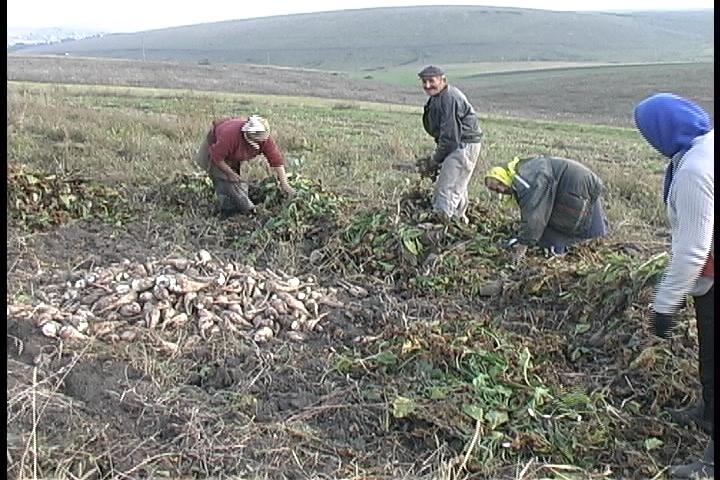 Cleaning Beets in the Fields
Before the beets can be brought to the burjakpunkt, all the stems have to be chopped off.
 Vladimirets on the Scale
The Vladimirets being weighed in at the burjakpunkt. The tractor and trailor are standing on top of a large scale. You weigh-in with the trailor full of beets, then you dump the beets, and then you weigh-in again. Thus you know how many beets you dropped off, and you will be paid in sacks of processed sugar accordingly, with the factory taking a cut of your sugar as payment for processing your beets.
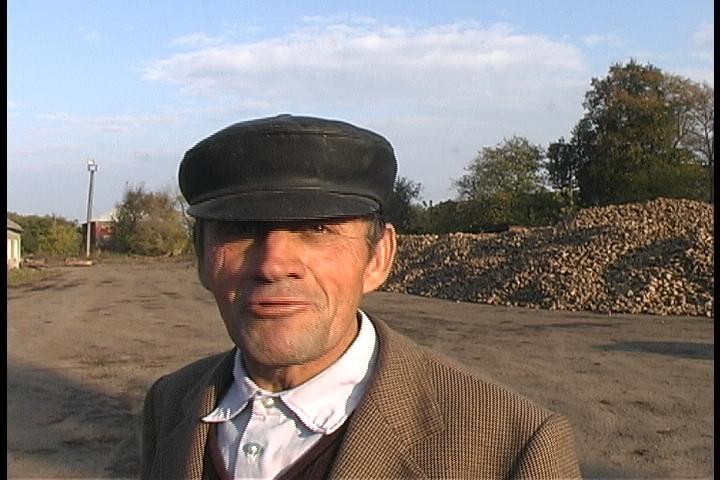 Villager
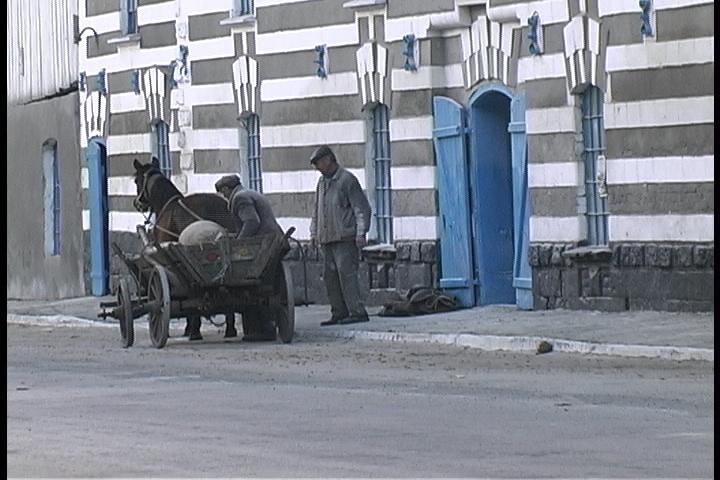
This fellow is from the tiny village of Muzhyliv, about 7km from the Pidhajtsi limits. He brought his sugar beets to the burjakpunkt by horse-drawn wagon, which is pictured below. Notice the pile of sugar beets behind him. A quarter of his day was spent getting there, another quarter getting home. He might have had enough in that wagon for half a sack. While talking to him, I learned that he was quite poor. I asked him why, to his mind, so many Ukrainians have remained poor while Pinchuk and Akhmetov (Ukrainian oligarchs) are billionaires. He said, "Because we don't have any good leaders. They always think about themselves. . .
"
 And His Horse and Wagon
About such wagons: One day during my first ever week in Ukraine I was with my father's cousin and his daughter, Oksana, who turned to me and said, in perfect English, "Stefan, look. . .our national mode of transportation for centuries, which, still has not died. . ." The last clause of what she said was an allusion to the Ukrainian national anthem, whose opening line is "Shche ne vmerla Ukrajina (Ukraine still has not died). . ."
 Mountain of Sugar Beet
To the left of this photo is the start of a huge pile of sugar beets.
 6 Sacks of Processed Sugar for 3 Trailor Loads of Sugar Beets
All those sugar beets piled up outside get processed, and people get paid in sacks of sugar.
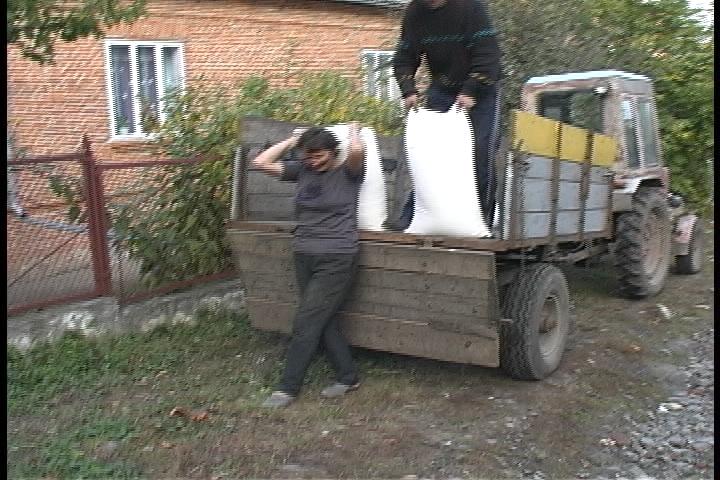
Bringin' the Sugar Home
In these three photos, Taras Kolodnytskyj and his mother Lesja unload the sacks of sugar, which are 25k each. I did put down my camera to carry in two sacks as well. I am no stranger to physical labor, as I grew up in a family of woodworkers and as the son of a good immigrant father who tried to teach me the value of hard work. While friends slept-in on weekends I went to work at his shop. While friends goofed around for the summer, I went to work at his shop. It's probably why I became such a hippie (I am not serious; there are real reasons of protest against the #1 American sickness of workaholism that one becomes a hippie). But now I like to thank him for the fact that, through his guidance and effort, I can work with both my hands and my head. When I work in the US, I drive a truck and do contract gigs, and am damn proud of it. . .

Bringin' the Sugar Home
 Bringin' the Sugar Home
They have a Ukrainian flag flying because this was UPA day, last Oct. 14. . .read the previous post for more. . .
Tuesday, October 18, 2005
Tales from the Village 1: Beet Harvest in Pictures
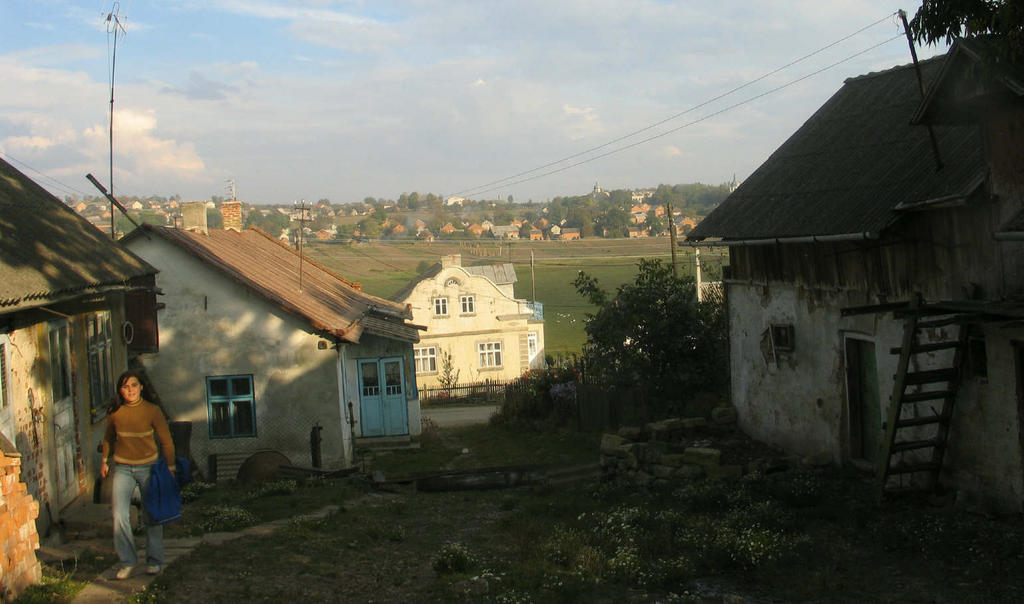 This is Oksana Kolodnyts'ka heading with me up to the fields where we will be harvestingher family's sugar beets. The view is of the village of Sil'tse across the Koropets River Valley from her grandmother's (Ol'ha Sybul'ska) homestead in the village of Halych. Sil'tse rests on a hill on the eastern side of the valley, while the town of Pidhajtsi and the village of Halych are on a hill to the west of the valley. Mind you, this is not the Halych for which much of Western Ukraine is named; that Halych is 45 km away from Pidhajtsi, and was a fortified town in medieval times. Remains of the medieval castle still stand. The village of Halych is basically a suburb of Pidhajtsi; you need a native to tell you where the town ends and the village begins. One can refer to the whole area, the town and surrounding villages, as Pidhajtsi. The population altogether is abut 7,000, and Pidhajtsi is 75km from Ternopil (pop. approx. 250,000) and 35km from Berezhany (pop. approx. 25,000). The town of Pidhajtsi also is the seat of the Pidhajtsi county (Pidhajets'kyj rajon).
The area between the town of Halych and Pidhajtsi is quite desolate. Many of the villages between the village of Halych (or Pidhajtsi) and the town of Halych have a disproportionate population of old people, as many youngsters have left in search of work in bigger cities or abroad. This means that the roads and other infrastructure in this area are quite run down even by Western Ukrainian standards, because pensioners don't pay taxes.
Last summer, that of 2004, Oksana and I once had to hitchhike from the town of Halych to Pidhajtsi. We didn't think that we would make it, as traffic was practically nil. The desolation of the area made a strong imperssion on us. An old couple returning from work in the fields that evening told us we were crazy to be traveling by auto-stop (Uki for hitchhiking; i.e., avtostop) that late in that area, and they waited with us until a car came. In the meantime, they told us about their hardships and how depressing it was in their village with so few young people around. Their own children had worked abroad, and now are living in other parts of Ukraine.
Altogether these are the Halychyna heartlands, and to some extent they are becoming depopulated. In other words, this is rural decline Ukrainian style, and which is something that the West underwent for a period of generations. The processes of deruralization in the West and the ongoing one here in Ukraine may be different, but either way, in both places, deruralization is the effect of rural neglect and profiteering by powers beyond the contorl of rural populations.
(One great book about the process of "rural modernization" in the US is Wendell Berry's classic The Unsettling of America. Berry also is a fabulous poet and essayist.)
 In this region in general the villages and most of the towns are built from the valley floor to mid-way up the hills, and usually on one side of the hill. On top of the hill and on the opposite slope usually are the fields. The above photo is another view of Sil'tse from the fields above Halych.
 These fields were all part of collective farms, but now each family has about one and a half hectares (or about 3.7 acres). This is enough for subsistence and for a degree of produce to take to market. However, here is an important point: the fields surrounding Pidhajtsi could easily be worked by a few American farming families using all the contemporary agribusiness techniques; however, if you were to apply them here, you would displace hundreds of families and ruin their livelihoods. This has been a problem in some parts of Ukraine, and is one contributing factor to rural flight.
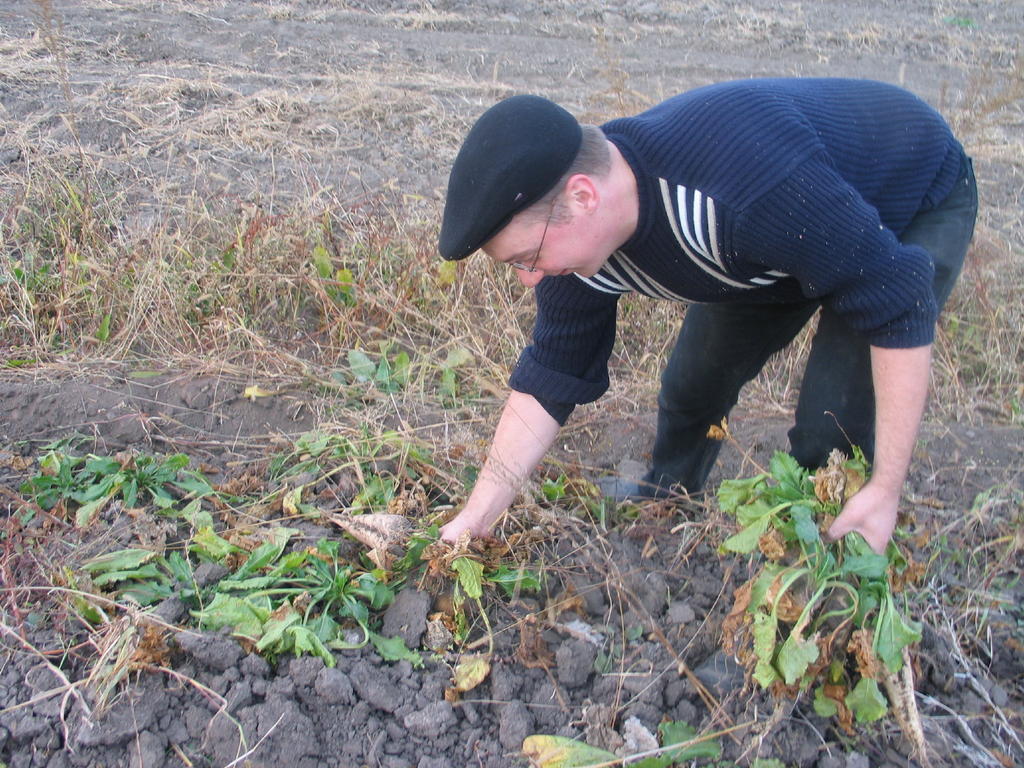 Here I appear for the first time ever on this blog. This is proof that I do actually work sometimes. The real reason I am posting it here is that I somehow managed not to get a picture of someone else picking the beets from the ground.
This year I was lucky. The Kolodnytskis all decided to pool some money and hire a guy with a tractor attachment that would dig the earth up from under the beets and turn it over, thus leaving the beets in loose soil near the surface. Last year, we picked each beet through the wet earth one by one. You can read an earlier post of mine here in which I talk about what is so important about wet earth at harvest time. In a nutshell, the Ks decided on this course of action this year as there has been no rain, and when the soil is dry, you can't pull the beets up from the earth. You have to dig each one from the ground. We tried waiting for rain before starting the work, but alas it got much too late to wait--we risked having to work in the rain, blowing winds, and the cold of the Pre-Carpathian autumn (as you can see from the photos, we are not far from the Carpathian Mountains).
Of course, the work went faster this way--last year we worked almost a week and a half, while this year the work took just three days. The Ks also gathered together a small company of neighbors and family to help out. These folks all owed the K's some help in return for their help to them. The K's have a tractor, and Taras, who is Oksana's brother and who is, like Oksana, my second-cousin, has been helping these others haul their beets to the burjakpunkt (the Beet Point), where you go to drop off and weigh your load of beets. In return you get a certain number of sacks of processed sugar, while the factory also takes a cut of the sugar for its work in processing the beets into sugar. All the sugar in Ukraine comes from sugar beets. Sugar beet is the main cash crop in the subsistence farming regiment of most of rural Western Ukraine. Lesja K, Oksana's and Taras's mother, will go to the weekly bazaar through the winter to sell sugar as the need for money arises. She is pictured below, as are Taras and Oksana again, and most significantly, as is their beloved Vladimirets Tractor. (Which makes me think of the book A Short History of Tractors in Ukrainian, which is a decent read; you can go to Neeka's site for her review of the book.)
Lesja has not held a job since the early 90s. She used to work in a preservatives factory in Soviet and early Post-Soviet times, but the managers ran the business into the ground while enriching themselves wildly. When the business closed, they sold the equipment. 100 or so people were out of work. This also happened at a woodworking plant in Pidhajtsi that produced sheets of wood out of the forests surrounding this area. From the environmentalist's perspective, it is probably a good thing that the plant shut down. However, the shut-down occured in such manner that again some managers got rich by mismanaging their business and selling off the equipment (which citizens of the Ukrainian SSR paid for, mind you), and ultimately by destroying the livelihood of another 100 or so people. I have other family who worked in that plant.
Oksana and Taras now have jobs, but for years no one in their family, not even their father Hryts, had a job. I will be posting a piece I have been working on about Hryts later. Their family's main source of income came from money sent from my grandmother in Minneapolis (their grandmother is my baba's sister), these beets, Baba Sybul'ska's pension, and the money that Hrtys made while working in Germany some years ago.
Things are a bit better for them now, as Hryts has now become a high-ranking official in the county administration. This was in part a reward for all the hard work and effort he put into the Yushchenko campaign and in organizing the OR, but his appointment also was made possible due to his local reputation as one incorruptible man. Someone in Ukraine's overwhelmingly paternalistic, connection-based kleptocracy made it into government based on principles of a meritocracy! That is, he got his post based on his merit, and not on his connections! Perhaps this a small sign that the OR has succeed a little; however, it is true that kleptocrats and nepotism still run amok in rural Ukraine, and this is why Yushchenko's cooperation with a plan to grant immunity to local officials is absurd, is indeed a betrayal of OR goals, and is why so many people in the countryside are PISSED off and disappointed.
More on Hryts and all of this some other time. . .
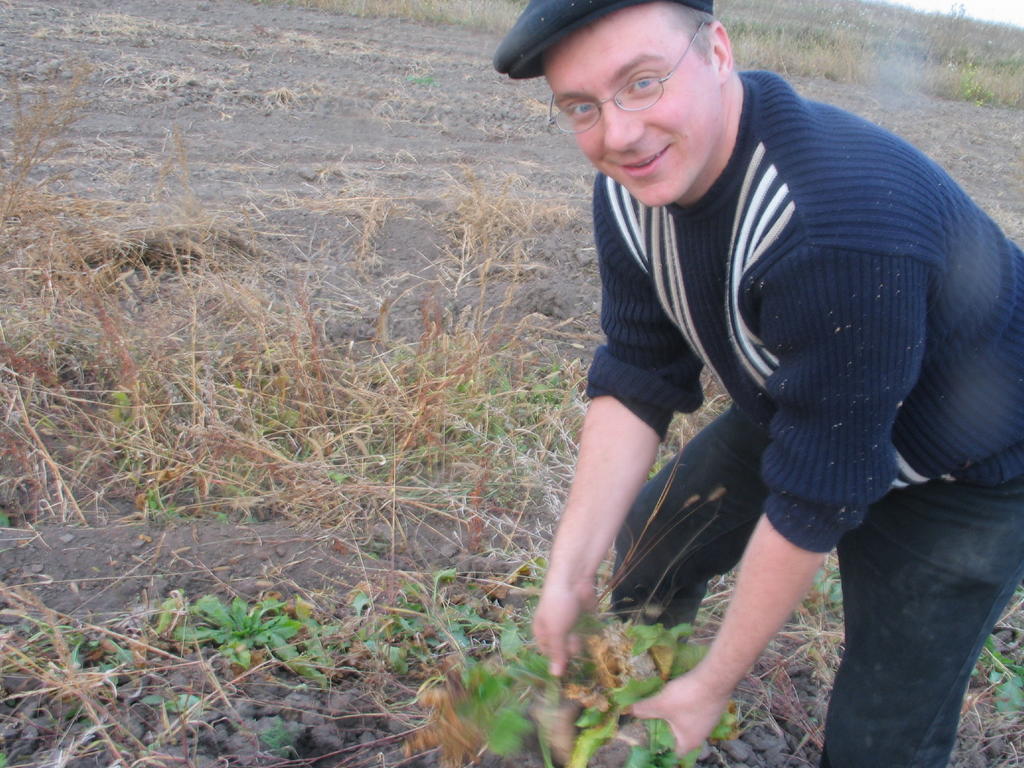
 One of the neighbors "obligated" to help out. It is not as bad as it sounds. People rather willingly help each other. Without this kind of exchange, labor for labor, the people of rural western Ukraine would not survive. There is a self-organizing specialization that happens here: this one guy knows how to fix clocks, this guy locks; that guy has a tractor, but that guy who used to have a tractor has certain combine attachments, etc.
The fellow pictured above lives in the house that is brightly illuminated in the first photo above, across the street from Baba Sybul'ska. I forgot his name, but he remembers my grandparents and recalls in vivid detail the day that they left Ukraine in 1944. By-the-way, my paternal grandparents (my mother's side is also from Ukraine) left their village on June 26, 1944. My first ever day in Ukraine and in Pidhajtsi was June 26, 2004. That I should arrive sixty years to the day that my paternal grandparents left was not a consciously planned event, as I discovered the relevant date only a few weeks before I returned to the states last February. The fellow who gave me this info was Ivan Kolodnyts'kyj, Taras and Oksana's grandfather, and husband to my baba's sister. I had asked him if he remembered the day that my grandparents left, and he said that he remembers it vividly, as he was quite fond of my grandfather. Ivan himself did not know what day I had arrived in Pidhajtsi, and after I told the date, his mouth opened in wonderment and his eyes welled with tears. Ivan is a passionate and gentle kind of man, and this is quite refreshing, given the stuffy air of machismo that far too many of the village youth try to put on and that makes me feel like I am beginning to suffocate after I have been in the village world for long enough.
Dealing with the stupid machismo is much, much worse for me than dealing with the sense of isolation one can get while in the village; or perhaps the machismo is the main source of the feeling of isolation I get when in the village world for long enough. Because of this, I generally prefer the company of women and of a few gentle fellows I know when there, and of Dido Ivan. However, I do like to go out for drinks once in a while, and the unmacho, but still real guys that I know are not drinkers (you know, if you ain't macho, you must be holobyj or some weirdo, or wait, the word that the kruti-macho guys like is a pedarast. . .). I don't much enjoy going out drinking with the macho men (the kruti) because, of course, drinking for them is a ritual of displaying extreme machismo by extreme drinking. I need to find some unmacho, but still cool, drinking buddies in Pidhajtsi. So far, such buddies have all been much older men. Anyway, I could perhaps someday write some pieces called "Tales of the Kruti". . .but nah, for they will just be scathing rants!
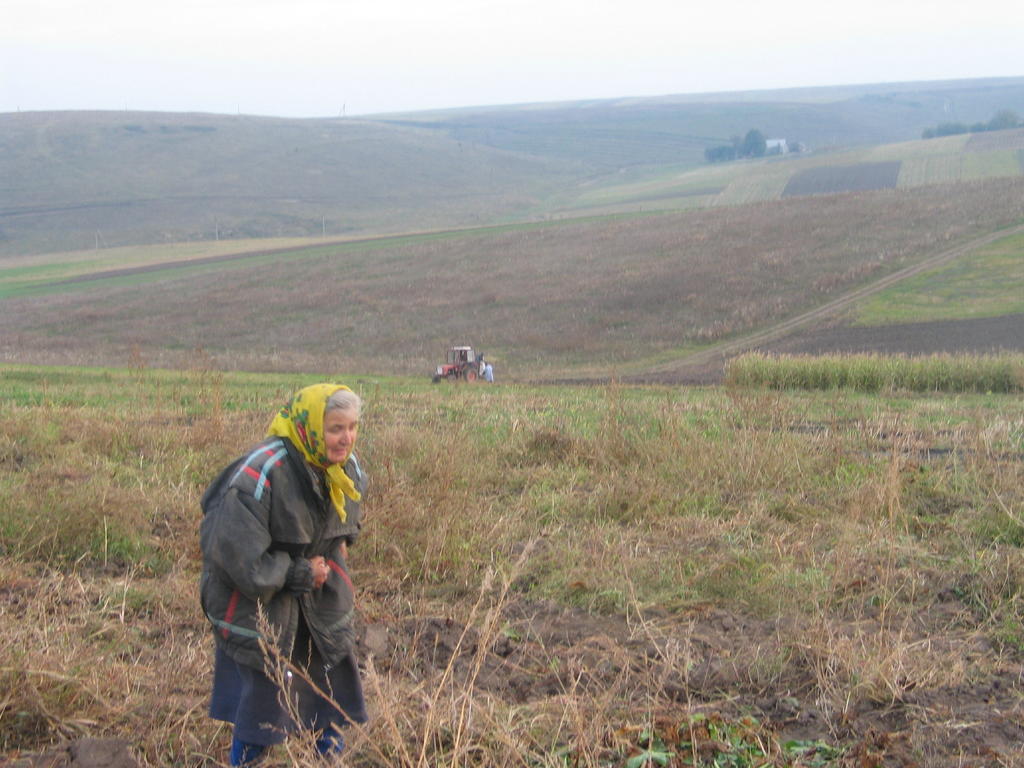 The above fellow's wife. Check out the hilliness of the terrain.
 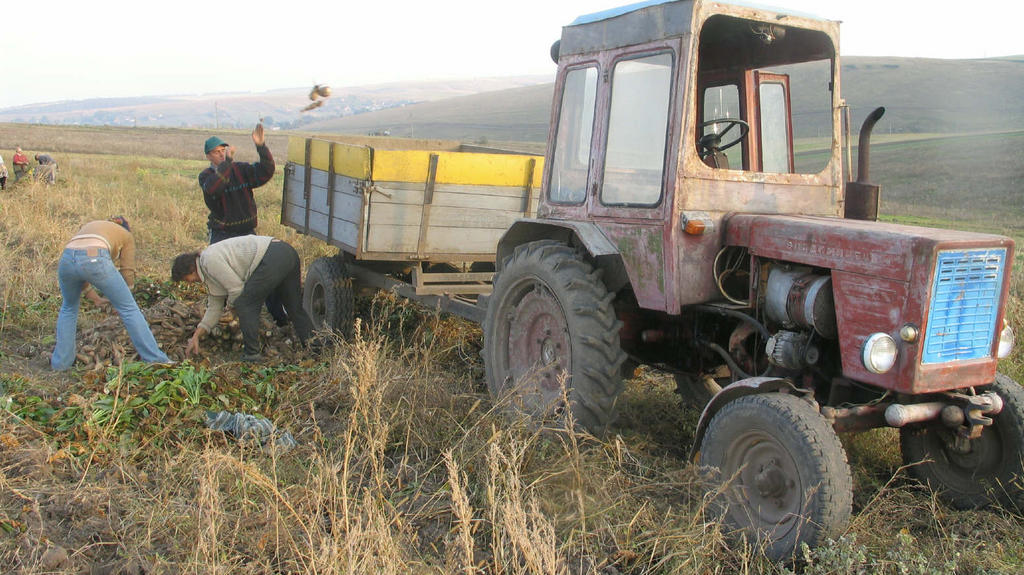 Taras, Oksana, and Lesja K tossing beets into the trailor of the Vladimirets. That's not a jug of moonshine (samohonka), but of water. The moonshine will appear in a photo below.
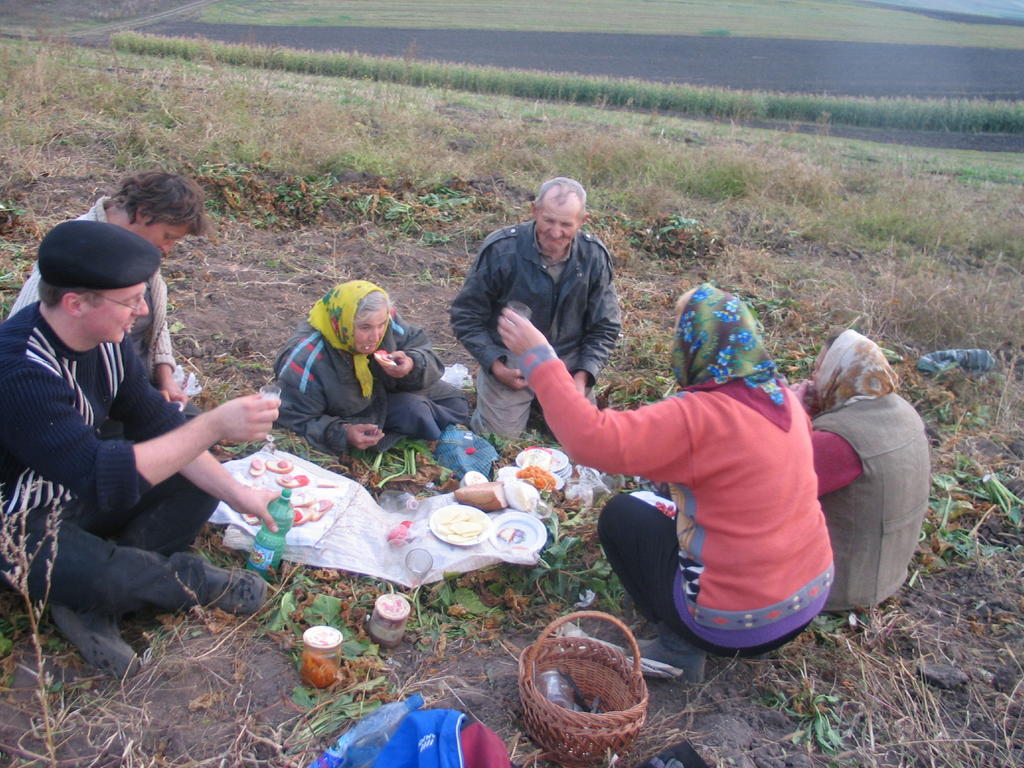
 At the end of the work, we sat for a bite to eat, and to drink and be jovial. This is the moment that makes all the work SOOOO valuable, the sitting, resting, chatting, eating, and singing in the fields. This, in so many ways, is what life in rural Ukraine is really all about. Below is a photo of the third, or fourth, or wait, was it the fifth, toast? Well, if it was the fifth, that means there was a sixth, for God loves all things in threes.
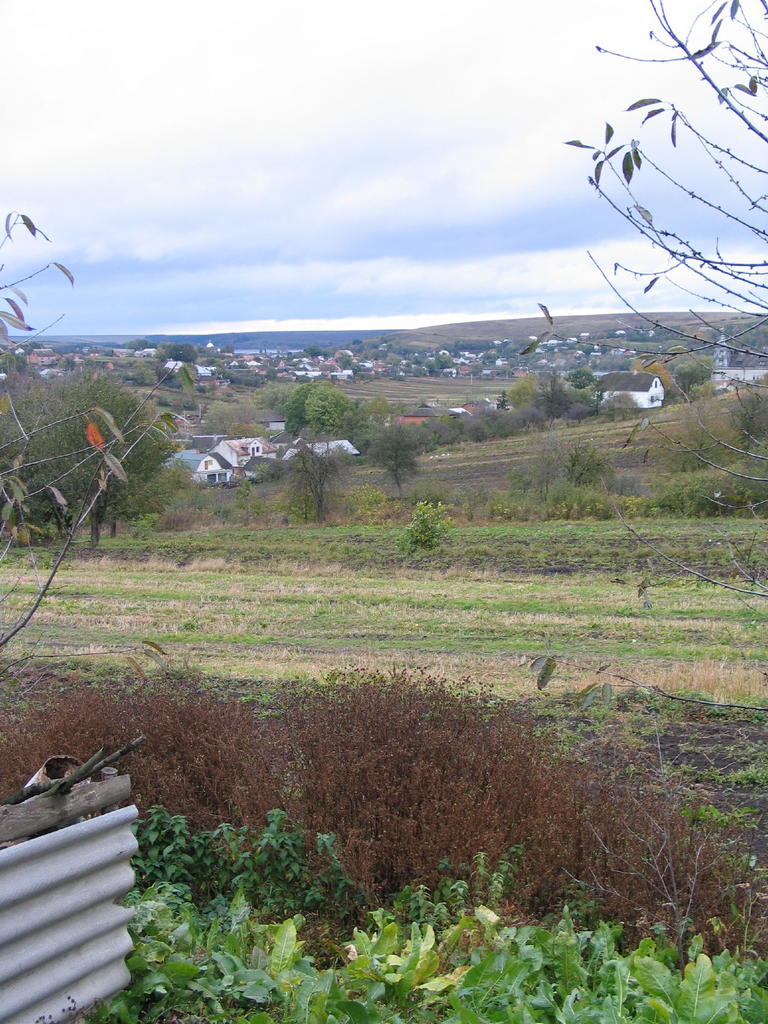 The view from the northern edge of Pidhajsti, where the K's live, to yet another village, Stare Misto.
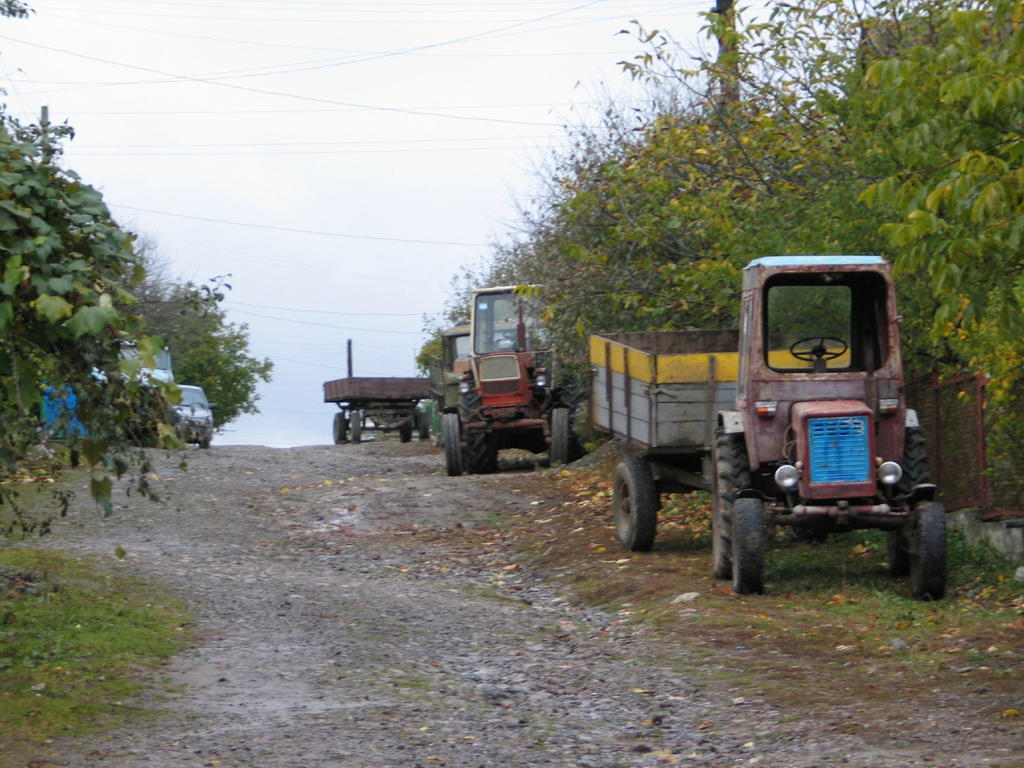 The Vladimirets parked safely back on Sunny Street (vulytsja sonjachna) in front of the K's home in Pidhajtsi, in front of another few tractors, at the end of the day after the stop at burjakpunkt.
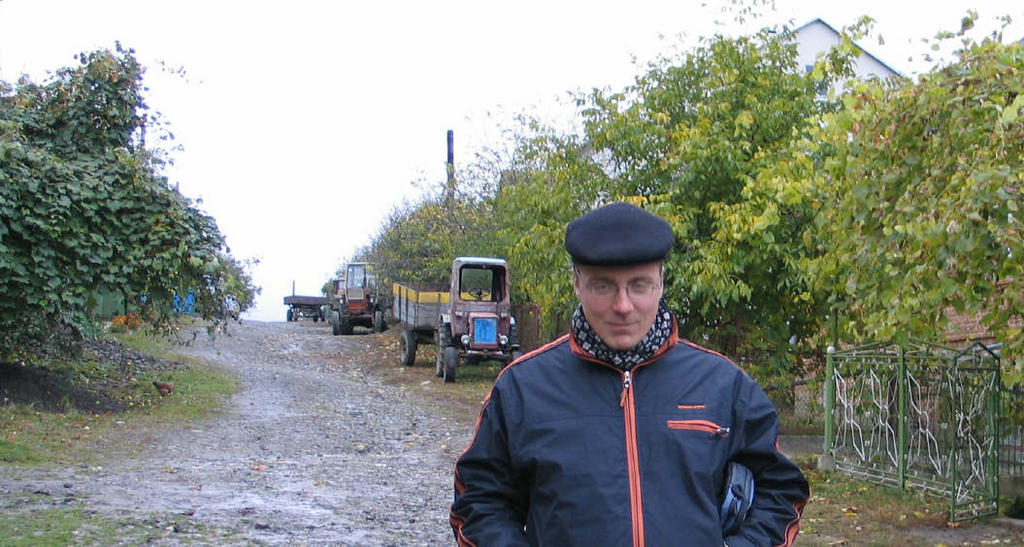 A few moments later, Oksana and I were all cleaned up and quickly headed to the local Cultural Center (Dim Kultury) for what turned out to be a rather entertaining concert in honor of the day--this was last Friday, Oct. 14, the traditional UPA day in Western Ukraine. They are trying to make it an all Ukrainian holiday, but because of the lingering effects of Soviet ideology, this holiday remains controversial in Ukraine. Check out Neeka's blog (see my links list) for some of her commentary one what took place in Kyiv (communists and others brawled with UPA veterans and celebrants on Independence Square).
As you can see, the rain started to fall just as Taras and I were heading back from the burjakpunkt in the Vladimirets. We are lucky that we got the work done, because it has been very cold and raining ever since then, including here in L'viv from whence I right.
Us'oho najkraschoho (All the Best),
Stefan
Tales from the Village. . .
Bright Lights, Big City. I have finally emerged from my sojourn in small-town Ukraine. I was not expecting to spend so much time in Pidhajtsi--I was there a total of three weeks--but one thing just led to another. One weekend there was a wedding I did not expect to go to, and that was REALLY fun; another, I spent an evening at a major party with 20-something colleagues, which meant the next day was a wash. But the main reason that I stayed for so long is that it took nearly a week and half of searching for and then begging the same people over and over to do interviews with me for my film. I was quite surprised at how difficult it was to find anyone willing to have an interview shot. But I now have some great footage, especially of work in the fields and of the few small-scale factories in Pidhajtsi.
But this is not why I am writing. In the coming weeks I will be posting photos and some pieces about my stay in Pidhajtsi. Pidhajtsi is a really interesting place in the sense that, being in the heart of the Ternopil region, it is in the heart of Halychyna, and is perhaps one of the most representative towns of what "Halychyna" is all about. It seems that every other person here has stories about family member who were active members or supporters of the OUN/UPA. In 1991, the Ternopil region had the highest voter turnout and most votes for independence. When Kuchma facecd off against UCP leader Petro Symenenko in a runoff, Pidhajtsi had (ironically, if you don't what was then at stake) the most votes for Kuchma (who had compaigned on the most pro-Ukrainian platfrom at that point in post-Soviet history). And last year, Pidhajtsi had the highest voter turnout and the most votes for Yushchenko in all of Ukraine in all three rounds of last year's election fiasco. The county of Pidhajtsi is also one of Ukraine's most impoverished with very little industry that is not related to agriculture, and it is an agricultural economy geared almost entirely to regional markets, which is to say, to neither of the more lucrative national nor export markets. It also has among the highest rates of unemployment in Ukraine, and therefore a huge number of people from here are working abroad.
I have often ruminated on the irony that this town and county of Pidhajtsi, in the heart of Halychyna and so typically Galician and thus this most fiercely patriotic of places, would have so many of its people leaving to work abroad. The pop superstar Skrjabyn (who is from Lviv but who openly and unapologetically supported Yanukovych, and who has since the OR excused himself by saying he owed his loyalty to those who helped him become such a pop star) sang a song that was kind of an anthem of sorts for a while in Ukraine; I forget the title, but he was singing to those Ukrainians living and working abroad, telling them that they should plan to return to their homeland and not forget that they are Ukrainians. It is a great song. The majority of those working abroad do hail from Western Ukraine. The fiercest supporters of the OR came from western Ukraine. Hm. Is there irony or contradiction in all this? One does sometimes hear criticism of of Western Ukrainians as pseudo-nationalists or patriots, and relatedly, one hears that they really are not patriotic but materialistic. Hm. But as I have already mentioned, Western Ukraine is much poorer than the other regions of Ukraine, and the infrastructure in Western Ukraine is in much worse condition than in the east in general. The point is, there is no irony or contradiction in any of this at all. And so here's the question: is it, willy-nilly, super nationalism that has always made Western Ukrainians so uppity, or is it the fact that they have long been the most neglected part of Ukraine? Galicia was among the most backwards, isolated, and impoverished parts of Europe in the late nineteenth century. Large numbers of Galicians left for a better life because of this, forming the first wave of Ukrainian (back then, Ruthenian) immigration to North America. The situation has hardly changed. West Ukrainian nationalism is a symptom of deeper concern. These are the folks who have suffered most from the corruption and neglect, and thus who have always fought for and needed a change in the country the most.
I write this because I am a bit tired of disparaging comments about "West Ukrainian nationalism" one encounters here and there, in the blogosphere and elsewhere. . .
Look for photos and some writing in the coming days. . .
But this is not why I am writing. In the coming weeks I will be posting photos and some pieces about my stay in Pidhajtsi. Pidhajtsi is a really interesting place in the sense that, being in the heart of the Ternopil region, it is in the heart of Halychyna, and is perhaps one of the most representative towns of what "Halychyna" is all about. It seems that every other person here has stories about family member who were active members or supporters of the OUN/UPA. In 1991, the Ternopil region had the highest voter turnout and most votes for independence. When Kuchma facecd off against UCP leader Petro Symenenko in a runoff, Pidhajtsi had (ironically, if you don't what was then at stake) the most votes for Kuchma (who had compaigned on the most pro-Ukrainian platfrom at that point in post-Soviet history). And last year, Pidhajtsi had the highest voter turnout and the most votes for Yushchenko in all of Ukraine in all three rounds of last year's election fiasco. The county of Pidhajtsi is also one of Ukraine's most impoverished with very little industry that is not related to agriculture, and it is an agricultural economy geared almost entirely to regional markets, which is to say, to neither of the more lucrative national nor export markets. It also has among the highest rates of unemployment in Ukraine, and therefore a huge number of people from here are working abroad.
I have often ruminated on the irony that this town and county of Pidhajtsi, in the heart of Halychyna and so typically Galician and thus this most fiercely patriotic of places, would have so many of its people leaving to work abroad. The pop superstar Skrjabyn (who is from Lviv but who openly and unapologetically supported Yanukovych, and who has since the OR excused himself by saying he owed his loyalty to those who helped him become such a pop star) sang a song that was kind of an anthem of sorts for a while in Ukraine; I forget the title, but he was singing to those Ukrainians living and working abroad, telling them that they should plan to return to their homeland and not forget that they are Ukrainians. It is a great song. The majority of those working abroad do hail from Western Ukraine. The fiercest supporters of the OR came from western Ukraine. Hm. Is there irony or contradiction in all this? One does sometimes hear criticism of of Western Ukrainians as pseudo-nationalists or patriots, and relatedly, one hears that they really are not patriotic but materialistic. Hm. But as I have already mentioned, Western Ukraine is much poorer than the other regions of Ukraine, and the infrastructure in Western Ukraine is in much worse condition than in the east in general. The point is, there is no irony or contradiction in any of this at all. And so here's the question: is it, willy-nilly, super nationalism that has always made Western Ukrainians so uppity, or is it the fact that they have long been the most neglected part of Ukraine? Galicia was among the most backwards, isolated, and impoverished parts of Europe in the late nineteenth century. Large numbers of Galicians left for a better life because of this, forming the first wave of Ukrainian (back then, Ruthenian) immigration to North America. The situation has hardly changed. West Ukrainian nationalism is a symptom of deeper concern. These are the folks who have suffered most from the corruption and neglect, and thus who have always fought for and needed a change in the country the most.
I write this because I am a bit tired of disparaging comments about "West Ukrainian nationalism" one encounters here and there, in the blogosphere and elsewhere. . .
Look for photos and some writing in the coming days. . .
Monday, October 10, 2005
Aslund and Kuzio Articles, Current Election Stats
Here are two articles--one from Anders Aslund and the-now-usual rebuttal from Taras Kuzio--that I have cut and pasted from the Ukraine List sent out by the Chair of Ukrainian Studies at the U of Ottawa, write to him darel@uottawa.ca to get a free subscription to the list.
I of course appreciate the rebuttal by Kuzio. . .
Sorry, no time to edit in the paragraph breaks (for some reason when I cut and paste to blogger, the paragraph breaks get lost. . .)
One other thing: a recent poll published in the newspaper Express (from Lviv) stated that if the parliamentary elections were held today, Regions of Ukraine (Yanukovych's party) and BJUT (the Yulia Tymoshenko Bloc) would basically tie at around 23%, while People's Union Our Ukraine (the party of Yushchenko, Poroshenko, et al) would garner about 8 or 9%. As for the rest of the major players, I forget the stats. . . (Sorry, I got these figures slightly wrong--Regions and BJUT have around 20% while People's Union Our Ukraine has 13%; edit Oct. 11)
Ukraine's Orange Revolution Can Still Succeed
by Anders AslundFinancial Times, 26 September 2005
The writer is director of the Russian and Eurasian programme at theCarnegie Endowment for International Peace (CEIP), Washington, D.C.
Ukraine's parliament last week confirmed Yuriy Yekhanurov as the country'snew prime minister by an overwhelming majority. Mr Yekhanurov replacesYulia Tymoshenko, the colourful heroine of the Orange Revolution.The move closed a chapter in Ukraine's history but the accomplishments of that "revolution" remain palpable. Ukraine has become a real democracy withfree and lively media, and its foreign policy has become western-oriented.For the past eight months, however, Ukraine's economic policy has beennothing short of disastrous. Economic growth has plummeted from an annual12 per cent last year to 2.8 per cent so far this year, driven by a fallin investment.The blame for this startling deterioration must lie with the government'seconomic policies. By agitating for widespread nationalisation and renewedsales of privatised companies, the government undermined property rights.In addition, it raised the tax burden sharply to finance huge increases inwelfare spending and public wages.Very publicly, Ms Tymoshenko interfered in pricing and property disputes,criticising individual businessmen. Chaos and uncertainty prevailed. Thispopulist policy had little in common with the electoral promises of ViktorYushchenko, the president, about liberal market reforms.Therefore, it was a great relief for the business community and economiststo see the revolutionary firebrands leave the government.Simultaneously, Mr Yushchenko dismissed several big businessmen fromofficial posts who were accused of having confused high government officewith their private business.It was a welcome sign that the newly born Ukrainian democracy was strongenough to be able to oust them after only seven months. Ukraine could nolonger afford their extravagant public quarrels.Today, Ukraine needs a competent government that can pursue a sensibleeconomic policy. For this task, Mr Yekhanurov appears almost ideal.He is one of Ukraine's most experienced economic politicians, having carriedout an earlier programme of mass privatisation and served as then primeminister Yushchenko's first deputy from 1999 to 2001.He has a clean reputation and few enemies and is known as an effectiveadministrator. He keeps a low public profile but that is exactly whatpost-revolutionary Ukraine needs. Mr Yushchenko appears to have kept thisloyal man in reserve.The composition of the new government will be announced any day now butits contours are already clear. About one-third of the incumbents will stay;one-third of the ministers will be able and untainted technocrats from theprevious Kuchma regime; and one- third will be newcomer professionals. Asthis government is supported by nine of the parliament's 14 party factions,it has a sound majority.Thus there are hopes the new government will be quite productive, althoughit will serve for only half a year until parliamentary elections next March.Its first task will be to stop the destabilising re-privatisation campaign,which is likely to lead to only one or two re-privatisations, and declare abig amnesty for other privatisations.A long-promised major deregulation, eliminating thousands of harmful legalacts, will finally be promulgated. The last laws needed for Ukraine'saccession to the World Trade Organisation can now be swiftly adopted. Thebudget for next year, which contains some tax cuts, needs to be enacted.The crucial political battle, however, is the elections next March. Theconfirmation vote for Mr Yekhanurov suggests a new dividing line inUkrainian politics. Most of the rightwing and centrist party factionssupported Mr Yekhanurov, while Ms Tymoshenko's bloc, the communists,and two oligarchic parties opposed him.From now on, the big antagonists in Ukrainian politics are likely to be MrYushchenko and Ms Tymoshenko. Their individual popularity remains roughlyequal. A consolidation around these two figures is possible, especially asthe next elections will be proportional.Ideally, a US-type Republican party could be formed around Mr Yushchenkoand a more leftwing, populist Democratic party around Ms Tymoshenko, butit is also possible that the old fragmentation will persist.Each side has "orange revolutionaries" as well as oligarchs from the Kuchmaperiod. The big question is whether Ms Tymoshenko's revolutionary fire hasburnt out or whether Mr Yushchenko's bold attempt at post-revolutionary
stabilisation is premature.
The Rift that Wrecked Ukraine's Revolution
Letter to the EditorFinancial Times, 29 September 2005
From Prof. Taras Kuzio.
Sir, Ukraine's Orange Revolution, like all revolutions, has a growing a number of myths surrounding it. One, according to Anders Aslund ("Ukraine's Orange Revolution can still end in success", September 26), was that Viktor Yushchenko's election programme supported "liberal market reforms". Yet any careful reading of his election programme shows it was highly populist in the economic and social domains.Mr Yushchenko's election programme became in essence that of the Yulia Tymoshenko government. Mr Yushchenko supported the inclusion of Socialists in the Tymoshenko government, including the head of the State Property Fund.Mr Yushchenko said Ms Tymoshenko led a "young, enthusiastic and self-confident government [that] has demonstrated both macroeconomic culture and increase in social standards".Throughout this year the president has only intervened after crises reached boiling point. Whereas his predecessor, Leonid Kuchma, was a micro-manager, Mr Yushchenko has a distant, hands-off style. His lack of direction was made worse by his attempt at balancing Ms Tymoshenko with his business ally, Petro Poroshenko, as secretary of the National Security Council, in effect creating two competing governments.While concurring with Mr Aslund that some of the Tymoshenko government policies were damaging for Ukraine's economy, we should lay the blame fairly on both Mr Yushchenko and Ms Tymoshenko.
Taras Kuzio,Visiting Professor,George Washington University,Washington, DC 20052, US
I of course appreciate the rebuttal by Kuzio. . .
Sorry, no time to edit in the paragraph breaks (for some reason when I cut and paste to blogger, the paragraph breaks get lost. . .)
One other thing: a recent poll published in the newspaper Express (from Lviv) stated that if the parliamentary elections were held today, Regions of Ukraine (Yanukovych's party) and BJUT (the Yulia Tymoshenko Bloc) would basically tie at around 23%, while People's Union Our Ukraine (the party of Yushchenko, Poroshenko, et al) would garner about 8 or 9%. As for the rest of the major players, I forget the stats. . . (Sorry, I got these figures slightly wrong--Regions and BJUT have around 20% while People's Union Our Ukraine has 13%; edit Oct. 11)
Ukraine's Orange Revolution Can Still Succeed
by Anders AslundFinancial Times, 26 September 2005
The writer is director of the Russian and Eurasian programme at theCarnegie Endowment for International Peace (CEIP), Washington, D.C.
Ukraine's parliament last week confirmed Yuriy Yekhanurov as the country'snew prime minister by an overwhelming majority. Mr Yekhanurov replacesYulia Tymoshenko, the colourful heroine of the Orange Revolution.The move closed a chapter in Ukraine's history but the accomplishments of that "revolution" remain palpable. Ukraine has become a real democracy withfree and lively media, and its foreign policy has become western-oriented.For the past eight months, however, Ukraine's economic policy has beennothing short of disastrous. Economic growth has plummeted from an annual12 per cent last year to 2.8 per cent so far this year, driven by a fallin investment.The blame for this startling deterioration must lie with the government'seconomic policies. By agitating for widespread nationalisation and renewedsales of privatised companies, the government undermined property rights.In addition, it raised the tax burden sharply to finance huge increases inwelfare spending and public wages.Very publicly, Ms Tymoshenko interfered in pricing and property disputes,criticising individual businessmen. Chaos and uncertainty prevailed. Thispopulist policy had little in common with the electoral promises of ViktorYushchenko, the president, about liberal market reforms.Therefore, it was a great relief for the business community and economiststo see the revolutionary firebrands leave the government.Simultaneously, Mr Yushchenko dismissed several big businessmen fromofficial posts who were accused of having confused high government officewith their private business.It was a welcome sign that the newly born Ukrainian democracy was strongenough to be able to oust them after only seven months. Ukraine could nolonger afford their extravagant public quarrels.Today, Ukraine needs a competent government that can pursue a sensibleeconomic policy. For this task, Mr Yekhanurov appears almost ideal.He is one of Ukraine's most experienced economic politicians, having carriedout an earlier programme of mass privatisation and served as then primeminister Yushchenko's first deputy from 1999 to 2001.He has a clean reputation and few enemies and is known as an effectiveadministrator. He keeps a low public profile but that is exactly whatpost-revolutionary Ukraine needs. Mr Yushchenko appears to have kept thisloyal man in reserve.The composition of the new government will be announced any day now butits contours are already clear. About one-third of the incumbents will stay;one-third of the ministers will be able and untainted technocrats from theprevious Kuchma regime; and one- third will be newcomer professionals. Asthis government is supported by nine of the parliament's 14 party factions,it has a sound majority.Thus there are hopes the new government will be quite productive, althoughit will serve for only half a year until parliamentary elections next March.Its first task will be to stop the destabilising re-privatisation campaign,which is likely to lead to only one or two re-privatisations, and declare abig amnesty for other privatisations.A long-promised major deregulation, eliminating thousands of harmful legalacts, will finally be promulgated. The last laws needed for Ukraine'saccession to the World Trade Organisation can now be swiftly adopted. Thebudget for next year, which contains some tax cuts, needs to be enacted.The crucial political battle, however, is the elections next March. Theconfirmation vote for Mr Yekhanurov suggests a new dividing line inUkrainian politics. Most of the rightwing and centrist party factionssupported Mr Yekhanurov, while Ms Tymoshenko's bloc, the communists,and two oligarchic parties opposed him.From now on, the big antagonists in Ukrainian politics are likely to be MrYushchenko and Ms Tymoshenko. Their individual popularity remains roughlyequal. A consolidation around these two figures is possible, especially asthe next elections will be proportional.Ideally, a US-type Republican party could be formed around Mr Yushchenkoand a more leftwing, populist Democratic party around Ms Tymoshenko, butit is also possible that the old fragmentation will persist.Each side has "orange revolutionaries" as well as oligarchs from the Kuchmaperiod. The big question is whether Ms Tymoshenko's revolutionary fire hasburnt out or whether Mr Yushchenko's bold attempt at post-revolutionary
stabilisation is premature.
The Rift that Wrecked Ukraine's Revolution
Letter to the EditorFinancial Times, 29 September 2005
From Prof. Taras Kuzio.
Sir, Ukraine's Orange Revolution, like all revolutions, has a growing a number of myths surrounding it. One, according to Anders Aslund ("Ukraine's Orange Revolution can still end in success", September 26), was that Viktor Yushchenko's election programme supported "liberal market reforms". Yet any careful reading of his election programme shows it was highly populist in the economic and social domains.Mr Yushchenko's election programme became in essence that of the Yulia Tymoshenko government. Mr Yushchenko supported the inclusion of Socialists in the Tymoshenko government, including the head of the State Property Fund.Mr Yushchenko said Ms Tymoshenko led a "young, enthusiastic and self-confident government [that] has demonstrated both macroeconomic culture and increase in social standards".Throughout this year the president has only intervened after crises reached boiling point. Whereas his predecessor, Leonid Kuchma, was a micro-manager, Mr Yushchenko has a distant, hands-off style. His lack of direction was made worse by his attempt at balancing Ms Tymoshenko with his business ally, Petro Poroshenko, as secretary of the National Security Council, in effect creating two competing governments.While concurring with Mr Aslund that some of the Tymoshenko government policies were damaging for Ukraine's economy, we should lay the blame fairly on both Mr Yushchenko and Ms Tymoshenko.
Taras Kuzio,Visiting Professor,George Washington University,Washington, DC 20052, US
Tuesday, October 04, 2005
Some quick observations on Ukraine then the US
Not much time to write. Follow the links to Neeka's Backlog for good, ongoing commentary on the ongoing situation in Ukraine. Also follow the news links on my blog. . .
Still no beet-harvesting with my family in Pidhajtsi. But I have done a ton of filming and inteviewing. Based on my observations from L'viv, some locales in the Carpathians, Pidhajtsi in the Galician heartlands, Ternopil, Kyiv, Odessa, and Poltava, it seems the following is the case with all of those who supported the OR:
By and large, average people are either now completely against all of them (Yushchenko, Poroshenko, Tymoshenko, et al) and still have no idea who to vote for next Spring, or if they are still for someone, they are overwhelmingly pro-Tymoshenko. .
I guess this is an obvious observation. But even among those who have been critical of them all, people seem to hold the least against Tymoshenko; whether this will be for better or worse, we will have to see.
I will be in Kharkiv and elsewhere in the east in a week or two to see what is up there.
Now on to the US:
I just read that Bush is giving his first press conference since May. Does this mean that he didn't once speak directly to the nation of which he is the nominal leader during the immediate days of the hurricane crisis? What, he can't defend himself to the people? I am tired of this aloof and executive-power drunk administration and the damned congress that tolerates it. Can the congress altogether say, "Bah! Bah! Bah!" Bush is not the God-appointed good Shepherd he took himself to be after 911 (don't forget he proclaimed that he felt he was meant to be president in this supposedly new time of terror). He's given the least press conferences of any president for a long time, while at the same time his administration and his justice-department wonks are doing everything they can to eliminate or limit transparency in government and business based on the excuse of terrorism. He's becoming ever more aloof and out of touch, while at the same time demanding the upmost respect for the post of presidency. Amreicans are being slowly convinced to accept a kind of king again. This is hyperbole, of course, but the point is: The US system under the Bush administration and under the Patriot Acts and under a president who looks as ridiculous and aloof as Kuchma used to at his press conferences has become far too tipped toward executive power.
I hope no heir to Bush is elected--or steals the election--next time around and that the Patriot Acts will be in every way revoked.
Still no beet-harvesting with my family in Pidhajtsi. But I have done a ton of filming and inteviewing. Based on my observations from L'viv, some locales in the Carpathians, Pidhajtsi in the Galician heartlands, Ternopil, Kyiv, Odessa, and Poltava, it seems the following is the case with all of those who supported the OR:
By and large, average people are either now completely against all of them (Yushchenko, Poroshenko, Tymoshenko, et al) and still have no idea who to vote for next Spring, or if they are still for someone, they are overwhelmingly pro-Tymoshenko. .
I guess this is an obvious observation. But even among those who have been critical of them all, people seem to hold the least against Tymoshenko; whether this will be for better or worse, we will have to see.
I will be in Kharkiv and elsewhere in the east in a week or two to see what is up there.
Now on to the US:
I just read that Bush is giving his first press conference since May. Does this mean that he didn't once speak directly to the nation of which he is the nominal leader during the immediate days of the hurricane crisis? What, he can't defend himself to the people? I am tired of this aloof and executive-power drunk administration and the damned congress that tolerates it. Can the congress altogether say, "Bah! Bah! Bah!" Bush is not the God-appointed good Shepherd he took himself to be after 911 (don't forget he proclaimed that he felt he was meant to be president in this supposedly new time of terror). He's given the least press conferences of any president for a long time, while at the same time his administration and his justice-department wonks are doing everything they can to eliminate or limit transparency in government and business based on the excuse of terrorism. He's becoming ever more aloof and out of touch, while at the same time demanding the upmost respect for the post of presidency. Amreicans are being slowly convinced to accept a kind of king again. This is hyperbole, of course, but the point is: The US system under the Bush administration and under the Patriot Acts and under a president who looks as ridiculous and aloof as Kuchma used to at his press conferences has become far too tipped toward executive power.
I hope no heir to Bush is elected--or steals the election--next time around and that the Patriot Acts will be in every way revoked.
Friday, September 30, 2005
Boloto ne Zoloto
That mud is the bane of many a Ukrainian villager—especially in agricultural, hilly or pre-Carpathian, erosion-ridden and therefore mud-covered, rural Western Ukraine—is illustrated by the comment that, “Boloto ne Zoloto!” No two terms could be more opposing in this rural struggle. Just change one letter of both terms, and you discover between them a dialectical unity of sorts: They form two poles of a single continuum that are immanent to one another. Thus, sometimes, mud is as good as gold, as it is these days, in the fall of 2005 in Pidhajtsi, during a fall harvest season with no rain. It is just short of damn near impossible to pull those money-makers, those damned little cash-crops, by hand when the top soil is baked a solid cake above the bulbs of sugar beats. So we have done no sugar beet harvesting. There is an acre and half or more waiting to be pulled. It’s a lot of work as it is when the topsoil is wet and friendly and readily allows the bulbs to pop free, but now the season is getting late. Soon we will have to hit the fields with shovels, to dig nearly each one from the ground, if the rain does not arrive—and one starts to wonder whether all the work be worth the pittance one will receive for the cash crop. These folks here, my family, are subsistence farmers with some supplemental income. They have no choice—they need whatever money they get, no matter how aggravating the work will be. So we wait for the rains until the latest possible moment. If you are Christian, pray for for rain for western Ukraine. If you are pagan, do a dance. And if you are Buddhist, you will advise us all here to calm our minds and just get to the work at hand with a peaceful mind, no matter how hard it is!
More later, gotta catch a bus back to Pidhajtsi. . .writing from Ternopil. . .
More later, gotta catch a bus back to Pidhajtsi. . .writing from Ternopil. . .
Monday, September 26, 2005
Personally Still Flabbergasted, Exacerbated By It All. . .
Two opinions, one article, on the compromise that got Yekhanurov approved (this is one of the weirdest keyboards, from my perspective, that I have ever seen. None of the punctutation marks are in their regular places for English fonts, and do not correspond to the symbols on the keyboard. . . ARGHHH!)
1) This is from Ukraine blogger Leopolis:
In Ukraine, Viktor (orange) and Viktor (blue) signed a pact that ushered in the approval of Yekhanurov and called for fair elections without administrative resources. It seems that Yushchenko has betrayed the Orange Revolution by suddenly making friends with evil Ya, right? Let's put it into perspective. 1) So far, Yu hasn't gone after election fraud perpetrators and it looks like he won't in the future. High school teachers in Donbass were just as responsible for election fraud as Kivalov was. Unfortunately, lustration failed to stick in this realm 2) After the Orange Revolution, Russia and everyone else expected that Ukraine would fracture into a deeper inter-regional blue-orange conflict; instead, former enemies are working peacefully in the Rada 3) Yushchenko is now more acceptable and legitimate for east Ukrainians thanks to this agreement potentially stealing votes from those who voted for Ya in 2004, or couldn't because of fraud 4) Yanukovych, without the direct patronage of Putin, can no longer seriously be the bogeyman in Ukrainian politics. This is demonstrated by a lack of opposition until Tymoshenko's pledge to form a counter force this month. Ya in 2004 does not equal Ya in 2006 5) Those who are most upset by the new pact , i.e. the "hardcore Ukrainian nationalists from west Ukraine" are going to vote for Tymoshenko anyway.
2) From Volodymyr Kish, writing to the the Toronto Ukrainian diaspora paper The New Pathway (Mr Kish is resident of Kyiv and a businessman with many years of experience in upper management and years of accumulated experience in and knowledge about doing business in Ukraine):
The View From There
By Walter Kish
A Deal with the Devil
The political events of this past week in Ukraine have left me both dumbfounded and more than a little disillusioned. Following a narrow failed vote to get his candidate Yuri Yekhanurov confirmed as interim Prime Minister, President Yushchenko did what many people here consider unthinkable – he made a deal with the devil in the person of his political archenemy Viktor Yanukovich.
The price Yushchenko paid was steep – an amnesty for all those accused of election fraud and vote-rigging, an end to “political persecution of the opposition” (read: the investigation and prosecution of any of the oligarchs, crooks and bandits who have pillaged Ukraine for the past decade), immunity from prosecution of any member of local, regional or oblast council, and granting the opposition political forces the chairmanship of a number of key Parliamentary committees including the committee for freedom of expression and information, and the committee for combating organized crime and corruption. The foxes have once again been granted the key to the chicken coop.
All those promises made during the Revolution about routing out corruption and bringing to justice those that have so abused the law and the people of Ukraine are now just empty words. As one political commentator here put it, you can now forget about those responsible for Gongadze’s murder or Yushchenko’s poisoning ever being prosecuted, all those oligarchs who got rich by stealing the country’s assets can now rest easy that their ill gotten gains are safe, and the business of politics in Ukraine can now revert back to being the cynical, corrupt, power game it has been since Ukraine became independent.
I find this turn of events almost incomprehensible. Why is it that Yushchenko was not able to find a compromise with the Tymoshenko bloc which shares virtually all his political and reformist ideals and principles, but was able to strike a deal with the very forces that cheated him of his election victory, were likely responsible for his poisoning, and whose policies and ideology are completely antagonistic to his own? Has his personal animosity for Yulia Tymoshenko so clouded his judgment that he prefers the company of Yanukovich, Kuchma and his gang? Was confirming a caretaker government for six months worth sacrificing all the most fundamental principles and ideals that brought all those hundreds of thousands of people to the Maidan last November and December? The irony of the situation is that most political experts say that Yushchenko could have gotten Yekhanurov confirmed as PM, albeit narrowly, without the support of Yanukovich and his Regions party.
It has become abundantly clear that whereas Yushchenko may have succeeded brilliantly in staging a revolution, he clearly lacks the skills that it takes to govern effectively and to manage the political processes in this country. To me, it is personally saddening, because I believe in his personal integrity and commitment. Nonetheless, he has fallen significantly short of being the leader everyone expected.
So now it seems to be business as usual in the running of the country, and neither I nor anyone in Ukraine should take comfort in that statement. The only winner in all that has transpired is Yulia Tymoshenko. Going into the Parliamentary elections next March she can effectively claim to be the only true inheritor of the orange revolutionary mantle. You can rest assured that she will campaign aggressively claiming that Yushchenko and his bloc have sold out the revolution and are no better than their predecessors. Whether she can win a majority remains to be seen.
The big losers of course, are all those millions of people who believed those inspiring ideals and promises that were so eloquently proclaimed on the Maidan.Who are they to believe and trust now?
Back to me: Kish's piece echoes what I have heard most people in Ukraine saying so far, on the street--and I have been in Odessa and Lviv, while talking with others in various parts (Poltava, Kyiv, and a small west-Ukrainian town). One can certainly bet that Tymoshenko will campaign on promises to continue reprivatization and prosecution/lustration--of higher ranking officials, not school teachers. (Lustration in the former Czechoslovakia, for example, targeted higher-ranking officials, not the run-of-the-mill apparatchyky or party grunts, on the theory that people in greater positions of power and authority bare greater responsibility. Ukraine does need some kind of Peace and Reconciliation process. . .Yushchenko seems to me to be too willing to give up on that process on the basis of a percieved threat of a too great instability )
3) Kuzio on the deal.
Neeka mentions that Tymoshenko was in Moscow over the weekend meeting with the Prosecutor-General, and possibly with Putin himself, and that all charges against her have now been dropped.
Any suspicious commentary/thoughts?
And oh, I am disappearing into the selo (village) world for a while and so won't have chance to re-surface in cyberspace for a few days (I may venture to Ternopil from Pidhajtsi ina couple of days if the itch for internet and news and email gets too great). I will be visiting family, chatting about politics, and working in the fields, helping various family groups bring in the rest of the sugar beet harvest, and do whatever else remains. I will also be filming a lot, especially the fall harvest, all for the section of the doc I am working on in which I will try to convey a sense of what it means to work the land truly by hand, and what it means to be a subsistence farmer.
1) This is from Ukraine blogger Leopolis:
In Ukraine, Viktor (orange) and Viktor (blue) signed a pact that ushered in the approval of Yekhanurov and called for fair elections without administrative resources. It seems that Yushchenko has betrayed the Orange Revolution by suddenly making friends with evil Ya, right? Let's put it into perspective. 1) So far, Yu hasn't gone after election fraud perpetrators and it looks like he won't in the future. High school teachers in Donbass were just as responsible for election fraud as Kivalov was. Unfortunately, lustration failed to stick in this realm 2) After the Orange Revolution, Russia and everyone else expected that Ukraine would fracture into a deeper inter-regional blue-orange conflict; instead, former enemies are working peacefully in the Rada 3) Yushchenko is now more acceptable and legitimate for east Ukrainians thanks to this agreement potentially stealing votes from those who voted for Ya in 2004, or couldn't because of fraud 4) Yanukovych, without the direct patronage of Putin, can no longer seriously be the bogeyman in Ukrainian politics. This is demonstrated by a lack of opposition until Tymoshenko's pledge to form a counter force this month. Ya in 2004 does not equal Ya in 2006 5) Those who are most upset by the new pact , i.e. the "hardcore Ukrainian nationalists from west Ukraine" are going to vote for Tymoshenko anyway.
2) From Volodymyr Kish, writing to the the Toronto Ukrainian diaspora paper The New Pathway (Mr Kish is resident of Kyiv and a businessman with many years of experience in upper management and years of accumulated experience in and knowledge about doing business in Ukraine):
The View From There
By Walter Kish
A Deal with the Devil
The political events of this past week in Ukraine have left me both dumbfounded and more than a little disillusioned. Following a narrow failed vote to get his candidate Yuri Yekhanurov confirmed as interim Prime Minister, President Yushchenko did what many people here consider unthinkable – he made a deal with the devil in the person of his political archenemy Viktor Yanukovich.
The price Yushchenko paid was steep – an amnesty for all those accused of election fraud and vote-rigging, an end to “political persecution of the opposition” (read: the investigation and prosecution of any of the oligarchs, crooks and bandits who have pillaged Ukraine for the past decade), immunity from prosecution of any member of local, regional or oblast council, and granting the opposition political forces the chairmanship of a number of key Parliamentary committees including the committee for freedom of expression and information, and the committee for combating organized crime and corruption. The foxes have once again been granted the key to the chicken coop.
All those promises made during the Revolution about routing out corruption and bringing to justice those that have so abused the law and the people of Ukraine are now just empty words. As one political commentator here put it, you can now forget about those responsible for Gongadze’s murder or Yushchenko’s poisoning ever being prosecuted, all those oligarchs who got rich by stealing the country’s assets can now rest easy that their ill gotten gains are safe, and the business of politics in Ukraine can now revert back to being the cynical, corrupt, power game it has been since Ukraine became independent.
I find this turn of events almost incomprehensible. Why is it that Yushchenko was not able to find a compromise with the Tymoshenko bloc which shares virtually all his political and reformist ideals and principles, but was able to strike a deal with the very forces that cheated him of his election victory, were likely responsible for his poisoning, and whose policies and ideology are completely antagonistic to his own? Has his personal animosity for Yulia Tymoshenko so clouded his judgment that he prefers the company of Yanukovich, Kuchma and his gang? Was confirming a caretaker government for six months worth sacrificing all the most fundamental principles and ideals that brought all those hundreds of thousands of people to the Maidan last November and December? The irony of the situation is that most political experts say that Yushchenko could have gotten Yekhanurov confirmed as PM, albeit narrowly, without the support of Yanukovich and his Regions party.
It has become abundantly clear that whereas Yushchenko may have succeeded brilliantly in staging a revolution, he clearly lacks the skills that it takes to govern effectively and to manage the political processes in this country. To me, it is personally saddening, because I believe in his personal integrity and commitment. Nonetheless, he has fallen significantly short of being the leader everyone expected.
So now it seems to be business as usual in the running of the country, and neither I nor anyone in Ukraine should take comfort in that statement. The only winner in all that has transpired is Yulia Tymoshenko. Going into the Parliamentary elections next March she can effectively claim to be the only true inheritor of the orange revolutionary mantle. You can rest assured that she will campaign aggressively claiming that Yushchenko and his bloc have sold out the revolution and are no better than their predecessors. Whether she can win a majority remains to be seen.
The big losers of course, are all those millions of people who believed those inspiring ideals and promises that were so eloquently proclaimed on the Maidan.Who are they to believe and trust now?
Back to me: Kish's piece echoes what I have heard most people in Ukraine saying so far, on the street--and I have been in Odessa and Lviv, while talking with others in various parts (Poltava, Kyiv, and a small west-Ukrainian town). One can certainly bet that Tymoshenko will campaign on promises to continue reprivatization and prosecution/lustration--of higher ranking officials, not school teachers. (Lustration in the former Czechoslovakia, for example, targeted higher-ranking officials, not the run-of-the-mill apparatchyky or party grunts, on the theory that people in greater positions of power and authority bare greater responsibility. Ukraine does need some kind of Peace and Reconciliation process. . .Yushchenko seems to me to be too willing to give up on that process on the basis of a percieved threat of a too great instability )
3) Kuzio on the deal.
Neeka mentions that Tymoshenko was in Moscow over the weekend meeting with the Prosecutor-General, and possibly with Putin himself, and that all charges against her have now been dropped.
Any suspicious commentary/thoughts?
And oh, I am disappearing into the selo (village) world for a while and so won't have chance to re-surface in cyberspace for a few days (I may venture to Ternopil from Pidhajtsi ina couple of days if the itch for internet and news and email gets too great). I will be visiting family, chatting about politics, and working in the fields, helping various family groups bring in the rest of the sugar beet harvest, and do whatever else remains. I will also be filming a lot, especially the fall harvest, all for the section of the doc I am working on in which I will try to convey a sense of what it means to work the land truly by hand, and what it means to be a subsistence farmer.
Sunday, September 25, 2005
Greetings from Ukraine
I am once again back in Ukraine, working on a secret project. Actually, I am here working on a project that is not secret--a documentary about the OR--but whose goal is to combat the idea that the OR, and by extension the rebellions in Yugoslavia and Georgia, was a secret US/Western project. Too much of the progressive community has flagrantly disregarded the genuinely populist nature of the OR.
I am also here to get a grip on how people feel in reaction to all the recent upheavals, and also to see the campaign season begin. Already, I have seen a lot of posters--for Our Ukraine, Tymoshenko Bloc/Fatherland Party, Green Party of Ukraine, the Socialists, and a new one (perhaps just to me) I will have to look into, the Republican Party of Ukraine.
But also, I have written in my journal some purely literary-descriptive pieces on Odessa that I will try to type up tomorrow. Odessa is, for me, the most fantastic city in Ukraine, I have decided. I repeat: Odes(s)a is simply fantastic. But expensive.
Anyhow, below is something I wrote in the comments section to a post on Neeka's Backlog about Yekhanurov being made PM. To follow it, you should know that Yushchenko had to make the following compromises in order to get the parliamentary majority he needed for Yekhanurov's approval: no prosecution of election commission workers involved in last year's election debacle; and no more reprivatization but for completing the Kryvorizhtal reprivat.
Greetings,
I too was quite disappointed with the promise to refuse further reprivatization and for no further efforts to prosecute anyone for the election violations. But I also expected these promises.
As for the latter, I have come around to thinking that this is Yushchenko' s very wise and compassionate, Buddha-and-Jesus-like side: let us just forgive and forget, make our peace, and move on into the future.
As for the former, Yekhanurov already stated sometime ago that there should be no more reprivat. And I think the above mentioned Buddha-and-Jesus thing is also what is behind Yushchenko's refusal of further reprivat (but this is generous--he is also being the tool of the international business community and investors who hate populist disturbances of any economy). Yushchenko et al seem so eager to move on into the future, and the best way is to make peace with the past, saying, "Ok, you guys got what you got through bogus means, but there will be no more bogus means. You can keep it, but you have to play with new, cleaner rules."
But the sincerity of this promise for newer, cleaner rules is rendered questionable as far as I am concerned by the fact that Yekhanurov has also has said, in relation to completing privatization, that the government should be allowed to hold meetings with members of the business community--Which one? Indigenous Ukrainian? Russian? International?--suggesting closed doors and deals struck just as before under an earlier round of privatizations before Yanukovych was PM. This, in a word, sucks.
What happened to transparency? Am I missing something here?
But once again, to be generous to Yushchenko and pals, perhaps they are weary over reprivat because of how the doors to further corruption (not perception) were opened. But that still remains to be demonstrated. One should keep in mind that the allegations of corruption against Tymoshenko are also, so far, just words. No doubt, the issue of reprivat has been very divisive, but where? In the government of Ukraine? In the opinion of the international community? Or among the Ukrainian people? I am back in Ukraine again, and have anyway been talking with lots of friends in both east and west. So OK. . .the pro-OR people, we will say, were about 55-60% of the population, and the pro-Yan were about 45-40-%. It seems to me that the break-down of people pleased/displeased with the lack of justice for the past is about the same. But that is my totally unscientific observation.
I asked my taxi driver today in Odesa what he thought about all this. He said, "I don't even want to talk about it. No justice, no fulfillment of promises. . .what are we to do with them all?"
I am also here to get a grip on how people feel in reaction to all the recent upheavals, and also to see the campaign season begin. Already, I have seen a lot of posters--for Our Ukraine, Tymoshenko Bloc/Fatherland Party, Green Party of Ukraine, the Socialists, and a new one (perhaps just to me) I will have to look into, the Republican Party of Ukraine.
But also, I have written in my journal some purely literary-descriptive pieces on Odessa that I will try to type up tomorrow. Odessa is, for me, the most fantastic city in Ukraine, I have decided. I repeat: Odes(s)a is simply fantastic. But expensive.
Anyhow, below is something I wrote in the comments section to a post on Neeka's Backlog about Yekhanurov being made PM. To follow it, you should know that Yushchenko had to make the following compromises in order to get the parliamentary majority he needed for Yekhanurov's approval: no prosecution of election commission workers involved in last year's election debacle; and no more reprivatization but for completing the Kryvorizhtal reprivat.
Greetings,
I too was quite disappointed with the promise to refuse further reprivatization and for no further efforts to prosecute anyone for the election violations. But I also expected these promises.
As for the latter, I have come around to thinking that this is Yushchenko' s very wise and compassionate, Buddha-and-Jesus-like side: let us just forgive and forget, make our peace, and move on into the future.
As for the former, Yekhanurov already stated sometime ago that there should be no more reprivat. And I think the above mentioned Buddha-and-Jesus thing is also what is behind Yushchenko's refusal of further reprivat (but this is generous--he is also being the tool of the international business community and investors who hate populist disturbances of any economy). Yushchenko et al seem so eager to move on into the future, and the best way is to make peace with the past, saying, "Ok, you guys got what you got through bogus means, but there will be no more bogus means. You can keep it, but you have to play with new, cleaner rules."
But the sincerity of this promise for newer, cleaner rules is rendered questionable as far as I am concerned by the fact that Yekhanurov has also has said, in relation to completing privatization, that the government should be allowed to hold meetings with members of the business community--Which one? Indigenous Ukrainian? Russian? International?--suggesting closed doors and deals struck just as before under an earlier round of privatizations before Yanukovych was PM. This, in a word, sucks.
What happened to transparency? Am I missing something here?
But once again, to be generous to Yushchenko and pals, perhaps they are weary over reprivat because of how the doors to further corruption (not perception) were opened. But that still remains to be demonstrated. One should keep in mind that the allegations of corruption against Tymoshenko are also, so far, just words. No doubt, the issue of reprivat has been very divisive, but where? In the government of Ukraine? In the opinion of the international community? Or among the Ukrainian people? I am back in Ukraine again, and have anyway been talking with lots of friends in both east and west. So OK. . .the pro-OR people, we will say, were about 55-60% of the population, and the pro-Yan were about 45-40-%. It seems to me that the break-down of people pleased/displeased with the lack of justice for the past is about the same. But that is my totally unscientific observation.
I asked my taxi driver today in Odesa what he thought about all this. He said, "I don't even want to talk about it. No justice, no fulfillment of promises. . .what are we to do with them all?"
Wednesday, September 21, 2005
Incredible How Events Twist and Turn
As we all know by now, Ukraine's parliament failed to accept Yekhanurov as PM. There are all these new allegations of Tymoshenko offering $30,000 or so to deputies to vote against him. And today she has made a public plea to Yushchenko to give it another go working together--i.e., to have her form another govrenment.
Well, the last two weeks have led to some major polarization, and many people have taken their sides on the matter: "He's wrong," "She's wrong," "They all are wrong." The last one is my own, but in a qualified sense: They all have been wrong, but some more than others. But I won't try to convince anyone--or myself, even--to either believe or disbelieve in these new corruption allegations against Tymoshenko. I feel exacerbated by it all, finally, much like Neeka.
But one comment: If Yushchenko does accept the offer (I rather doubt he will), he can not create another situation where there are two parallel governments, one legimate and the other one basically unconstitutional. The paralysis of the post-OR government that led to the failure to deliver on most OR promises was due in large part to the fact that Yushchenko (unconstitutionally, mind you, by endowing the post of National Security Secretary with extra powers) positioned people with different ideologies of reform in strategic (and parallel) offices to the point that they blocked each other and got nothing done. There can be only one boss of the government and one approach toward reform.
Here's two good articles on these developments, from RFE:
1) Jan Maksymiuk, the Ukraine desk editor at RFE, writes an interesting piece ("Orange Revolution Drowns Amid Mutual Recirminations) on what went wrong after the OR that ends on a totally non-objective note by giving a really biting condemnation of how the OR has failed and is, to his mind, completely over. . .I don't agree with the depth of his vindictiveness, but the article is an interesting read;
2) An article of thoughts on Yekhanurov being rejected and Tymoshenko's plea to Yushchenko form another government with her, and what the future may hold.
Well, the last two weeks have led to some major polarization, and many people have taken their sides on the matter: "He's wrong," "She's wrong," "They all are wrong." The last one is my own, but in a qualified sense: They all have been wrong, but some more than others. But I won't try to convince anyone--or myself, even--to either believe or disbelieve in these new corruption allegations against Tymoshenko. I feel exacerbated by it all, finally, much like Neeka.
But one comment: If Yushchenko does accept the offer (I rather doubt he will), he can not create another situation where there are two parallel governments, one legimate and the other one basically unconstitutional. The paralysis of the post-OR government that led to the failure to deliver on most OR promises was due in large part to the fact that Yushchenko (unconstitutionally, mind you, by endowing the post of National Security Secretary with extra powers) positioned people with different ideologies of reform in strategic (and parallel) offices to the point that they blocked each other and got nothing done. There can be only one boss of the government and one approach toward reform.
Here's two good articles on these developments, from RFE:
1) Jan Maksymiuk, the Ukraine desk editor at RFE, writes an interesting piece ("Orange Revolution Drowns Amid Mutual Recirminations) on what went wrong after the OR that ends on a totally non-objective note by giving a really biting condemnation of how the OR has failed and is, to his mind, completely over. . .I don't agree with the depth of his vindictiveness, but the article is an interesting read;
2) An article of thoughts on Yekhanurov being rejected and Tymoshenko's plea to Yushchenko form another government with her, and what the future may hold.
1) Info on Latvia's Ukrainian Diaspora; 2) Upcoming Conference in Riga on Ukrainians in the Baltics
 Ukrainian Embassy in Riga
 1) Info on Ukrainians in Latvia, excerpted from this, a publicly-run informational website about the EU:
 Ukrainians mainly entered Latvia after World War II and especially after 1959 as part of the labour force used to carry out large construction projects or as part of the Soviet army. The number of Ukrainians rose from 0.1% (around 1,800 persons) of the total population in 1935 to 3.5% (around 92,100) of the total population in 1989. According to 2004 data from the Board for Citizenship and Migration Affairs approximately 59,400 Ukrainian persons (some 2.6% of the total population) currently live in Latvia.
According to provisional statistical figures from 2000, in Latvia about 17.000 Ukrainians (27% of the total number) declare Ukrainian to be their mother tongue. These people use Ukrainian on a daily basis. 4% of Ukrainians declare Latvian to be their mother tongue, and 68% declare Russian to be their mother tongue (whereas 96% has knowledge of Russian). On the one hand this high percentage is due to the “Russification” campaign during the Soviet period which contributed significantly to the reduction of mother tongue retention rates and loss of identity among Ukrainians. But on the other hand it needs to be stressed that the number of Ukrainians declaring Russian as their mother tongue (L1) in 1989 was ‘only’ 49.3% and has thus increased by more than 15% since Latvian independence. Although more qualitative research would need to be done in this field, this increase in Russian as a mother tongue could be linked to Ukrainians identifying themselves more overtly as Russians within the new Latvian state-political constellation. Since Ukrainians seem to adhere more to Russian than to their own language (which shows a high degree of mutual intelligibility with Russian and Belorussian) it comes as no surprise that intergenerational language transmission of Ukrainian is limited to a motivated cultural minority.
Despite efforts of the Latvian government in stimulating activities that are meant to encourage Ukrainian/Latvian bilingualism the number of persons having knowledge of Latvian among the Ukrainians is only growing slowly. With the ethnic integration programme the Latvian government hopes to create favourable circumstances that will help people in maintaining their own ‘ethnic language’, and that will encourage them to learn Latvian instead of the process of “Russification” they have experienced hitherto. At present only a minority within the minority takes up the task to foster the minority language. It is questionable whether the limited use of Ukrainian on Latvian public radio (half an hour per week), its use in some cultural organisations and the very limited success of Ukrainian minority schools will help to revive the Ukrainian language. More coordinated efforts will have to be developed in the future in several societal niches to secure the situation of Ukrainian (in Latvia) in the future. A major obstacle to the revitalisation of Ukrainian is the existence of interest groups who are in favour of further “Russification” or the maintenance of Ukrainian culture without necessarily having to maintain the Ukrainian language. They tend to counter those who are interested in the revitalization of Ukrainian. This poses identity problems within the Ukrainian minority that urgently need to be studied from a qualitative point of view focusing on language attitudes and language awareness.
2) Conference announcement:
As it is in Ukrainian and I gotta run out, here are the basics in English:
International Conference on Ukrainians in the Baltics
Riga, December 9, 2005
Working Languages: Ukrainian and Latvian
Organizing Committee Contacts:
Konstjatyn Hupalo, President of Ukraine-Latvia Society
phone: +371 7598564
email: konstag@inbox.lv
Venta Kocere, director of the Latvian Academic Library
phone:+371 710 6206
email: vkocere@lib.acadlib.lv
Send submissions of your text for the conference by November 20 via email to isveice@akadlib.lv or to either of the above; for submission questions you may also call +371 759 8564 or +371 7106240
Historical and political aspects and structures of the life of the Ukrainian diaspora in the Baltics, Baltic Studies in Ukraine, contemporary Ukrainian art in the Baltics, etc.
Міжнародна науково-практична конференція
Рига, 9 грудня 2005 року
Латвійська академічна бібліотека, український інформаційний центр Латвійської академічної бібліотеки, Товариство українців в Латвії, Українське культурно-просвітницьке товариство “Дніпро” в Латвії, Посольство України в Латвійській Республіці проводять 9 грудня 2005 року в м. Рига 2-гу Міжнародну науково-практичну конференцію “Українці в Балтії”
Конференція відбудеться в приміщенні Латвійської академічної бібліотеки, Латвія, Рига,
вул. Рупнієцібас,10
Тематика конференції:
- Історичні і політичні аспекти життя української діаспори в Балтії
- Загальнобалтійська система української освіти
- Балтійська україністика і дослідження Балтії в Україні. Сучасне українське мистецтво в Балтії
- Український культурно- інформаційний простір Балтії
- Співпраця українських організацій з державними структурами та громадськими інституціями країн проживання, Посольствами України у Латвії, Литві, Естонії
надати до 10 листопада 2005 року
-назву доповіді
-інформацію про учасника: прізвище, ім’я, організація, посада, вчене звання, ступінь, телефон, факс, адреса електронної пошти, сайт
До початку роботи конференції організатори планують опублікувати збірник тез доповідей учасників конференції “Українці в Балтії”
Учасники конференції повинні надати електронний варіант своїх тез – це є необхідною умовою їх публікації у збірнику. Електронний варіант надсилається е-поштою, або надається на дискеті 3,5 дюйма в оргкомітет конференції до 20 листопада 2005р.за адресою isveice@lib.akadlib.lv, додаткова інформація телефонами +371 7598564, +371 7106240
Вимоги до тез для публікації у збірнику
- файл повинен містити назву доповіді, прізвище, ім’я автора (ів), повне найменування організації ( в дужках – скорочене), країна, місто; ім’я файлу тез становить прізвище автора чи першого співавтора
- тези для публікації надаються на одній з робочих мов конференції – українській або латвійській
- текст тез повинен відкриватися короткою анотацією (2-3 речення) англійською мовою
- максимальний обсяг інформації – не більше 2-х сторінок формату А-4 (3000-4000 символів)
- матеріали приймаються у форматі Mikrosoft Word 6.0 та вище, гарнітурою“Times Nev Roman”, 12 пунктів, без табуляторів. В тексті не використовувати набраними великими літери
Тези будуть опубліковані у авторському варіанті, без редакторської правки, при умові виконання нижчевикладених вимог:
- назва доповіді ( на новому рядку, симетрично по центру);
- на слідуючому рядку (симетрично по центру) – прізвище автора та ініціал;
- на слідуючому рядку (симетрично по центру) - повна назва організації, установи, країни - для приїжджих учасників
Співголова оркомітету конференції Костянтин Гупало - голова товариства “Україна-Латвія”, тел. +371 7598564, e-mail: konstag@inbox.lv
Subscribe to:
Posts (Atom)