Monday, August 07, 2006

New (to me) Ukraineblog

I just discovered and am enjoying this Ukraineblog.

Here is a sample:
Where does the government-opposition fault line lie? Is it in terms of issues, in terms of the election results, or in terms of fear of losing power? If NSNU’s joining the “anticrisis” coalition is about national unity, then why does it split the Orange Revolution — the very engine that brought NSNU to power? Two steps forward, three steps back. Welcome to the schizophrenic world of the Orange Counter-Revolution.

Anyway, the talks will resume Tuesday, August 1. This day will mark the 15th anniversary of the notorious “Chicken Kiev” address Bush Sr. delivered during his visit to the capital of then Soviet Ukraine. For those who vaguely remember it,listen to this: “Freedom is not the same as independence; Americans will not support those who seek independence in order to replace a far-off tyranny with a local despotism." Can anybody imagine that this piece Moscow-centric garbage that flies in the face of Wilsonianism actually came from the pen of Condi Rice?

Karmically speaking, the Universal exemplifies the worst of branding choices, considering how the UNR had fared. Why not call it the Universal of National Utopia? The UNR government, run by Socialists, had naively relied on the assumption that the dictatorship of the proletariat would not attack a socialist democracy.

Ukraine remains one of the few nations in the democratic universe where the opposition and the government can’t settle their identities. The Snoozes (NSNU) seem to be lost in the Peter Pan-like fantasy of squaring the circle, keeping the West while shacking up with the PRU. It’s this misguided dreaming, not the Regs’ (Regionalists) dominance itself, that makes this country vulnerable to outside influence.
From this post here.

Friday, August 04, 2006

Looks Like The Good Ol' Boys are Back

Remember when Interior Minister Bilokon boasted before the 2004 elections that the militsija would celebrate Ya's presidential victory with three days of drinking? Well, the good ol' boys are back; got this from abdymok:
asked by reporters on aug. 4 how yanukovych planned to celebrate his re-appointment as prime minister, party of regions spokesmen replied, “по-мужски” (in a manly way). asked what that meant, they elaborated: “нажраться, подраться и кого-нибуть выебать” (eat too much food, have a fist fight, and fuck someone).
Bob also reminded me of this:

further degrading the image of yanukovych [in the lead-up to the 2004 elections] as the “people’s choice,” was the assignment for police officers to guard each of the 6,000 billboards nationwide on which the prime minister’s campaign poster appears.

the reports stated that the measure was enacted in order to protect the posters – and the prime minister’s image – from vandals. heavy criticism of this maneuver later led to denials from the prime minister’s office that this was indeed the case.

In the late summer of 2004, either in August or September, I was on the same bus route from Lviv to Pidhajtsi (a 2 1/2 to 3 hr trip) that I had, by then, been on a # of times when I spotted a giant poster of Yanukovych placed in the center of each of the major Lvivska and Ternopilska oblast towns through which we passed--thus, in the towns of Peremyshljany, Berezhany, and then in Pidhajtsi, but also in a number of villages along the route. I was rather shocked, and thought to myself, "Well, those won't last long without being defaced." Once in Pidhajtsi, I learned that the two-story-tall poster of Ya in the center of town was being guarded at night by a policeman. And indeed it was. Parked right there every night in front of the poster was a car--not the usual, marked, car of the militsija, but a car nonetheless.

"Nu, Stefane, rozumijesh? Admin resource! (Well, Stefan, understand? Administrative resources!)," I was told.

It became a local tradition to walk past the poster giving it the finger or the sign of the thumb pressed between the index and middle fingers. People cursed at it, spit at it, shouted at it as they passed by. If Ya could only comprehend how ridiculous he looked, standing there in the center of a town of people who despised him.

Pidhajtsi county of the state of Ternopil had the highest votes for Yu as well as the highest voter participation in the 2004 elections in Ukraine. The Pidhajtsi region has a long and colorful history of fervent Ukrainian nationalism (all the pluses and minuses of that history). It was a hardcore OUN-UPA center. Nearly everyone in the Pidhajtsi region has relatives that were and/or who have continued to be active participants in the Ukrainian nationalist cause. In this context, that Ya poster guarded by a militsijoner or policeman could not have announced any more clearly the utter shamelessness and the Soviet mentality of Ya and gang, as well as their total contempt for the Western Ukrainian people.

Late one night some boys finally succeeded in throwing some paint bombs at the poster. A chase ensued, but the lazy police who were roused from a half-asleep stupor did not catch them.
It was almost sad when the poster was taken down. It had become such a rallying point for townsfolk, and a fun little tradition to curse the bastard, almost as though in person.

The good ol' boys are back--well, they basically haven't gone anywhere since the OR, except the few that have either run away or killed themselves--and their talk about national unity is bullshit, and I am not convinced that they've been "tamed" or will be "tamed" in the coming process. . .

And oh, most folks in Pidhajtsi, I am told, supported Ty in the parliamentary elections and continue to support her bloc.

Thursday, August 03, 2006

Yu Finally Takes A Stand?

From my perspective, whether this is the beginning of the beginning or the beginning of the end of a budding Ukrainian democracy (I have no answer myself on this question), it need not have gone this way, and Ya need not have to have the chance to become PM again. Yu i joho ljubi druzi have been a colossal disappointment.

I talked with Oksana today in Pidhajtsi and she spoke of tremendous disappointment. Her brother had gone to Kyiv to picket the parliament and demonstrate for new elections.

Here is an article from Kuzio which I copy here because I liked his points about Yushchenko, but which I reproduce here with a bunch of omissions of statements regarding the West (Kuzio in this article is far too idealistic for me about Western democracy). Read the full article here if you haven't already.

The Non-Listening President

One of the most surprising aspects of the Viktor Yushchenko administration has been its unwillingness, or disinterest, in public relations and public opinion, whether in Ukraine or abroad. The Yushchenko administration and Our Ukraine ignored public opinion in Ukraine among Orange Revolution supporters, and that of the USA and the West in general, which called for a revived Orange coalition following the March elections. A coalition was only put together on the eve of the June deadline but it immediately collapsed and led to the current political crisis.

In ignoring domestic and foreign public opinion and advice, the Yushchenko administration has boxed itself into a corner. The two choices facing President Yushchenko are both unpalatable; proposing Viktor Yanukovych as Prime Minister or dissolving parliament and holding new elections. The first would be to make Yushchenko a lame duck president and the second would make Our Ukraine a lame duck political force.

The Orange Revolution did not have to develop this way if the president and Our Ukraine had upheld one of the central ideals of the Maidan. When Ukrainians went on to the streets in the Orange Revolution they sought to change their relationship with their rulers.

The post-Soviet relationship had continued the Soviet approach of the ‘new class’ living in a different world to its ‘subjects’. The Orange Revolution was a call for the ruling elites to treat its ‘subjects’ as citizens.

[...]

A central component was to be that the ruling elites would listen and act in line with public opinion. But Yushchenko has failed to become a listening president.


Orange Revolution supporters were never told why the ‘bandits’ (commonly understood as former President Leonid Kuchma and his senior officials) never met any justice and are in parliament today heading key committees? When the newly free media asked awkward questions, such as why Roman Zvarych could be Justice Minister without legal training and after falsifying his CV or questions regarding the president’s son, they were told to stop asking them or were condemned.

President Yushchenko never explained why he had to remove the Yulia Tymoshenko government, after saying three weeks earlier that it was the ‘best government in Europe’. Similarly, Prime Minister Yuriy Yekhanurov never explained why the bad oligarchs had suddenly become ‘good national bourgeoisie’?

Every poll that followed the March elections showed that an overwhelming majority of Orange Revolution voters in Our Ukraine, the Yulia Tymoshenko bloc and the Socialists wanted to see a revived Orange coalition. Yet, Our Ukraine and President Yushchenko took credit for holding Ukraine’s first free election while, on the other hand, ignored the fact that Our Ukraine had come third.

Ukrainians also flocked to the Orange Revolution because they believed that Yushchenko, and other Orange leaders, were different. The September 2005 crisis, drawn out coalition negotiations following the 2006 elections and the July crisis have proven to many Ukrainians that this Maidan assumption was wrong.

Our Ukraine and Socialist politicians have not proved they are different to those under Leonid Kuchma. Only the Tymoshenko bloc has stuck to its stance of refusing to talk with Yanukovych.

If Our Ukraine had come first in the Orange camp in the 2006 elections, as they expected, there would have been an Orange coalition established in April, with Yekhanurov as premier. The only reason for the drawn out talks, and ignoring of Orange opinion, was President Yushchenko’s and Our Ukraine’s dislike for Tymoshenko, who had a right to claim the post as her bloc had come first in the Orange camp.

Instead of listening to Orange voters, Our Ukraine (presumably with the president’s knowledge) negotiated simultaneously with its Orange partners and the Party of Regions. This dual-track duplicity, coupled with the drawn out talks, only served to reinforce the view that the Orange camp was hopelessly divided.

In the foreign arena, the Yushchenko administration has also ignored public opinion and public relations. This is surprising as during the 2004 elections the Yushchenko camp had by far the best public relations exercise in the West.

The ‘pro-Western’ President Yushchenko and Our Ukraine ignored US and NATO advice following the March elections, which linked a revived Orange coalition to a NATO Membership Action Plan and NATO membership (without supporting any particular candidate for Prime Minister).

The only conclusion one can make is that personal animosity towards Tymoshenko became a more important policy than listening. . . [What follows is more talk about how Yu should have listened to the West and hired Western PR firms, etc.--these comments seem unnecessary to me. It would have sufficed for Yu to have listened more to his own constituents--which I take to mean the people who stood in the streets for ideals he claimed to represent, the so-called Orange demonstrators and pro-democracy voters. But again, go here to read the whole article.]

The return of Yanukovych as prime minister would be proof of Yushchenko’s failure to implement the core values of the Orange Revolution in becoming a listening president. He should have implemented what he promised on the Maidan.

Sunday, July 30, 2006

Baltica 2006


This is footage from Day 3 of this year's Baltica Festival in Latvia. The Baltica Festival takes place each summer in one of the Baltic States, so every third year it is in Latvia, as it was this year. The Baltica Festivals, I believe, started in 1986 and were a major part of the movement that led to the Baltic States' independence from the Soviet Union.

The festival always takes place in a variety of locations in each of the host countries. This year it opened on a Th near the town of Sigulda; Fri it was in Riga; Sat it took place in different locations throughout the Latvian countrside, and Su it closed with a concert and ceremony in the very picturesque town of Kuldiga.

This is footage from Sat in the village of Kolka, which is located on the coast at the point where the Baltic Sea and the Bay of Riga meet in the Kurzeme or Courland region of Latvia.

More specifically, this is footage of two groups from Latgale. Latgale is a region of Latvia that has long fascinated me; it is considered by many to be the most rural part of Latvia, and it shares a long border to the east with Russia. The Latgallian dialect is quite distinct from the rest of Latvian, and Latgallians are considered a distinct group within the Latvian nation, though there is a small, small minority who consider the Latgallians a distinct Baltic ethnicity seperate from both Latvians and Lithuanians. I have heard many people--i.e., other Latvians--claim that one of the major points that makes the Latgallians distinct is the Slavic influence they have inherited in their borderland with Russia. Whatever is the case, there is a degree of similarity between, say, some Latgallian dance styles to those of their eastern neighbor, which is represented here at the end of the clip. I have seen/heard other Latvian groups play this tune while dancing in a different manner to the music.

One of the perfomers gives an explanation of his group's next song in the middle of the clip, which I have not subtitled. He explains, while speaking in more standard Latvian, that North Latgallians also differ from South Latgallians, which I presume he mentioned because of this stereotype in Latvia concerning how different Latgallians are from the rest of the Latvian bunch--well, he seems to be saying, Latgallians even differ from themselves, too! He goes on to say that the next song is an "apdziedasanas" (which I write here without the diacritical marks, as I don't have Latvian fonts on my laptop)--a song in which people sing about one another, often humorously. He says the singing of such songs is still part of wedding traditions in his, I think he meant to say, South North Latgale, and warns the audience that they might not understand the words as they are sung in the Latgallian dialect.

In short, Latgallians are to Latvians what Hutsuls are to Ukrainians.

In general, I have gathered from native speakers of Latvian that they can catch on to Latgallian if they listen carefully enough.

For readers of my blog, this is a perfect example of what I mean by "real" folk music/dance performance--no Sovietski Bullshitski, nor overly arranging and/or ornamenting the music, but rather the presentation of music and dance with an authentic village-based sensibility.

I absolutely adored the orchestra of the 4 older musicians that appears at the beginning of the clip.

In the middle and at the end of the footage appears my daughter with her mama and one of Julija's buddies--they are all dressed in Livonian costumes.

For family and friends: I was part of the festival, performing with the folk ensemble Skandinieki with Zinta; Julija was with us throughout the festival. In the footage you will see her charging to the performers on stage. Julija was a frequent and quite welcomed cameo in a variety of acts during the course of the festival, and was on stage when Skandinieki performed. Listen for the crowd's laughter in this clip as Julija takes the stage.

Thursday, July 27, 2006

Dream, er, Nightmare. . .

Had the following dream two nights ago (reproduced here with just a tiny bit of embellishment):

BjuT continues to boycott parliament which Yu finally chooses to disband, but the rump parliamentarians refuse the order to dissolve (as promised). So the 1993 Yeltsin v. Parliament incident repeats itself in Ukraine, but in Ukraine things are more complicated. It turns out that Yu i joho ljubi druzi have sold the pipelines to Gazprom. The Kremlin then sends Russian Spetsnas into Ukraine--in collusion with the rump Parliament--under the pretense of protecting the pipelines and guaranteeing oil and gas deliveries to Europe during Urkaine's crisis. A civil war breaks out and the Kremlin sends more forces to back forces within Ukraine's military that remain loyal to the parliament, with the claim that Yu's move to disband the parliament was undemocratic and that the Kremlin most help restore democracy to Ukraine. Guardian writers publish pieces that say, "We told you so, about those Oranges," while others chide that this is what the West gets for meddling in Russia's backyard.

The forces of the rump parliament win with the aid of the Russian army, and the parliament rams through more legislation reversing the constitutional changes and restoring full powers to the presidency, after which they declare Ya an interim president before new elections.

As the war raged, the US, the EU and the UN all meakly said that the fighting should stop and that a negotiated peace should be brokered, and the EU of course continued to feed at the trough of Russian gas while they all three thanked Russia behind the scenes for protecting the pipes. All three are quick to recognize the legitimacy of the Russian-backed Ya government (this time it is they, not Putin, who are humiliated), and they--due to the new geopolitics of the situation and their neverending realpolitik that trumps all idealpolitik or principled politics--accept the presence of a Russian "peacekeeping force" in Ukraine. A partisan war begins, yup again in Western Ukraine against occupation by Muskali (slang for Russians). So unfortunately, scenes from that damn video game that was created in Russia during the OR come to life. (The game goes like this: it is 2008 or so and the OR has failed and Ya is President and Russian troops are in Ukraine again; there is a partisan war in the West, and in the game you are a Russian soldier shooting down Western Ukrainian insurgents).

The funny or most dreamlike part of the dream is that I am flying around Ukraine on a magic carpet with a hooka pipe in the center, observing everything happening. With me are Solzhenitsyn, Bulgakov, and Roman Szporluk (Professor of History at Harvard and former director of the Ukrainian Harvard Research Institute). Solzhenitsyn rambles on, saying such things as, "See, we told you nothing original comes from Ukraine. The Ukrainians are derivative, they copy us, they borrow our culture and tastes and call them their own. They copy what we, the Great Russians do, in history. The Great Russians are the true descendants of Rus', while Ukrainians--the Little Russians--are the offshoots, historical accidents. It is indeed time that the Little Russians returned home once more." Bulgakov sits there, only nodding his head but to mention once, "It takes a Russian writer from Ukraine to create something original--like Gogol, or myself."

Szporluk protests, mentioning first that Gogol had a rather tormented and unsettled/uncertain sense of his own identity and that one had obviously to admit that though he expressed himself in Russian, his inspiration was Ruthenian or "Little Russian," and that his Little Russianness accounted for a great deal of his originality as an author. Szporluk then went on to discuss first Nikolai Gogol's/Mykola Hohol's predicament and identity crisis as a perfect example of the predicament of colonial writers in the modern/colonial period, and then he discussed the history of colonial/post-colonial relations between Russia and Ukraine as per arts and culture, emphasizing how before the Muscovites incorporated Kyiv, there were no universities in Moscow and that there had been little high culture in Moscow that was not related to religion and icon painting. He went on to say--repeating in my dream a lecture he delivered the summer I studied at the Harvard Ukrainian Summer Institute--that Ukrainians would never be truly free to develop themselves as a nation until the two major Continental powers of the late modern period--the Germans and the Russians--stopped bullying Ukraine and figured out who they were as peoples. The German nation, he argued, was now more or less fully formed and settled within stable borders, and that it had succeeded in doing so because it had given up further imperial adventures on the continent and channeled its energies into the supranational EU project--which for Ukraine means that it could expect no more invasions from the West. But looking down from the carpet, he said that it was clear that Russia will not give up imperial ambitions and delusions and stabilize in this generation, and so Ukrainians still had a generation or more of struggle ahead of them before they could truly try to build a society and government of which they could feel proud.

I do not intend here to put the lion's share of the blame for Ukraine's troubles on Russia or the Kremlin--the ending to my dream suggests I might. . .

Monday, July 24, 2006

More on Riga's Gay Pride and Latvia's Shame

Note: For those of you who may notice--this is a reposting of this post. I started to write this a couple of hours ago and then had to deal with getting the little one to bed, and must have accidentally hit "Publish Post" instead of "Save as Draft". . .though this is not a finely edited piece, the more drafty draft is gone. . .what's the blogger etiquette on this, I wonder, but only to wonder. . .

Notes and links:


1) The group that organized events surrounding the Gay Pride Parade, called Mozaika (Mosaic--their site here) has gathered 250 signatures so far and is calling for the resignation of the Minister of the Interior. The Latvian PM has given the Interior Minister 3 days to make a report on what happened during the confrontations, which took place both in front of Hotel Latvia and a church, in which he is to report on who the main people were that "did bad things." The bad things included throwing eggs and feces, and I forgot to mention in the previous post that there were perhaps a thousand or more counter-demonstrators. I don't know how many people were attending the events in the Hotel, as I did not myself go inside

2) A friend, a Latvian-American, said that she went into the Hotel Latvia as one showing her support for the GLBT community. Inside, people were told not to go out the front doors, and that transportation was being arranged out a side door. She, however, felt that she had come to show her support against the counter-demonstrators, and so went out the front door. Though nothing happened to her, she said that she was scared and that her impression was that the police were not doing a very good job of crowd control.

For more information on what happened to others, including to people who were just passing by, you can go to this post at the All About Latvia blog.

3) Some news links. . .it is one site. . .at the very top of the page, are two links with video of events:

A) The one entitled "'LNT ziņas: 23.jūlijs (2006)" has footage and info (in LV) of what happened in front of Hotel Latvia

B) The one entitled "900 sekundes: 24.jūlijs (2006)" has footage and information (in LV) of what happened today, the calls for resignations and demos in front of the ministry of interior.

I don't know how long those links will be up, and you have to go to that page to see them both, I can't provide perma or seperate links to them. . .

4) Then this today, from the Baltic Times: Minister of Interior responds to criticism.

5) Found this today, a statment by Latvia's President Vaira Vike-Freiberga.

Though she has her critics, she is a strong president who knows how to use her powers, limited to a largely symbolic function, to maximum effect. She is in general beloved of Latvians and in general disliked by those Russians who disagree with Latvia's strong language laws and attempts to beat a fiercely independent path from Moscow.

6) Another article here.

7) Article about last year's events, with damning comments from the PM:

Prime Minister Aigars Kalvitis had opposed the event, saying Riga should "not promote things like that".

"For sexual minorities to parade in the very heart of Riga, next to the Doma church, is unacceptable," he told LNT television on Wednesday.


8) My closing thoughts from my post after last year's Gay Pride in Riga:

I was sitting in a cafe in Riga, in a location of a restaurant chain called Lido that serves traditional Latvian food (there are similar chains in Ukraine, serving Ukrainian food, of course), and I looked out the window to notice a tall, very muscular black man wearing a very tight black dress that came down only to mid thigh level, and who was wearing knee-high leather boots with stilleto heels. I was amazed. Ok, in the US one might be able to spot such bold display of one's sexuality, but here in Riga! And also given that he was a black man in a country where nonwhites are but a decimal point of the population, one can guess that he was quite a sight. At the time, I had no idea how to read him and his display of sexuality but for to think, "Right on man, be proud!" But I could not believe the risk he was taking. He just strutted--and he strutted--up and down the street looking intently at each person who passed by. I therefore wondered about his eagerness most of the day, until later I learned about this whole anti-gay uproar. That fellow is just as courageous as any of the Latvians who boldly stood out to proclaim their right to be Latvian against the Soviet government. Or to put it another way, in light of last week's anti-gay fervor, walking down that street in that dress was just as bold and courageous (and potentially dangerous) for that man as it was for any Latvian to have walked the streets wrapped in the (red-white-red) national flag in the early days of perestroika and of open resistane to the Soviet regime. Thus, I truly, truly hope that neither he nor anyone else like him becomes martyred as did the many Latvians who bravely struggled against the Soviet regime for one thing: the right to be who they are

9) And one more thing: It is true that the vast majority of the counter-demonstrators spoke Russian. You can make your own heads or tails of this--but I will voice in here to say that I think it is quite evident that the leadership of the Russian community of this country is leading its members into much darker areas of the human spirit than the leadership of the Latvian and other non-Latvian communities are leading their members . . .Not, of course, to say any one community is free of prejudice and intolerance of any kind.

Saturday, July 22, 2006

Riga's Gay Pride and Latvia's Shame, Part II

As the world is going to hell--i.e., Israeli fundamentalists bomb Lebanon and warn of a ground invasion in a world in which far too many people foolishly view war as a means of lasting peace; and Ukrainian politicians continue to fuck over the people of Ukraine due to their meakness (Yushchenko), their tactical stupidity (Our Ukaine), their stubbornness (Yushchenko, Our Ukraine), their lack of vision and will (Yushchenko) or of moral compass (Moroz, Regions, but also Our Ukraine's upper eschelons), or all of these things (all of them); and claims about electoral fraud in Mexico get burried and laughed at as quickly as did the claims of fraud in Ohio 2004--things in Riga have to make me feel a bit more gloomy today. . .

The Issue of the Gay Pride Parade in Riga (go to this site for some general info):

Here is something from an email I just sent:

Well, have you heard anything about the issues surrounding a march for Gay Pride here in Riga? It was supposed to happen today, but the city council did not approve the permit for the march, claiming not that it was opposed in principle to a Gay Pride Parade, but that it was going to be too dangerous--last year, while 40 or so people marched in the parade, many more people showed up to throw insults and eggs and tomatoes at the marchers, and the counter-demonstrators pledged to return this year to do much worse than last year. So the city claimed that they could not guarantee the marchers' their saftey, said that the march was too dangerous, and one politician said that to march would be suicidal.

The claim that they can not provide security is, of course, completely bullshit. Every May, when Latvians and Latvian-friendly non-Latvians in Latvia celebrate the day the country (more or less) declared its independence form the USSR in 1990, mostly Russian counter-demonstrators show up and hurl insults and the occasional egg or tomatoe at the those celebrating. So, this past May major counter-demonstrations against Latvia's indepedence from the USSR were planned for the site where Latvians gather for their independence celebration (at Freedom Square), and the city council ensured that a massive cordon of police encircled the celebrants, protecting and seperating them from the counter-demonstrators. I guess there was a bit of violence this past May.

So, the claim by the city council that they could not protect a Gay Pride march is bogus. They could have--they just lacked the political will to do so, and this lack of political will betrays the prejudices and double standards of those in office, or the prejudices of the fellow party members and electorate of those in office. Last year, the city allowed the Gay Pride Parade to take place, but then faced a storm of criticism from portions of the Latvian press, the city government, and from the parliament and certain political parties. Calls were made for the resignations of members of the city government and even of some MPs. That many people in Latvia--no surprise--hold anti-gay attitudes here. (Read here what I wrote about Gay Pride in Riga last year; I got here one week or so after it was held.)

So this year, since there was no parade, the counter-demonstrators showed up in front of the Hotel Latvia, where events were to be held after the parade. The counter-demonstrators were there in front of the hotel today, heckling those who tried to enter and their supporters. The men that were counter-demonstrating against GLBTs were extremely angry and fiercely violent. Some guys charged at those trying to get into the hotel and the police jumped in to stop them. It was an angry, violent, disgusting scene--not because of the GLBTs, of course, but because of the intolerant ones.

But the point is that the city provided some security at the hotel. . .but they had to. Hotel Latvia is a prestigious (I think 4 star) hotel where foreign businessmen, diplomats and tourists stay. . .

They could have done so for a parade.

One hopeful comment, though: there were those in the press and in politics here who complained bitterly that all of this stood out against EUropean values and that they planned to take the decision of the city council to some EUropean court (I forget which), and I had dinner tonight with a bunch of fifty-something Latvians who I would never have expected to have held tolerant views about GLBTs, but who all agreed that allowing a march is part of the meaning of democracy. And oh, some pundits went so far as to warn that such ongoing intolerance could be grounds for throwing Latvia out of the EU. There are plenty here that would be all too happy if that happened (go here and look at the second photograph), but that is another issue. It is of course quite unlikely that Latvia would get the boot over a gay pride parade; more likely that the EU will become more tolerant of intolerance, as places the world over seem to be becoming these days (see this here for what I think of that).

I will try to get some video up of the confrontation in front of the Hotel in the next day or two. . .

Tuesday, July 18, 2006

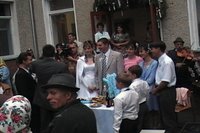
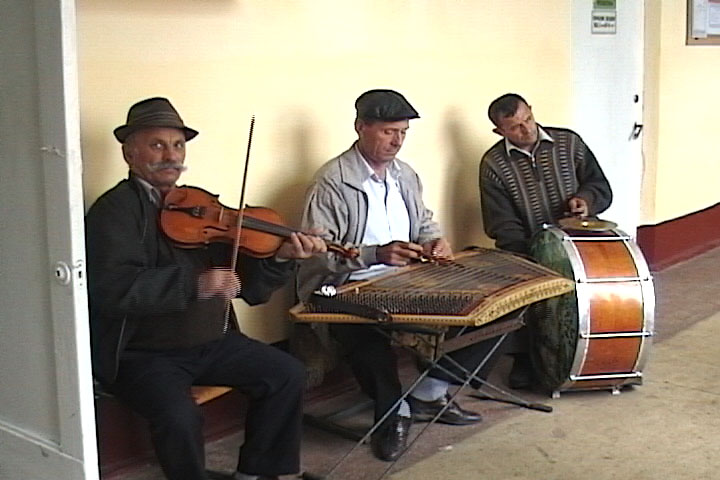
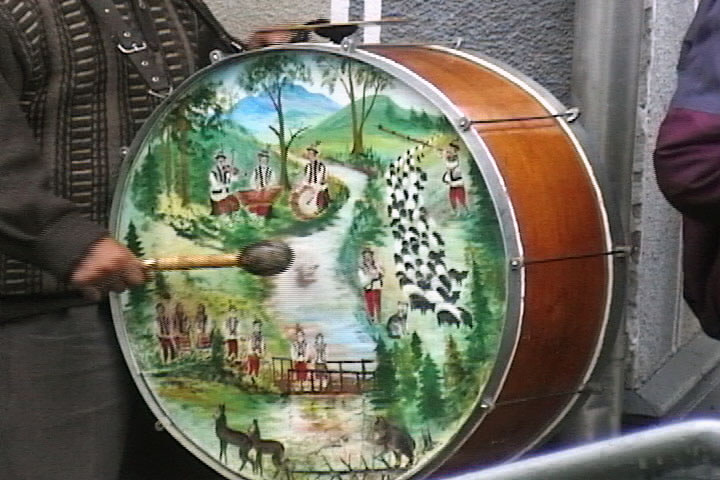
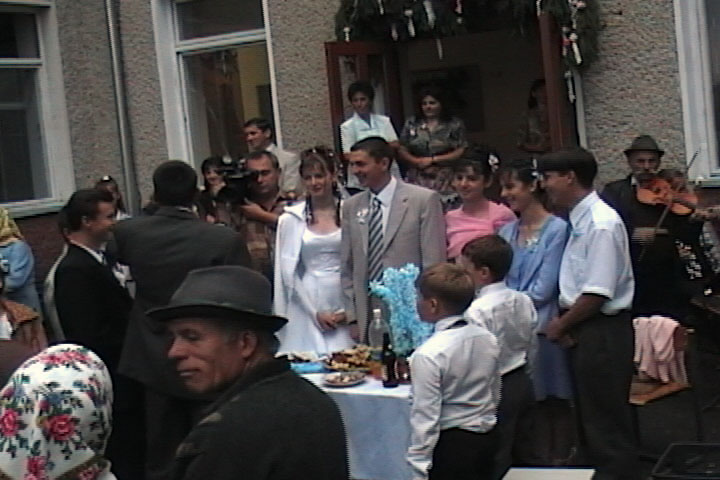
A Hutsul Wedding


Take a break from Ukrainian politics:

Watch the video

This is part I (go to part II here) of three short (8-10 min) pieces I will post of footage I took at a wedding in the Carpathian Mountains of Ukraine in August 2004. The wedding was that of a cousin of a friend, Anna. Much of Anna's heritage is Hutsul. Hutsuls and their descedents have lived in their part of the Carpathians for some 500-600 400-500 years*. The sign at the entrance to Anna's home village of Jabloniv boasts 450 yrs of settlement.

The video begins with footage of Anna, two other friends (including my second-cousin Oksana Kolodnytska from Pidhajtsi) and I leaving from Anna's village for another, nearby village for the wedding.

The majority of Hutsuls identify themselves as Ukrainians, unlike other peoples of the Carpathians who, like the Hutsuls, speak a language closely related to Western Ukrainian dialects. That is, the majority of people comprising other Carpathian Mountain groups that speak languages closely related to Ukrainian dialects, such as the Lemkos, Bojkos and Dolynjany, insist that they form a seperate ethnic identity from Ukrainians and refer to themselves as Rusyn or Carpatho-Rusyn (see this site for more info about the Rusyns).

(I am of the mind that the outsider must accept the ethnic self-definition of the majority of any ethnic group. Hence, Hutsuls indeed are Ukrainian, while the Bojkos and Dolynjany, and perhaps Lemkos too, are Rusyn. . .)

In general, the people of Western Ukraine and the Ukrainian Carpathians are thought to have preserved a great deal of their traditions. These are quite rural and agricultural areas that were once dubbed as among the most isolated and "backward" in Europe --and they may still be. "Backward," however, is a strong and wrong word, depending on one's prejudices (i.e., need of creature comforts); this can be a deeply enchanting and powerful land, especially if one can forego the typical requirements, service expectations, and judgments of a Westerner. Much of what many consider the traditional past remains contemporary here--with all its plusses and minuses (many of the latter of which are formidable vis-a-vis the young and especially for women).

Some notes to the footage:

This is Ukraine, and so drinking vodka (or better, horylka, as it is known in Ukrainian) plays a big role in the wedding festivities. I encourage the viewer to have an open mind about this and also to pay attention to a unique tradition in this area: when drinking a shot outdoors, people frequently would throw the bottom 1/3 or so of the shot over their right shoulder or downward at the ground.

There are some substitles, but much is left untranslated. From what is subtitled, one should easily get the gist of what is going on.

This is the best quality I knew at this time for uploading such a large file to the internet. It is best viewed while not expanded to full screen.

If one would like a high-resolution CD or even a DVD of this and the next installment, contact me at ontorev@yahoo.com to make arrangements.

This was obviously shot and edited by a folk music fanatic, thus the emphasis on
music/musicians. Note that while much if not most of the music is specifically Hutsul, some of the music is part of a general repertoire of Western Ukrainian Wedding Music--in particular, note the Wedding March played outside the Groom's Home, which is common throughout Western Ukraine, though with some variation. (Update: compare the wedding march in this video from the Hutsul region of the Carpathians to the wedding march here from Pidhajtsi, a quintessentially Galician town.)

Part II will come later, containing:

-Footage of the wedding ceremony at the church
-More footage of the Carpathians from this village of Nyzhnij Bereziv
-The Reception line and various traditions as people arrive at the reception
-Reception dinner and singing
-The Dance--including footage of authentic Hutsul dancing as done, not for the sake of performance but for enjoyment, by contemporary-day Hutsuls, including an arkan (UPDATE: this footage will form Part III, and will not be in Part II)
-More footage of the musicians!

*Update: The ancestors of the Hutsuls are thought to have been Vlachs (Romanian-speaking sheepherders/mountain people) that migrated up the Carpathian Chain from the Balkans about 400-500 years ago. Where these Vlachs settled amongst Rusyns, they eventually became Ukrainian. It is also thought the Gorale of Poland have a similar ethnogenesis. This is based on linguistic evidence: Real Hutsul dialect is said to have a number of words with Romanian roots.

SEE PART II HERE.

Tuesday, July 11, 2006

Coming Soon. . .New Video

This is a still from footage of a contemporary Hutsul wedding I went to in August, 2004. I am almost done editing a short video (15? maybe 20 minute) of the day. I finally have a computer again with which I can get back to work using Adobe Premier; the last month has been full of nothing but lap-top troubles, computer help centers, and costing $. . .
****************
Pro bozhevilnu sytuatsiju v Ukrajini:

1) Kuzio pointed out, in some "notes to the disaster," that most of what was left in Our Ukraine for the parliamentary elections were its coalition-with-PR-friendly "national bourgeoisie," while most of its "genuine" national-democratic constituency had bolted; from the UkraineList:

From: "Taras Kuzio"
Date: Sun, 9 Jul 2006 00:16:26 -0500

This disaster can be squarely blamed on Yushchenko's indecision and lack of strategy, Our Ukraine's unwillingness to accept the election results and the Socialists lack of moral principles.

The only [foreign policy] factor I would add is that the US support for an Orange coalition was too narrow. Perhaps the US should have backed an Orange coalition OR a Grand coalition with Yulia Tymoshenko as Premier.

The two parties to gain from the new coalition are Regions and Tymoshenko. Back in late 2005, I labelled such a scenario as one of three, but unlikely and called it Kuchma-Lite.

The Socialists, Our Ukraine and Yushchenko have lost out.

Lytvyn will gain votes in the next election from the Socialists who can now be accused of "betrayal" of their votes. I doubt this parliament will last 5 years.

Our Ukraine are weakened by not having their national democratic constituency in parliament. Our Ukraine is less national democratic today than it was in 2002 and more centrist. Major national democratic blocs did not join Our Ukraine in 2006 (Pora-Reforms & Order and the Kostenko bloc) and lost the elections. In 2002 these two blocs were inside Our Ukraine.

After returning from Kyiv I concluded that Yushchenko is a one term president. A minority told me in Kyiv that he might even not last one term (like Kravchuk who called early elections in 1994 and lost to Kuchma). I now believe that Yushchenko could go the way of Kravchuk as a coalition dominated by the anti-presidential institution left + anti-Yushchenko Regions, could attempt to either impeach Yushchenko or abolish the presidency by making Ukraine into a full parliamentary republic (where the president is elected by parliament, a step that Kuchma-Medvedchuk proposed in 2003 when constitutional reforms were proposed).

The only "good news" is that if you think that an Orange coalition had internal contradictions then take a look at Kuchma-Lite's anti-capitalist left & Regions big oligarchs (translation: Yekhanurov's "national bourgeois'). How long will Kuchma-Lite last?
2) LEvko at Foriegn Notes points out this piece about Moroz.

3) Yuri Shevchuk (Lecturer of Ukrainian Language and Culture at Columbia U, originally from Rivne, PhD from Shevchenko State U) had this optimistic thing to say I thought worthy of rumination (vis-a-vis his claims about PR here):

From an interview printed in Toronto's Novyi Shliakh newspaper (full text)

RT: What is your prognosis for the Ukrainian political situation?
YS: I feel a coalition between Our Ukraine and the Party of Regions (PR) would be the best outcome given the reality because I don't see any substantial difference in thinking and acting between the two forces. The pronouncements are all very well, but they say one thing, do another thing.

RT: But what about their different views on NATO and the EU?

YS: The PR absolutely wants to join NATO and EU; it wants their respect. Russia won't give them respect. It regards them as its vassals, not as serious partners, and PR realizes this. Simply behind them there are millions of people who have an animal fear of everything Ukrainian and PR is their hostage. But when PR is in power, they will sing another song. I think PR will achieve more for the European integration of Ukraine than this toothless and chaotic government we have now. It should have been done from the very beginning-unite with PR. Tymoshenko's bloc will be a great opposition and bridle them all. She's very charismatic; if in five years she persuades Ukrainians that she has an alternative, people will vote for her.

In my opinion, the Orange coalition has no future. These are completely different people, who hate each other; it will be a paralysis. On the other hand, it [that the democratic process of forming a coalition is taking place] is done for the first time in Ukraine. We should take this into account and not be frustrated.

[Sometimes], I get the impression that if Parliament never worked, no one would notice and life would go on...If laws are adopted, does anyone observe them? The problem is not in the laws, there must be political will to do things: to support culture, to not hinder business, etc.

Friday, July 07, 2006

As Bob says, Ultra-Competitive Uki Politics

Frickin' Ukrainian politics. . .

I have been dumbfounded, flabbergasted for the past few hours, and now have come up with this:

Our Ukraine should suck it up and accept Moroz as a Speaker and the Orange coalition should continue to hold and Tymoshenko get the PM seat. The three parties of the pro-democracy coalition getting the three more or less top jobs in descending order: Yushchenko/Our Ukraine, as victors of the presidential election, get the President; BJuT as the winners of the parliamentary elections within the pro-democracy camp, gets PM; and the Socialists, as the third partner, get the speaker position. I never wrote about or proposed such a scenario, but I have often ruminated on it. . .

This, I believe, is Moroz's intention/gamble. He may be a schmuck for so last-minutely backing out of the coalition deal, but I don't believe he was bribed. He is a cunning politician, a cool, cold-ass operator and manipulator who is not very gracious toward those he has used along his political path (i.e., Melnychenko, a la abdymok), but he is right about one thing: combination of Tymoshenko as PM and Poroshenko is full of potential disaster/s.

I once again blame the incredible stubbornness of Our Ukraine that has resulted in a) its failure to accept its defeat at the polls and b) its continual support for people like Poroshenko for much of what happened today.

And of course, Moroz's cunning is also to blame. . .he is indeed a major political risk-taker and is very, very cunning; will this risk work?

It is a little premature, it seems to me, to declare the experiment with democratization over just yet. . .let us wait and see who becomes PM. . .again, the Orange coalition can re-form if Our Ukraine can accept Moroz as Speaker (probably a pipe-dream); I am sure BJuT would accept it, if Tymoshenko can get the PM job. . .

Of course, the Socialists would have to agree to Tymoshenko still getting the PM job. . .

If they are completely against that, too, then they are schmucks, and Moroz one of the worst traitors of Ukrainian history. . .

UPDATE: Perhaps I was foolish to assign any degree of nobility to Moroz's move. . .just read (how did I miss this, out of all the things I have read today?) that he claims the other rationale for his move in addition to his opposition to Poroshenko is "the need to heal the east-west divide. . ." Now what the f? Why wasn't he talking about all that and a grand coalition when Our Ukraine was talking about it? Oh, of course, because he probably wouldn't have gotten the Speaker seat by going along with Our Ukraine. . . So he had to do it this way? He's that hungry to have hands on significant levers of power? For what purpose?

I don't know what to think about Ukrainian politics in Kyiv anymore. I think I will, from now on, keep completely to the grassroots, as I mostly do on this blog, anyway. . .

But I still think that Our Ukraine and BJuT should just suck it up, accept Moroz's perfidy, and keep the Orange Coalition alive as outlined above. . .

Fat chance. . .too many variables. . .too much distrust. . .too much contempt. . .

"If there aren't Russians, Germans, or Poles to fight, we have got one another to fight to the ruin. . . "

Saturday, June 24, 2006

Good Analysis of the Coalition Deal

RFE's Jan Maksymiuk did a helpful piece explaining the basics of the coalition agreement here.

In the second, more analytical part of the piece, he sounded one warning I completely agree with:
Our Ukraine's proposal that Petro Poroshenko, Tymoshenko's fiercest enemy in the 2005 feud within the then-Orange coalition, take the post of parliamentary speaker seems to be an ill-advised "parliamentary check" on Tymoshenko as the head of the cabinet. There is a great likelihood that the former rivalry between these two might start anew, plunging the new coalition once again into recriminations and quarreling.
. . .Have not had time to do any blogging or vlogging this week after getting back from my trip, as Latvia "goes nuts" celebrating the Summer Solstice this week every year, and I have been very busy either performing myself this week with the folk group Skandinieki or looking after Julija while her mama performs . . .am recovering today from an all-night celebration of Solstice with the Skandinieki and their friends. . .Latvians often refer to Summer Solstice as Ligo or Jaņi (as Ukrainians call it Ivana Kupala, the first name coming from the Xtian calender/attempt to co-opt the pre-Xtian holiday). . .Ligo is one of the best times of the year to visit Latvia, especially if you can celebrate it with pagany, spiritual, folkloristic, nationally-oriented Latvians, rather than with those just looking for an excuse to party. . .but party and drink we did, along with the deep spirituality of the event!

Tuesday, June 20, 2006

2 Articles

I am back from my little Central to Eastern Europe adventure--Riga to Vienna to Budapest to Kyiv to Riga--and will have something to write about it, maybe, in the future.

For now, two good Kyiv Post op-eds worth reading if you have not:

How to understand Ukrainian President Viktor Yushchenko

by Taras Kuzio, rather (correctly) scazing about the man once thought to be contemporary Ukraine's savior

Ukrainians are not that easily fooled
(good analysis of Tymoshenko's past and personality that clarifies why she should be given another chance)

I read somewhere the other day that Our Ukraine had proposed Poroshenko as speaker;if true, that is f**in' ridiculous. Zvarych, Bezsmertnyj and Poroshenko. . .blah

Wednesday, May 31, 2006

Excellent Commentary: Lessons of Germany's Grand Coalition for Ukrainian Process

If you get it, the most recent e-poshta (for May 31, 2006; you can join by writing to myroslava_e-poshta-canadaus@yahoogroups.com)

this week has an excellent commentary on the lessons that the recent Grand Coalition building process in Germany has for Ukraine. Many commentators, including from Our Ukraine and Yushchenko, have been making this comparison.

The major points of the commentary were thus (which are points I and others have been making in the Ukrainain blogosphere, in our various ways):

On the German model, Our Ukraine must accept that they lost the right to name the PM within a reform-oriented, pro-democracy coalition and must accept Tymoshenko's demand for the PM post. Merkel demanded the SPD's acceptance of her as PM before beginning talks on a guiding government program/policy, and the SPD, which like Our Ukraine was stunned by its defeat, initially resisted but eventually gave in. Our Ukraine should accept Tymoshenko's premiership, THEN talk about a specific program.

Second, Tymoshenko and her cadre then must proceed to divide posts reflecting relative states of electoral preference, agree to respect the president and his party, and work hard to compromise on a specific program and, once that program is in place, they MUST stick to it.

Now the following is my point, though it was hinted at in the piece: Though I share some doubt over whether Tymoshenko is a principled politician and populist or people's politician--i.e., whether she is not just an overly ambitious and glamorous loudmouth and de facto crony capitalist--she must be given a chance to demonstrate her sincerity once again. She will, as I have said in many other places, have to check her ambition and her stubbornness and will have to give-in on a variety of matters. And there are those who would argue that she has indeed attempted to strike a much more conciliatory tone toward Ukraine's free-market liberals and even, to some extent, the oligarchs.

The final issue hinted at in the piece: what was not done in the German case and what can not be repeated in the Ukrainian one is creation of a government with more than one center of power. I still blame Yushchenko squarely for the failure of his first government because of this, and his pal Poroshenko next.

I could not cut and paste the e-poshta article, as I am writing from an internet club in Vienna and the computer here, for some reason, is not letting me cut and paste.

My cousin, born and raised in Germany and grandson of Lev Rebet, the social-democratic oriented ideologue of the OUN, is getting married here in a famous Uniate Cathedral that is symbolic, for Ukrainian Uniates, of Maria Theresa's patronage of things Ruthenian.

Tuesday, May 30, 2006

Video: The Mill and the Peasants


Watch the video

This is more footage from the town of Pidhajtsi in Western Ukraine, shot in August, 2005.

If a peasantry is a population bound to and dependent for survival upon the land through various means that grossly benefit local or not-so-local lords while keeping the individual farmer more or less locked in his/her place--such as via outright serfdom or through credit arrangements and dependency on local "lords" to pay out some cash—then the cash-crop and subsistence farmers of Western Ukraine qualify as a contemporary, postmodern peasantry of the latter sort.
In the previous two posts I have briefly discussed the plight of the people/farmers of the Western Ukrainian countryside. Here I continue: This is footage of men loading sacks of processed wheat flour into their wagons and tractors (see previous post for a comment about the persistence of wagons in the Ukrainian countryside).

There are three main cash-crops that people sell in Pidhajtsi and throughout the Western Ukrainian countryside; in order of economic relevance (i.e., in order of what is most lucrative for the peasant household), they are: sugar beet, wheat, and cow's milk. Each of these crops are harvested by the peasant household and brought elsewhere to be processed. Cow’s milk and wheat are brought to local processing plants where they are made, in the case of milk, into cheese, creams, pasteurized milk, etc., and into processed flour in case of the wheat. Sugar beets are brought to a burjakpunkt or drop-off point from whence they are hauled elsewhere to be processed into sugar. All of the sugar in Ukraine comes from sugar beets.

Each family has roughly 1.5 hectare of land in the fields. Nearly all of the work is done by hand using rudimentary, though time-honored, implements and little or no modern machinary. In addition to the aforementioned cash-crops (there are sometimes others, but those are the main ones) a typical household raises foodstuffs for home consumption: red beets, yellow beets (for feed), corn (for feed), potatoes and a variety of other vegetables and herbs. There is a common plumb-and-apple orchard and most homesteads have apple trees, while some have plumb and cherry trees and berry bushes. Plumbs, though certainly good for eating and commonly used in pastries, is also necessary for making the local samohonka or moonshine, which usually is not a vodka or horylka (the Ukrainian word for vodka), but a plumb-brandy called, in this part of Ukraine, slivjanka. (Note: plumb-brandy is called slivovitsa by other peoples of Eastern Europe, and sometimes rakija in the Balkans; to Hungarians, it is palinka). It is also important to note that just about every household has either one cow or a goat for milk from which creams and cheeses are made, and plenty of fowl (as shown in a previous post).

Just a few American families employing American agribusiness technology could farm the land around Pidhajtsi; instead, the land supports about 7-8,000 people, if you include the nearby villages as "suburbs” of Pidhajtsi (Ukrainians live clustered into towns and villages with the fields surrounding the settlements). Many analysts complain that Ukraine’s agricultural potential is massively underdeveloped.

When farmers take their foodstuffs to be processed, they are repaid by the factories not in cash but in barter: they receive a cut of the final processed goods made from their beets/wheat/milk. A portion of the processed goods go for home consumption; the rest is sold whenever the need for cash arises at a local, weekly market (every Thursday in Pidhajtsi). In this footage, the men are loading their share of the processed flour made from their wheat.

Sugar beets yield sacks of sugar, and milk yields pasteurized milk or other processed dairy products. With the wheat, people will bake their own bread at home and will use the sugar that was the fruit of their own labor. The processed, pasteurized dairy products often go to market, as most villagers use milk straight from the cow in their own diets.

I was universally told by people in Pidhajtsi that it is not worth it for anyone to bring milk to the dairy factory unless one has at least three or more cows. Thus, in the afternoon you can see Babas carrying bucket after bucket to and from home and factory a number of times.

Whether it is the dairy, beet, or wheat factory, everyone will tell you that the exchange rate is unfair and to the advantage of the processors.

Who owns and runs these factories?

I tried to get an answer to this question in the following ways:

1) I tried to get some interviews and to film inside some of the factories, but neither the mill nor the dairy plant was willing to oblige. At the dairy factory, I was told by the plant’s manager that the owner was not present, that he does not live in Pidhajtsi and that he is probably at another one of his plants. The manager also said that she already knew the owner would not be willing to be interviewed, and when I asked if I could interview her, she said she had no right to speak about the company and told the security guards present to escort me and my second-cousin off the factory grounds. And oh, one of the guards had already made sure that my videocamera was turned off.

It was more of the same at the mill; thus the footage here is shot not just across the street from the plant but from across the street and down the road a bit, as security had told me to move on.

At the burjakpunkt or beet pick-up site, I was allowed to film, though the people rather nervously allowed me to do so. I was hollered at anytime I turned my camera on any worker. The most violent response to my camera came from the man in the room where the local peasants came to collect their sacks of processed sugar. Some of that footage will appear later.

2) I tried to get some answers from local officials, but most of them were reticent, even after the Orange Revolution, to answer my questions about who owns what and how they came to own it.

However, I do know the following from the tales of locals: The mill and the dairy factory both were part of a Soviet-era conservatives factory that produced a range of foodstuffs (bread, pastries, jams, jarred salads, pickles, dairy products, etc.). It collapsed in the early 1990s, and most people say that the managers of the factory ran their business into the ground and sold off factory equipment for their own, short-term gain (others defend them saying that they could not adjust to market conditions so quickly after the end of the command economy). The mill and dairy factory were reopened years later as private businesses, but on much smaller scales.

Corruption and and lack of transparency in the agricultural sector and especially in the Ukrainian countryside are truly large-scale problems. Many in Pidhajtsi have come to feel that Yushchenko has neither the intention nor the will to truly take on rural problems, and sometimes complain that like all previous administrations, his is focused all-too-exclusively on industry (which also means on Eastern Ukraine). One major sign to many locals that Yushchenko is not concerned with their plight in the countryside was his memorandum with Yanukovych in which Yushchenko agreed to extend parlaimentary immunity from prosecution to local government officials. Another symptom of this lack of will for many is his close relationship with Petro Poroshenko, Ukraine’s so-called Chocolate King. Poroshenko owns a large chocolates-and-sweets factory in addition to other businesses, and is definitely a New Eastern European worth an estimated $350 million, according to Warsaw-based Gazeta Wyborcza. He is widely perceived by many as profiting from the unfair barter practices in the countryside—a cheap supply of sugar for his factory contributing to is considerable wealth.

However, Ukrainians at the local level do have this problem: they barely self-organize to take on the power of rural agricultural corporations and officials. Western Ukraine is not Latin America and certainly not Chiapas, where there are local movements developing at the most grassroots of levels to take on or refuse the power of middlemen (coyotes) and corrupt politicians in the agricultural sector. Though the Orange Revolution showed an unprecedented level of civic activism and self-organization in Ukraine, and though such activism remains higher than it was in pre-OR times, people in general seem to have once again put all of their hope in the state and in politicians to make a difference. This is too bad. One recent speaker ruminated on whether Ukrainians have truly broken from what he called the following, centuries-old and unhappy tradition in Ukraine: apathy and disillusionment with political and civil-society processes creating a cycle of inaction only occasionally interupted by periods of revolutionary upheaval. He was not sure that Ukrainians are now solidly discovering the middlepath in which everyday actions by an active citizenry truly makes a difference, though many have proclaimed such is the result of the Orange Revolution.

This is what makes the apparent disappearance of the NGOs of the election campaign and Orange Revolution period so sad, and why it was so lamentable that the main (largest and best organized) activist group Pora! was more or less hijacked by those who wanted to make of it a political party. What Ukraine badly needs today is not more political parties but ongoing grassroots organizing efforts; and what Ukrainians should take as a contemporary model are the collectivist, self-organizing efforts of people on the ground in various parts of Latin America--or examples from their own history. A Zapatista, or even better yet, a Makhnovist (but without the guns) or OUN inspired model for regional self-organization could work well in agricultural Western Ukraine. This time, the fight would not be with foreign invaders but with locals, and the goal an effort to ensure a better rate of exchange. A Ukrainian Cesar Chavez?

Wednesday, May 24, 2006

Officially-Unofficial Talks Soon to End and Officially-Official Talks Soon to Begin

The officially-unofficial talks on a parliamentary coalition will officially end with the start of the next parliament, after which officially-official talks will begin with a presumably unofficially-official clean slate; or that is so according to this blurb from RFE newsline:

UKRAINIAN PREMIER SAYS 'OFFICIAL' COALITION TALKS TO START AFTER PARLIAMENT'S INAUGURATION.

Prime Minister Yuriy Yekhanurov said in an interview with the May 24 issue of the Kyiv-based daily "Ekonomicheskie izvestia" that an "official negotiation process" regarding the creation of a new ruling coalition will begin only after the inauguration of the newly elected Verkhovna Rada. "For the time being, it's just a warming-up, a preparatory work -- there is an exchange of opinions [and] ascertaining of positions of the sides under way," Yekhanurov added. The Ukrainian parliament elected on March 26 gathers for its inaugural session on May 25. President Viktor Yushchenko is expected to attend the session and make a speech. Under the amended Ukrainian Constitution that took effect on January 1, 2006, the president has the right to dissolve parliament if it fails to form a majority within 30 days after its first sitting or to form a new cabinet within 60 days after the dismissal or resignation of the previous one. JM

Monday, May 22, 2006

Video: Fall Harvest in Western Ukraine I


Watch the video

This is footage taken in late September, 2005 in the town of Pidhajtsi (pop approx. 4,000) in the state of Ternopil in western Ukraine.

These people are gathering the remaining corn stalks in their fields after having had completed the fall harvest. They will use the stalks as windbreaks, i.e., as protection against the strong, bitterly cold winds of the Pre-Carpathian winters (Pidhajtsi is in the foothills that climb up to the Carpathians of southwestern Ukraine). They will place the stalks either directly alongside the outside face of the walls of their home, or will line the fences around their home with them.

Note that they are using a horse and wagon; for the most part, those who use a horse and wagon for fieldwork and hauling can not afford a small tractor, though there are those who still prefer the old way to the modern. The modern and premodern live side-by-side much more in Ukraine than in the West, which means that the line between culture and nature, city and countryside is nowhere near as distinct in Ukraine as it is in the West.

Others who choose not to use the stalks for wind-breaks merely burn the stalks in the fields. Throughout the harvest season, the hillsides are dotted with small fires burning--quite a sight at night.

Heating and insulation are a major issue in Ukraine today; the traditonal, mud-and-clay walled homes of the East Slavs were much better insulated than the more modern homes built in the region since the turn of the 20th century or just before. Ukrainians have among the highest per capita consumption of natural gas in the world. Their winters are bitterly cold, but their more moderny homes are very poorly insulated. The Soviet government found it easier to build cheap homes and to burn lots of energy to heat them; this is the legacy still badly effecting all of Ukraine today.

Notice the little girl in the footage. She was fabulous!

For more info about the people of Western Ukraine, especially vis-a-vis poverty, subsistence farming, low wages and unemployment, see comments to last post.

Video: A Baba Feeds the Fowl in Western Ukraine

I now have a vlog (video blog) site through which I can cross-post footage to this, my Ukraineblog. This is the first entry on that site; the text and foto below appear here according to vlogger's cross-posting format that uses a still-foto I selected from and text I wrote about the footage.

Many more entries are soon to come to that site, which you can go to
here; here on DYKUN, I will cross-post only Ukraine-related stuff. Enjoy.

Watch the video
This is footage that was shot in the town of Pidhajtsi (pop approx. 4,000), state of Ternopil, in western Ukraine in September, 2005. The people of the small towns and villages in this region--the Pidhajetskyj rajon (county of Pidhajtsi), which is among the poorest regions in Ukraine--survive as subsistence farmers with some degree of waged labor. The official unemployment figure for the county, according to pre-Orange Revolution stats, is 10-15%; a number of county officials told me that the actual figure is between 35-45%. Average wages/pensions are about $60/month. Nearly every household in the town of Pidhajtsi (Ukrainian counties are named for their seat of government) has three generations present whose members usually survive $2/day or less ($2/day being the true poverty line for people of the northern hemisphere, due to heating cost). The people of this region in general can not survive without raising and growing their own food. The scene in this clip: Nearly every household keeps chickens, geese, and ducks, while some also have turkeys. Baba Feeds the Fowl.

Wednesday, May 17, 2006

Tired of Our Ukraine Shenanigans

Why is this putz still in a position to make any such
comments at all? From RFE newsline:


OUR UKRAINE REPORTEDLY SUSPENDS COALITION TALKS WITH
ORANGE-REVOLUTION ALLIES. Roman Zvarych of Our Ukraine
told
journalists in Kyiv on May 16 that his bloc has
suspended talks on
the creation of a ruling coalition
with the Yuliya Tymoshenko Bloc
and the Socialist Party,
Ukrainian media reported. Zvarych explained
that the
move was taken in response to Yuliya Tymoshenko's
earlier
public statements that her bloc will get the
post of prime minister
and the Socialists that of
parliamentary speaker. He stressed that
Our Ukraine
will not accept an "ultimatum." Zvarych also said
that
Our Ukraine wants the three 2004 Orange
Revolution allies to request
that President Viktor
Yushchenko hold a meeting with them. "[We want
to
request that] the president receive leaders of these
political
forces in order to find a joint way out of
this situation," Zvarych
added. Yushchenko is Our
Ukraine's founder and honorary chairman.
Meanwhile,
Oleksandr Turchynov of the Tymoshenko Bloc told

journalists on May 17 that the talks between the
three forces were to
be restarted later the same day,
UNIAN reported. JM


Translation: Our Ukraine is still dragging its feet, pissing people
off, and this time engaging in some BS about gentlemanliness:
"We want to talk to you, but only if you are nice."

And only if you don't make demands that reflect how
Orange voters
voted!

Kuzio got it right here (Kyiv Post editorial).

[Update: I forgot that the Post has started making its older op-eds
available only for money, true to their mission of making Ukraine
over in the image of Western-capitalist paradiso. In short, Kuzio said that
the West should change its image of Tymoshenko, as she appears as
the only political leader left in Ukraine--beside Moroz?--serious
about taking on corruption.

Though I am not 100% confident of her sincerity, I want t
to see have another go at it: see what I wrote here.]

And Bob has been right all along about
Yushchenko.

Tuesday, May 16, 2006

I've Reappeared In. . .

Riga Train Station

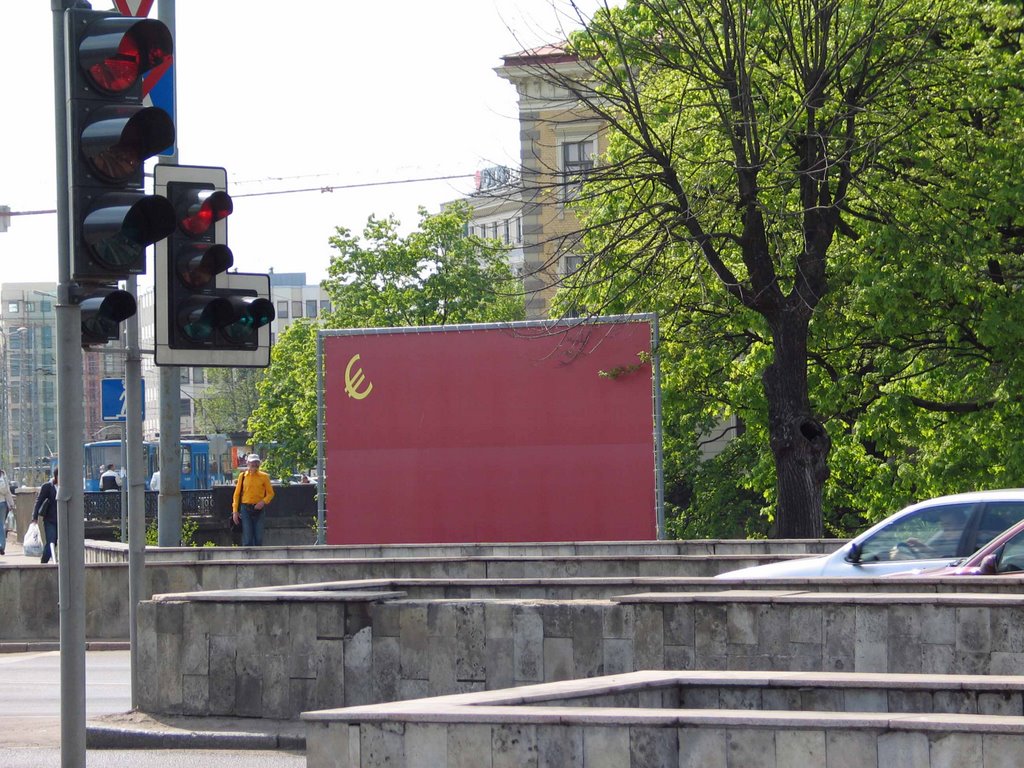
Propaganda
(More on the way. . .)

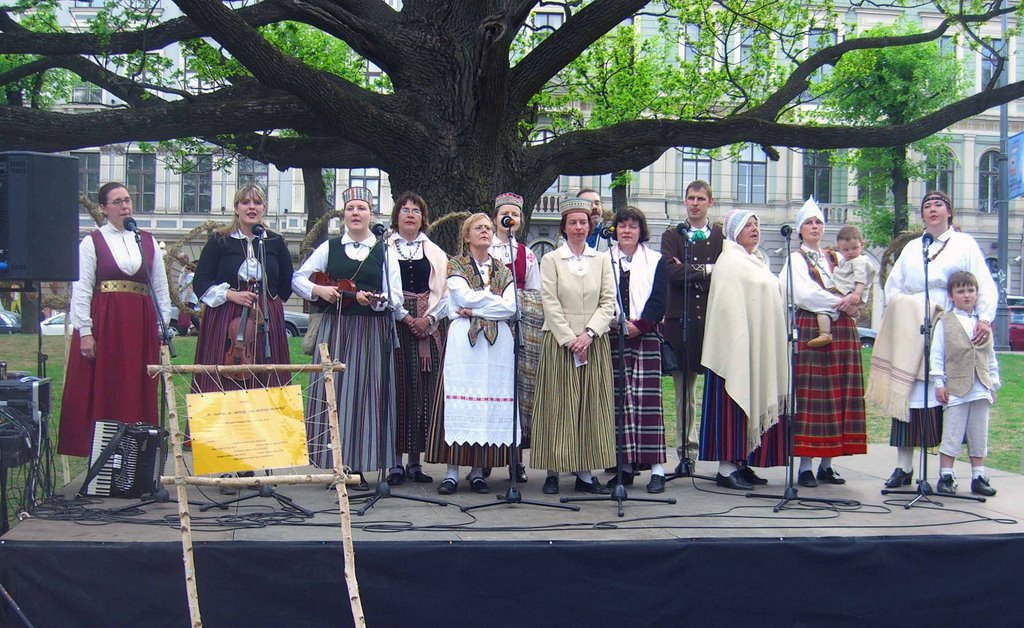
Skandinieki-Mother of Latvian Folk Choirs
(Zinta, Julija's mama, is the one on the far left)

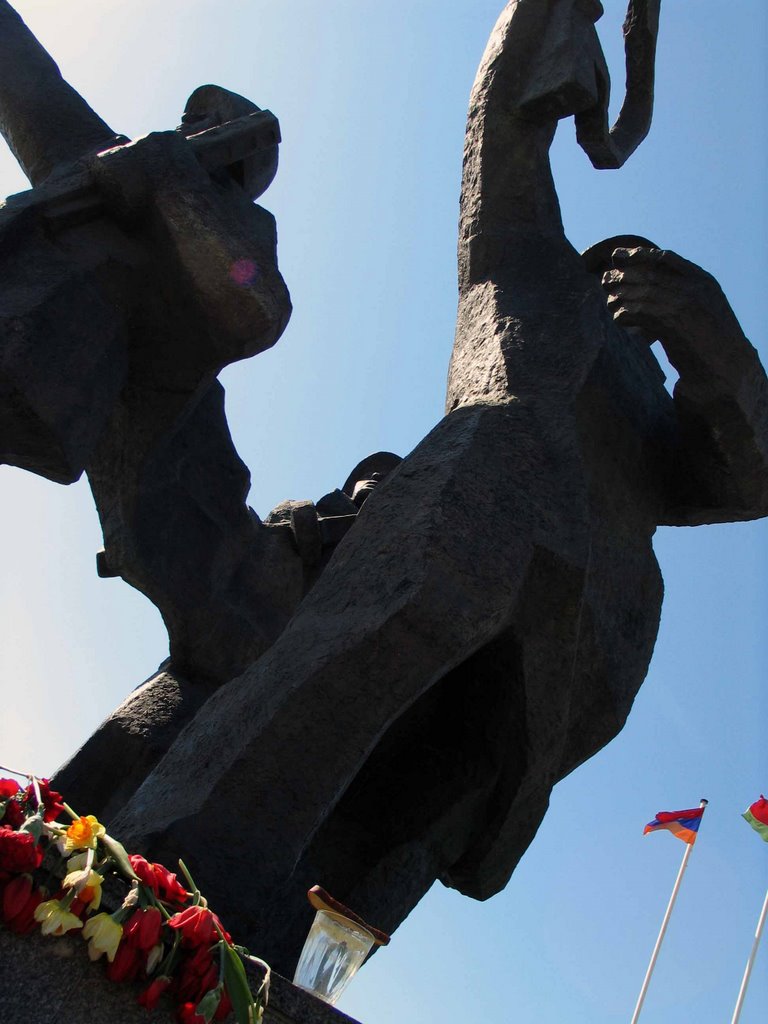
At the WWII Memorial a couple of days ago

VE Day in Latvia is celebrated primarily by ethnic Russians. Most Latvians look at May 9 as commemorating those inglorious days in which one dictator was defeated and another took over, bringing more mass deportations, executions/purges, and an attempt at cultural genocide. They are not being bad sports for not celebrating this day as Western Europeans and many Russians do, or as folks nostalgic for the Soviet past do; those who think so minimize their suffering and the importance of their collective memory/experience of the history of the WWII period.

To my mind, it is important to commemorate Hitler's end; but in those countries where it matters, the day should indded also be a commemoration of what happened in the wake of that defeat--another devastating defeat.

Daughter Julija

Julija's First Teeth