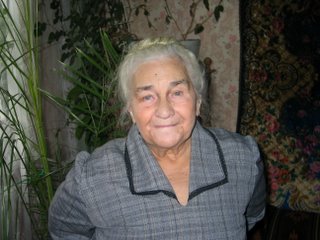
 Lida Tkachenka, Baba Omaha's Sister in Poltava
The last time I was wandering the blogosphere, I wrote that I never heard any of the members of Baba Omaha’s family in the city of Poltava saying “spasybi;” this of course does not mean that spasybi has gone out of use in the Poltavan dialect and has been replaced by Russian “spasiba.” Nor is spasybi merely a Ukrainianized version of spasiba as many diaspora Ukrainians maintain, at least according to Baba Omaha. Baba Omaha says that spasybi was commonly used in her hutor, and says that the first time she was exposed to the Russian language was when she was nine or ten years old.
That is, Baba Omaha says that during her childhood in Chetverylivka everyone said “spasybi” and “velyki spasybi,” and that the first time she heard “djakuju” being commonly used was from Galicians in the DP camps after the war. She also says that the first time she heard Russian was when Bolshevik soldiers came to her family’s home, labeled them kulaks and took away their tractor (which was one of two used by everyone in the hutor, while her father did the maintenance on both the tractors), animals, and foodstuffs, including all the bread and grain they could find. She began to learn Russian after surviving the holodomyr in a new school that was established on the new collective farm. She recalls having her teacher put a bar of soap in her mouth for refusing to speak. Baba Omaha is neither a particularly patriotic nor unpatriotic person; she is best described as deeply humanist. It seems that, as a young girl she was simply able to detect the inhumanity of linguicide. . .
It was in the DP camps that she came into touch with both sides of Galician nationalism, i.e., with both its divisive and polarizing aspect as well as its admirable and unifying aspects. The Galician patriots she met complained bitterly about her supposedly Russified speech. Baba Omaha insists that she never learned Russian very well, though she has a better than average facility in languages, especially in other Slavic languages.
In order to survive socially in the camps, Baba Omaha says she quickly learned to speak proper Galician dialect. Before then, she had learned Polish well enough to fake it in the Polish side of the DP camps until the allies stopped sending former Soviet citizens back to murder and exile; she therefore learned to get by in Polish before she settled among the remaining Ukrainians in the camps. From Poltava, she had never heard Polish before then and says that she spoke very little, only what was necessary, so as not to give herself away--which she of course eventually did, but that’s another story. Still before then she had learned quite a bit of German during her time as a Nazi slave, and she often tells the story of an encounter with a German officer in such vivid detail, using such fluent German phrases, that she practically becomes that officer in the acting-out of the role he still plays in her memory. Her second husband was a Czech fellow who, like she, was a post-war refugee to the West and whose tongue she learned quite well. She also had a Belarusyn friend in Omaha who spoke actual Belarusyn, from whom she learned quite a bit. That she had learned to speak Galician-dialect Ukrainian in the camps also helped socially when she settled in Omaha. Omaha’s Ukrainian community was a feature of the post-war immigration and has been, like many other Ukrainian communities of North America, Galician-dominated.
However, her native dialect has lurked in her subconscious, and as she gets older and the tasks of self-conscious control become more difficult, some of her native Poltavan manners of speaking reappear. Thus, she has this story to tell: A few years back, she hitched a ride home after an event at the Ukrainian Greek Catholic Church of Omaha from one of the more prominent members of that community, a Galician woman. Baba Omaha has never learned to drive, and so getting out of the woman’s car she said, “Nu, Pani, velyki spasybi.” This Pani replied by saying something like, “Oh, Halja, after all these years, you still don’t speak proper Ukrainian” Then to paraphrase what Baba Omaha next said to me (and pardon the fact that I did not type this out in Ukrainian Cyrillic, and that I left out soft signs, and that I probably made other mistakes, especially with grammatical marks; my Ukrainian, my first language as a child and then later lost, is now a second language mostly reconstructed from listening and a little studying. . .):
“Jaki ukrajintsi vony domajujut Vony je? Ja mozhu skazaty shcho Vony, Halychany, rozmovljajut majzhe jak Poljaky! Ja nikoly ne chula rusku movu, tilkyj koly Bilshovyky pryjikhaly do nas v hutori i skazaly shcho my kuljaky, i vzjaly vsjo. . .vsjo. . .vid nas. Todi mala ja vchyty rusku movu v shkoli, v novymu kolkhospi, ale ja pohano vchyla. Po pershe meni ne spadovalasja vchyty, bula ja taka pohana studentka. A takozh ja bula taka uperta. . .Pomjataju shcho ja, kolys, mala sisty z mylom u buzi bo ja ne khtila hovoryty po jikhnomu, po ruski. Ja bula dytyna, i pomjataju shcho ja vidchuvala shcho, to ne je moja mova. A my vzhe skazaly spasybi v hutori. Tse takozh ukrajinska mova. Akh, Stefane, ty znajesh jak Ukrajintsi je! Vony tak ljubljut svarytysja, a khto je Ukrajinets, a khto ne je. . .A ja zavzhdy dumala shcho my vsi Ukrajintsi!”
*****************
So when Baba Omaha arrived in Poltava in 1984 (I got the dates mixed up in the last post) along with my Tata Stevka (mama’s sister), how shocked the Central Ukrainian family was to hear that their long lost relative and her daughter, born in Germany in a Ukrainian sector of a postwar refugee camp and raised in a Ukrainian community in the US, spoke jak Banderivtsi! Tata Stevka tells me that she was teased with the phrase, “Nu, Bandera pryjikhav!” And the joking continued with me.
******************
Baba Omaha says that her sister now speaks with plenty of Russian words that are foreign to her memory of their Poltava dialect. She does not say this as a criticism of the language of her sister nor of her remaining family in Poltava, but as a defense of her memory of her Poltava dialect against the complaints of Galicians that her ridnamova sounds Russified.
*******************
My mama told me just now, when I read the above to her, that it more or less accurately reflects the way her mother talks in her mostly Galician mode. Mama also said that Baba Omaha slips into using more and more words from her Poltava dialect when she tells a story about her childhood. My mama says she always understands Baba, but would never select those words on her own. She says Baba Omaha has done this her entire life—slips into her childhood speech when she gets excited about the past.
The cultural and linguistic differences in Ukraine are indeed deep and yet are completely fascinating, and they have been artificially made into political divisions. As I frequently wrote in my OR pieces, the authorities of the post-Soviet, Soviet, and Imperial eras all did their most to encourage people to think in terms of khlib versus khleb while they themselves vied for power and stole the dough--a dough that was prepared by the people, whatever language they spoke.
Update 1: One should note that the Party of Regions and similar oligarchy-based parties continue in their efforts to split Ukraine's electorate in such manner, while the various pro-OR forces struggle in various ways to transcend the artificial political divide and bring back the pluralistic, Ukrainian-Russian-Tatar-Jewish-etc. cooperation that marked the days of the OR (albeit, so far, quite unsuccessfully).
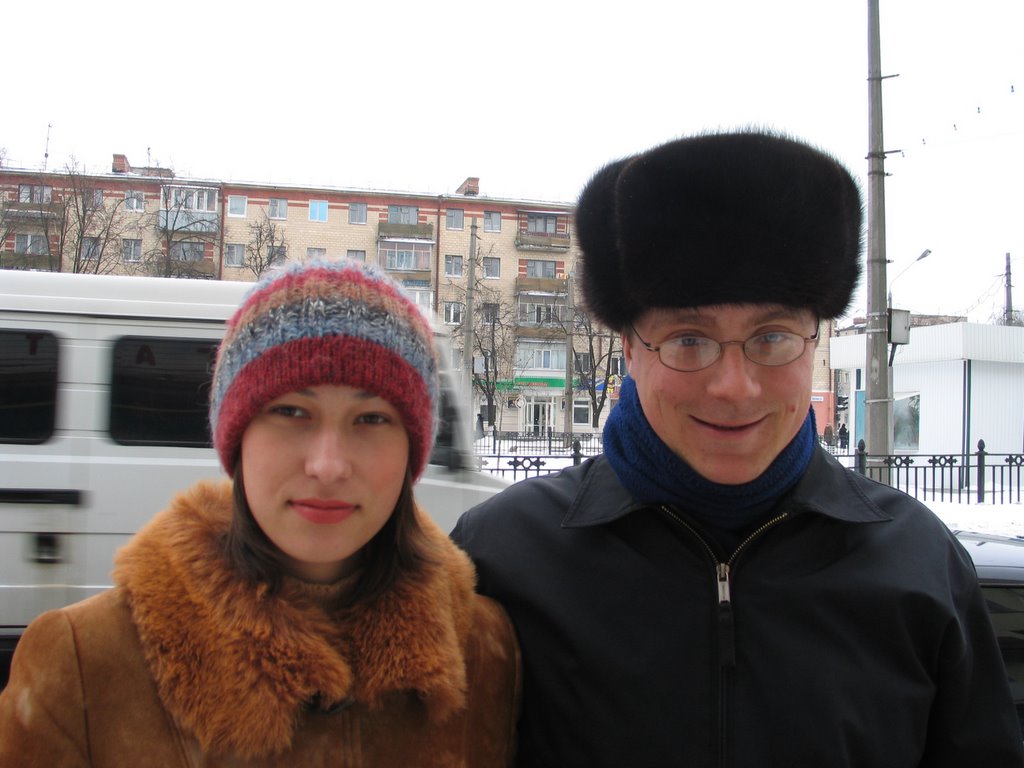
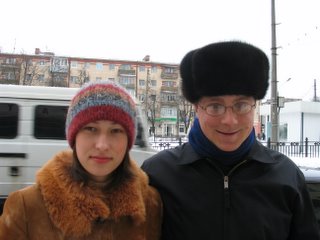 Who's the Smiley American? Me with my second-cousin Olja in Poltava
Note: perhaps spasybi is a Ukrainianized version of a Russian word. I don't know, and although I am not a linguist (though linguistics fascinates me), it does seem that perhaps both spasiba and spasybi derive from an old East Slavic root. I beg more knowledgeable people to comment here. But the overall gist of how Baba Omaha has been treated at times by fellow emigre Ukrainians conveyed here is quite accurate.
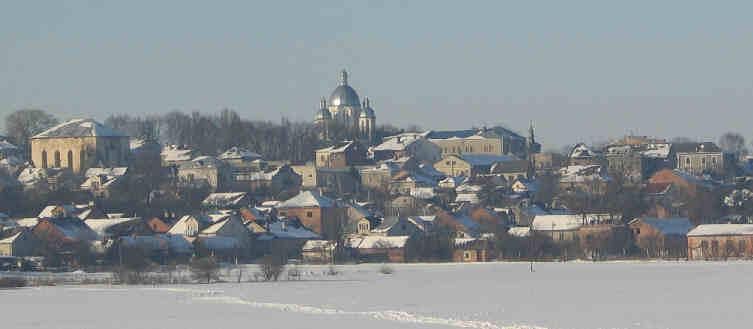
Update 2: Just for the sake of balance, I hope that readers will recall that I have strong roots in Galicia and spent nearly a year during the past two years residing and participating in the life of the town of Pidhajtsi, a town in the heart of Halychyna. For example, see this; this, especially the comments section; and more or less all of the posts during the month of November and October, which contain posts with photos of life and work in Pidhajtsi, or in a town in the heart of Galicia/Halychyna. I am proud of my Galician heritage!
Update 2: Galician nationalism was the rock upon which the tidal wave of Little Russianism that was rolling across Ruthenia once and for all broke before striking land. The waters of that tidal wave are still receding and continued storms in the north and east slow the process; our great hope of course is that there is not another major earthquake in the north that pushes yet another massive wave of Little Russianism across the land. (Perhaps some else has come up with this metaphor elsewhere. . .)

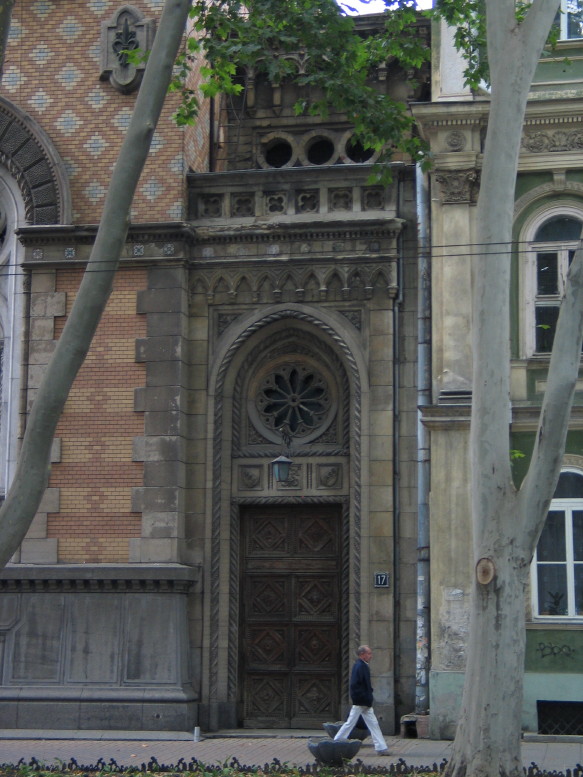


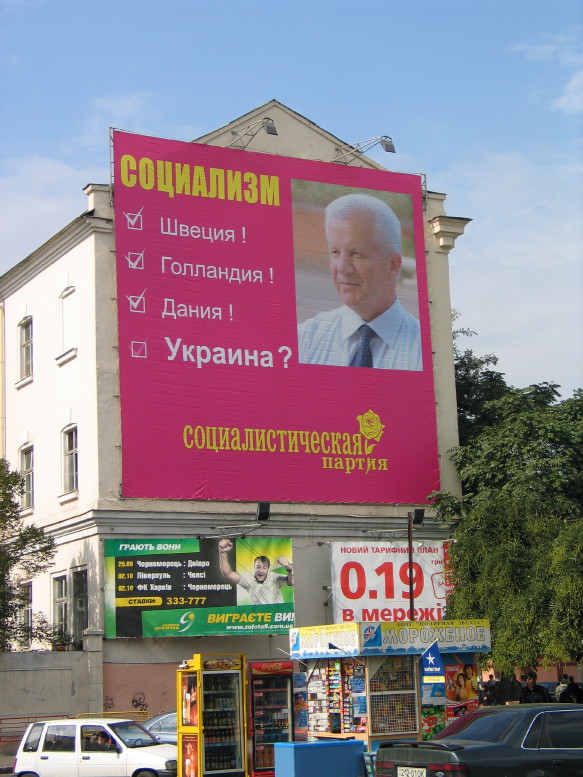 Campaigning Last August
 The Real Odessa
  Romantic Odessa
 Rich Odessa